Kljukuša Recipe – Bosnian Baked Potato Dish
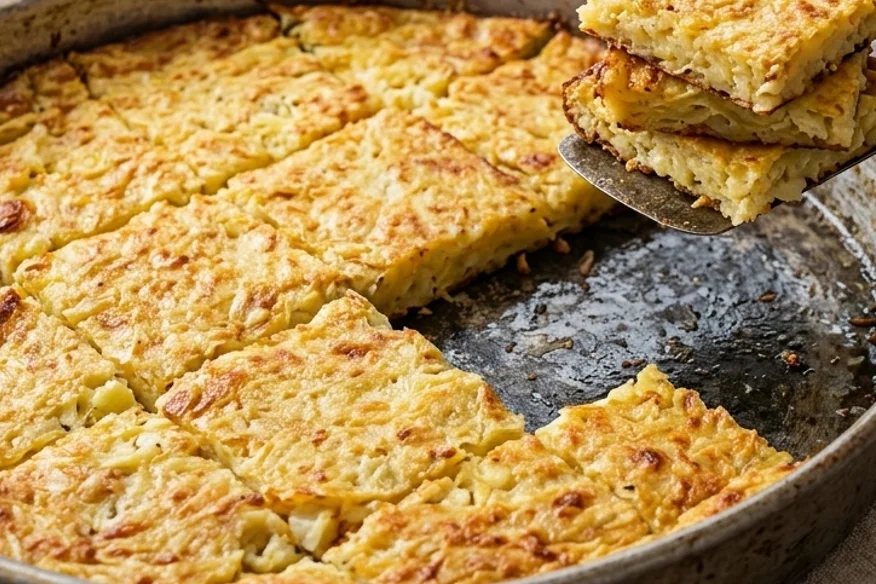
Kljukuša is a simple Bosnian baked potato dish made from coarsely grated potatoes, onion, flour, water, and oil. A hot metal pan helps brown the bottom and edges while the potato-rich center stays soft and substantial.
This kljukusa recipe has no eggs or cheese in its basic mixture. The potatoes and flour form the dish together, with melted butter brushed on after baking and a short covered rest to soften the surface slightly.
Serve it warm as a modest main dish with plain yogurt or cultured soured milk on the side. It is especially welcome on a cold evening, and the straightforward pan preparation also works for a family meal when you keep the layer shallow rather than making one oversized batch.
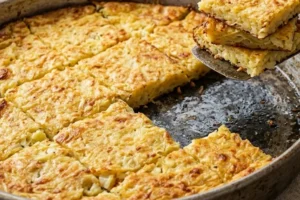
Kljukuša – Bosnian Baked Potato Dish
Ingredients
- 2.65 lb floury potatoes russets are a practical US choice; peeled, then weighed and coarsely grated
- 6.35 oz onion peeled, then weighed; very finely diced or coarsely grated
- 7.05 oz all-purpose flour weighed; plain flour, not self-rising; German Type 405 may be used
- 4.06 fl oz lukewarm water maximum allowance, not a required amount; add gradually only as needed
- 1.35 fl oz sunflower oil for the potato mixture; separate from the pan-and-top oil
- 2 tsp fine table salt defined US interpretation: 6 g per teaspoon; do not substitute kosher salt by volume
- 1 tsp ground black pepper ground, not whole peppercorns; 2.3 g per teaspoon reference
- 1.35 fl oz sunflower oil divide five-eighths for the pan and three-eighths for the surface; refined oil rated for high-heat cooking
- 1.41 oz butter melted for finishing after baking; plain unsalted is a practical US choice
- 2 tbsp warm water for lightly sprinkling after baking; rounded US measure
- plain yogurt optional; choose a dairy accompaniment, not required in the mixture
- soured milk optional cultured dairy; an alternative accompaniment
- sour cream optional; an alternative accompaniment
- 1 small garlic clove optional; finely grate into the chosen dairy accompaniment, to taste
Equipment
- Kitchen scale
- Large mixing bowl
- Coarse box grater
- Sharp knife
- Sturdy spoon
- Metal baking pan about 11¾ × 13¾ inches (30 × 35 cm); oven-rated for 450°F (230°C), one pan per base batch
- Pastry brush
- Dry oven mitts
- Second pan for loosely covering after baking
- Instant-read thermometer for reheated leftovers
Method
- Heat the oven and pan. Preheat a conventional oven to 450°F (230°C). Brush about five-eighths of the pan-and-surface oil over the metal pan. Heat the oiled pan in the already hot oven for 8–10 minutes, timing this to finish when the mixture is ready. Use refined sunflower oil suitable for this heat. Do not leave the empty oiled pan heating indefinitely; if oil smokes, stop heating and let it cool safely before proceeding.
- Grate the vegetables. Peel and briefly rinse the potatoes, then coarsely grate them directly into a large bowl. Very finely dice or coarsely grate the peeled onion and mix it into the potatoes immediately. Do not rinse or squeeze the grated mixture; its starch and moisture help bind the dish.
- Mix and adjust the moisture. Mix in the salt, pepper, and the separate potato-mixture oil. Sprinkle over the flour and combine thoroughly. Gradually work in the lukewarm mixing water, starting with about two-thirds of the allowance if needed, then adding the remainder only in small amounts when dry. The mixture should be heavy, moist, and spreadable with a spoon, not a pourable pancake batter. You may not need all the water.
- Fill the hot pan. Using dry oven mitts, set the hot pan securely on a heatproof surface. Carefully spoon in the mixture close to the pan to limit splashing; keep hands and face back from the hot oil. Spread evenly about ¾–1¼ inches (2–3 cm) deep. Brush or drizzle the remaining three-eighths of the pan-and-surface oil over the top. Keep the same depth when scaling by using separate base-size pans.
- Bake until tender. Bake on the middle rack for about 35–45 minutes, until the top is golden, the edges well browned, and the potatoes fully soft. Start checking the center with a knife at about 35 minutes. Hard potato shreds or a raw, pasty center mean it needs more baking; color alone is not enough.
- Butter and rest. Melt the butter. Remove the baked dish from the oven and immediately brush the butter evenly over its surface. Lightly sprinkle with the finishing warm water without flooding it. Loosely cover with a second pan and rest for 10 minutes outside the oven.
- Serve warm. Cut into squares or irregular pieces and serve warm. If desired, offer plain yogurt, cultured soured milk, or sour cream separately. Finely grate the optional garlic into the chosen dairy accompaniment, to taste. These additions are not part of the potato mixture or its nutrition estimate.
Nutrition
Notes
- Oil allocation: Keep the potato-mixture oil separate from the pan-and-surface oil. Divide only the latter five-eighths for preheating the pan and three-eighths for the top. Butter and finishing water go on after baking.
- Water: The mixing-water quantity is a maximum, not a target. Potato moisture varies. Add gradually to a thick, spreadable mixture; do not make a runny batter.
- Pan and scaling: Use one 30 × 35 cm metal pan for the base batch, two at 2x, or three at 3x. Divide the mixture and pan oil evenly and keep each layer about 2–3 cm deep. Do not put a doubled or tripled batch into one thick layer. Bake in batches if the pans cannot fit with good airflow; total working time will increase.
- Salt and pepper: The source gives spoon measures without defining salt grain size. Here, fine US table salt is standardized at 6 g per teaspoon (also the King Arthur reference); ground black pepper is 2.3 g per teaspoon from USDA. Different salt crystal sizes have different weights. US ounce and fluid-ounce conversions are rounded; Metric preserves the reference amounts.
- Storage: Portion leftovers into shallow containers and refrigerate promptly at 40°F (4°C) or below, within 2 hours after cooking or 1 hour above 90°F (32°C). Do not wait for the entire pan to become cold on the counter. Use within 2 days.
- Reheating: Warm portions in a 350°F (180°C) oven, starting around 8–10 minutes, until the center reaches 165°F (74°C). Cold, thick portions may need longer. A microwave softens the edges; frozen and thawed potatoes may be wetter.
- Nutrition: Independently calculated per serving using USDA FoodData Central reference foods, all flour, both oil allocations (80 ml total per base batch, modeled at 0.92 g/ml), and all butter. The raw russet flesh-and-skin entry is a composition proxy for peeled potatoes; actual variety and peeling change the result. Fine table salt and unsalted butter are assumed. Some pan oil may remain uneaten. Optional dairy and garlic are excluded.
Kljukuša and Krompiruša Are Different Dishes
Both use potatoes, but Krompiruša wraps a potato-and-onion filling in thin jufka dough. Kljukuša has no pastry wrapper, rolled layers, or spiral. Grated potatoes are mixed directly with flour and baked as one shallow layer.
Family versions vary, including versions with eggs or dairy. Here, yogurt, soured milk, sour cream, and optional garlic are serving accompaniments. They do not go into the basic potato mixture. Kvrguša, which includes chicken baked with a batter, is a separate dish rather than another name for this potato version.
Choosing Potatoes, Flour, and Seasonings
Floury potatoes are the starting point. US russets are a practical choice because their high starch and relatively low moisture suit baking; the Washington State Potato Commission’s variety guide explains those characteristics. Weigh the peeled potatoes for a repeatable mixture, then grate them just before mixing. Waxy potatoes retain a firmer shred and may need longer to become tender.
Plain US all-purpose flour is a practical adaptation for German Type 405. It is not an identical milling classification, but it supplies the flour binding this dish needs. Weigh it rather than packing cups, and do not use self-rising flour. More flour would make the center heavier and drier, so keep the listed proportion.
The original salt is measured in teaspoons without a specified crystal size. This card defines it as fine US table salt, using six grams per teaspoon; kosher salt is not interchangeable by volume. Ground black pepper uses the USDA reference of 2.3 grams per teaspoon. US weights and fluid volumes are rounded, with the reference amounts available through Metric.
Getting the Raw Mixture Right
Briefly rinse the peeled potatoes before grating. Grate them coarsely straight into the bowl, then add the finely diced or grated onion immediately. Do not rinse or squeeze the shreds afterward: this version keeps their starch and moisture in the mixture.
Mix in seasonings and the oil reserved for the potato mixture, then the flour. Add the lukewarm mixing water gradually. The listed quantity is an upper allowance, not a compulsory addition. Start with roughly two-thirds only as needed and add the rest in small increments if the mixture is dry.
The result should be heavy and moist, spreading under a spoon rather than flowing across the pan by itself. A dry clump needs a little more of the measured water allowance; a pancake-like batter has too much liquid. Mix and bake promptly because grated potatoes darken and release more moisture as they stand.
Why the Metal Pan Starts Hot
Use a sturdy metal pan about 11¾ × 13¾ inches (30 × 35 cm), rated for a 450°F oven. Glass and ceramic are not substitutes for this empty-pan preheating step. The hot metal starts cooking the base immediately, helping it brown rather than remaining pale and soft.
There are two separate oil allocations. One goes into the potato mixture. Divide the other between greasing the pan and coating the surface: five-eighths before preheating and three-eighths after spreading the mixture. For the base batch, that division is approximately 25 and 15 milliliters. The recipe scales those allocations proportionally.
Choose refined sunflower oil whose label permits high-heat cooking at this oven setting. Sunflower oils have different smoke points, so do not assume an unrefined or cold-pressed bottle is suitable. Heat the oiled pan for only eight to ten minutes in the already hot oven, coordinating it with the mixture, rather than leaving it empty throughout a long preheat. If oil smokes, stop heating and let it cool safely before proceeding.
Use dry oven mitts and set the pan securely on a heatproof surface. Spoon the mixture in carefully and close to the pan; dropping a wet mass from a height can splash hot oil. Spread evenly to about ¾–1¼ inches (2–3 cm) deep and add the remaining surface oil.
Baking and the Butter Finish
Bake at 450°F (230°C) in a conventional oven for about thirty-five to forty-five minutes. Start checking the middle around thirty-five minutes. Look for golden top patches, browned edges, and potatoes that are completely tender when tested with a knife. A browned surface can conceal hard potato shreds in a layer that is too thick.
Brush melted butter over the hot baked surface, then lightly sprinkle with the finishing warm water. This is a small finishing sprinkle, separate from the water mixed into the potatoes; do not pour water over the pan. Loosely cover with a second pan and rest for ten minutes outside the oven before cutting.
At 2x use two base-size pans; at 3x use three. Keep the same depth, divide the mixture and oil between them, and allow airflow around each. Bake in successive batches if they cannot fit comfortably. The original baking range is for each shallow pan, and a larger production takes longer overall.
Dry, Gummy, or Pale: What to Check
A dry, dense center: Too much flour, too little available moisture, or excessive baking can make the dish compact. Weigh flour, add only the water the potatoes need, and check tenderness before extending the bake.
A gummy or wet center: A layer that is too thick, too much water, or undercooked potatoes can all contribute. Keep the mixture thick and spreadable, use the specified pan area, and check the middle rather than judging by the edges alone.
A pale base: A cold pan or poorly distributed pan oil can limit browning. Follow the brief metal-pan preheat and spread the mixture evenly.
A dark top with firm potatoes: Check actual oven temperature and layer thickness. If the surface already has enough color, loosely shield it with foil while finishing the center, keeping the foil clear of heating elements. Do not serve until the potato shreds are soft.
Serving, Storage, and Reheating
Cut into squares or rustic pieces and serve warm. Plain yogurt, cultured soured milk, or sour cream brings a cool, tangy contrast; choose one and add a little finely grated garlic if desired. A small spoonful of ajvar is another optional accompaniment. These additions do not change the basic recipe.
For guests, plan around the short rest and serve soon afterward. If making more, extra pans preserve the browned surface better than a single deep dish. Make-ahead portions are practical, although reheated edges will not be exactly the same as freshly baked ones.
Divide leftovers into shallow containers and refrigerate promptly at 40°F (4°C) or below, within two hours after cooking, or one hour above 90°F (32°C). Do not wait for the whole pan to cool completely on the counter. Use within two days. This follows the FDA’s refrigeration principles with a conservative storage window.
Reheat portions in a 350°F (180°C) oven, starting around eight to ten minutes and continuing until the center reaches 165°F (74°C). Portion size and starting temperature affect the time. A microwave is convenient but softens the surface. Freezing is possible, though thawed potatoes can be wetter and softer; thaw in the refrigerator.
What the Nutrition Estimate Includes
The independent USDA-based estimate divides the full potato mixture, all pan-and-surface oil, and all finishing butter among six servings. It assumes fine table salt and unsalted butter. The raw russet flesh-and-skin record is a composition proxy for peeled potatoes, so the actual variety and peeling introduce some variation. Any oil left in the pan can reduce the amount actually eaten.
Optional yogurt, soured milk, sour cream, garlic, and other serving accompaniments are excluded. The mixing water contributes no calories, whether you use all of its allowance or only part of it.