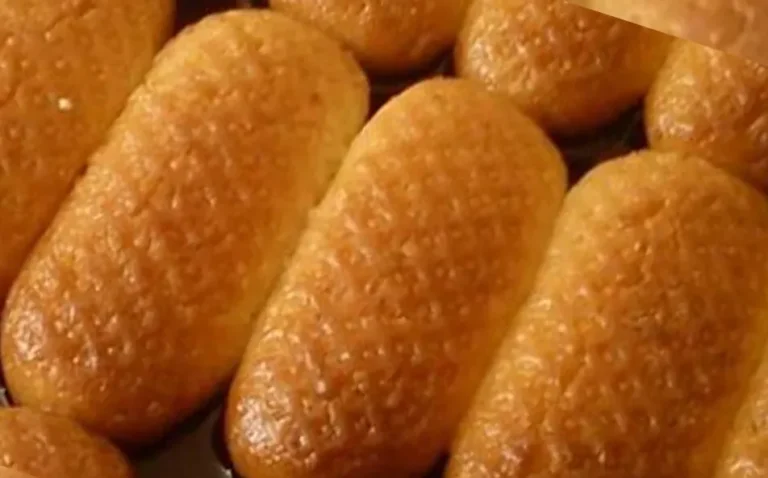
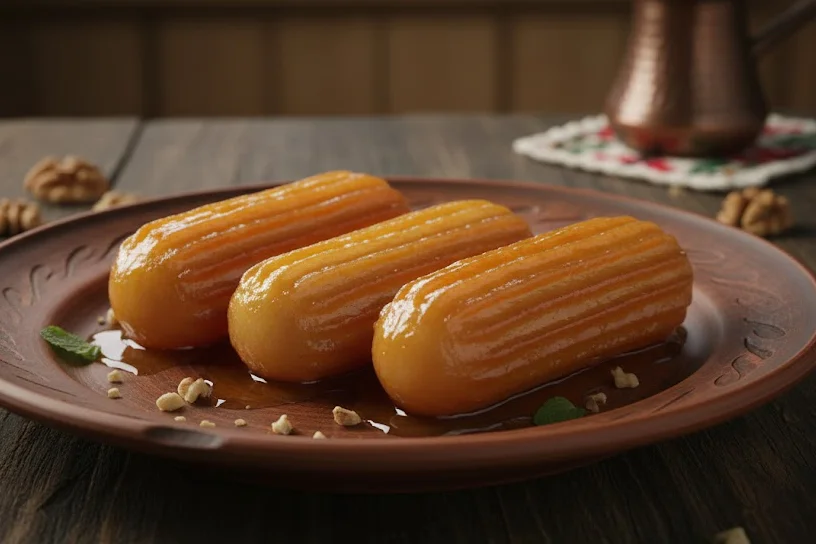
Tulumbe Recipe – Balkan Syrup-Soaked Fried Pastries
Tulumbe are small Balkan pastries with deep ridges, a golden fried shell, and a sweet, syrup-soaked center. This tulumbe recipe uses a cooked flour-and-egg dough, piped into hot oil and briefly dipped in lemon syrup.
The key is the order: make the syrup first and let it cool completely, cook and cool the dough before adding the eggs, then fry small batches at a steady temperature. Hot pastries meet cool syrup only after their centers are fully cooked.
A batch makes about two dozen small pieces for sharing with coffee or adding to a family dessert table. Plan to make them the day you serve them for the firmest surface; the syrup continues to soften that surface during storage.
Tulumbe – Balkan Syrup-Soaked Fried Pastries
Ingredients
- 17.64 oz granulated sugar weighed
- 13.53 fl oz water US fluid ounces, rounded; Metric gives the reference volume
- 1 tbsp fresh lemon juice rounded US measure
- 8.45 fl oz water US fluid ounces, rounded
- 2.71 fl oz sunflower oil for the dough; separate from frying oil
- 1/6 tsp fine table salt weigh if possible; table salt reference is 6 g per teaspoon, not kosher salt
- 7.05 oz all-purpose flour weighed; plain flour, not self-rising; German Type 405 may be used
- 3 large eggs about 50 g each without the shell; crack separately and add individually
- 1 tsp baking powder 4 g per teaspoon reference; sift before adding
- 33.81 fl oz sunflower oil starting supply, not the amount eaten; use refined oil suitable for frying, and keep the pot below one-third full
Equipment
- Kitchen scale
- Two saucepans
- Large mixing bowl
- Sturdy wooden spoon
- Mixer with dough hooks
- Heavy high-sided pot about 8–8¾ inches (20–22 cm) across; enough capacity to keep the oil below one-third full
- Sturdy piping bag
- Open star tip ½–9/16 inch (12–14 mm)
- Kitchen scissors
- Frying thermometer
- Instant-read thermometer
- Two slotted spoons
- Paper towels
- Wide syrup dish
- Shallow serving dish
Method
- Make the syrup. Heat the syrup sugar and water in a saucepan, stirring only until the sugar dissolves. Bring to a boil, then simmer gently, uncovered, for 10 minutes. Stir in the lemon juice and simmer 1 minute more.
- Cool the syrup completely. Remove from the heat and let the syrup reach room temperature with no residual warmth. Transfer to a wide dish on a stable surface well away from the frying pot. Make the dough while it cools; do not start frying until the syrup is fully cool.
- Cook the dough. Bring the dough water, dough oil, and salt to a boil in another saucepan. Reduce the heat and add all the flour at once. Stir vigorously over low to medium heat for about 3 minutes, until the dough forms one mass, pulls away from the pan, and leaves a thin pale film on the bottom.
- Cool and mix in the eggs. Transfer to the mixing bowl and cool for about 15 minutes, until only lukewarm. Work in the eggs one at a time, completely incorporating each before adding the next. The mixture may separate briefly before coming together. Sift in the baking powder and mix for about 30 seconds. The smooth, glossy dough should hold distinct piped ridges; do not taste raw dough.
- Set up for frying. Fit a sturdy piping bag with the open star tip and fill with dough. Put the frying oil into a dry, heavy, high-sided pot, never filling it more than one-third full. Heat to about 329°F (165°C). Monitor with a frying thermometer and maintain 320–338°F (160–170°C). Keep water, wet utensils, children, and the syrup dish away from the hot oil.
- Pipe small batches. Lightly oil the scissors with a little cold oil reserved from the frying supply. Hold the tip close to the oil without touching it. Pipe lengths about 2⅜ inches (6 cm) long, snipping each close to the surface to limit splashing. Keep hands back. Fry only a small batch with room to expand and move freely; about six to eight pieces fit the source-size pot, but use fewer if crowded.
- Fry until cooked through. Fry for about 6–8 minutes per batch. Wait until the surface sets before turning, then turn carefully several times for an even dark-golden color. Keep the oil within the stated range. Lift a sample onto a clean plate to check the first batch: the center should be fully set, with no wet, gummy or raw dough, and reach at least 160°F (71°C) on a clean fine-tip thermometer. Color and the clock alone do not prove doneness; fry longer as needed at the controlled temperature.
- Soak while hot. Lift the cooked pastries out with a slotted spoon and drain on paper towels for only 20–30 seconds. Immediately put them in the completely cooled syrup. Soak for 5–7 minutes, turning once or twice. Use a separate clean slotted spoon to lift them into a shallow dish in a single layer.
- Repeat and cool. Bring the oil back to about 329°F (165°C) before each batch. Repeat with the remaining dough, coordinating the brief soaking with the next batch without leaving hot oil unattended. Turn off the heat when finished. Rest the soaked pastries for at least 30 minutes, until fully cool; serve at room temperature or chilled. Refrigerate within the time limits in Notes.
Nutrition
Notes
- Yield and scaling: The servings selector counts individual pieces. Keep the same tip and piece size at 2x or 3x; expect roughly twice or three times as many frying batches and a longer working time. The scaled frying-oil quantity is a supply allowance, not an instruction to pour it all into one pot. Reuse the working oil between batches and keep the vessel below one-third full; do not increase batch size to match the scale.
- Timing: Allow about 2 hours for the base batch: 30 minutes preparation, about 45 minutes combined syrup cooking and frying, and 45 minutes for dough cooling and final cooling. Syrup cooling and short soaking overlap other stages. The syrup must be completely cool before frying; allow longer if needed, and extra time for larger batches.
- Texture: Hot pastries go into fully cooled syrup. Lift them out after the short soak instead of storing them submerged. Their surface gradually softens; a soaked interior should remain set rather than gummy.
- Oil safety: Never leave heating oil unattended or add water. If oil smokes, stop heating and let it cool safely. Never use water on a grease fire. Let used oil cool completely before straining or disposing of it under local rules; do not pour it down the drain.
- Storage: Best on the day made. Refrigerate in a shallow covered container at 40°F (4°C) or colder within 2 hours of frying, or 1 hour above 90°F (32°C). Use within 3 days. Do not wait for a large pile to cool on the counter. Freezing softens the texture and is not the preferred make-ahead method.
- Nutrition estimate: Per piece at the base yield. Independently calculated with USDA FoodData Central reference foods, counting all dough ingredients and the entire prepared syrup, plus a hypothetical 70 ml of absorbed frying oil per base batch (oil density 0.92 g/ml). The remaining frying supply is excluded. The 70 ml assumption comes from the source and is not a measured or independently validated absorption rate. Uneaten syrup is not measured either, so the displayed sugar and calories are a full-syrup allocation, not measured intake. Actual values vary with both oil and syrup uptake; this is an illustrative estimate, not a precise per-piece analysis.
What Makes Tulumbe Different?
Tulumbe start with a choux-style dough cooked in a saucepan before the eggs are added. An open star tip creates the ridges, and frying sets their shape before syrup is absorbed. Hurmašice are shaped cookies baked in the oven and then soaked. Their dough and method are different, even though both desserts use syrup.
This version is fried throughout. Moving it to the oven would change the result and requires a separate recipe. A properly soaked tulumba is moist inside but still has a fully set structure; a wet, gummy ribbon in the middle is undercooked dough, not desirable syrupiness.
Ingredients and Equipment That Matter
Use plain US all-purpose flour as a practical substitute for German Type 405. Flour types are not identical across countries, so weigh the flour rather than packing it into cups; do not use self-rising flour. The US ounce amounts are weights for flour and sugar, while “fl oz” means fluid volume. The Metric selector retains the original reference quantities.
US large eggs provide about 50 grams each without the shell, close to the source recipe’s medium European eggs. Add them individually to lukewarm dough and let each disappear into the mixture before continuing. Baking powder is a separate ingredient, added after the eggs.
A sturdy piping bag and an open star tip about ½–9/16 inch (12–14 mm) wide are important for the thick dough. A thin disposable bag may split. Use a high-sided heavy pot, a frying thermometer, and a separate clean spoon for the syrup dish. Refined sunflower oil suitable for frying keeps the original oil choice.
Cold Syrup, Hot Pastries
Simmer the dissolved sugar and water gently for ten minutes, then add the lemon juice for the final minute. Let the syrup lose all warmth before you fry. Do not keep cooking it into a thick candy syrup, and do not thin it afterward with an unmeasured splash of water.
While it cools, cook the flour mixture until it forms a cohesive mass and leaves a pale film on the pan. Cool that dough for about fifteen minutes before adding eggs. The finished dough should be glossy and thick enough to hold ridges, rather than running from the tip.
After frying, drain each batch for only twenty to thirty seconds and transfer it while hot to the cool syrup. Turn during the five- to seven-minute soak, then lift the pastries out into a single layer. Leaving them submerged makes their surface progressively softer. Keep the syrup station well away from the pot so no syrup or water can fall into hot oil.
Frying Safely and Cooking the Center
Heat the oil to about 329°F (165°C), then maintain 320–338°F (160–170°C). For pieces about 2⅜ inches (6 cm) long made with the specified tip, the source method allows about six to eight minutes per batch. Larger or thicker pieces take longer, so time alone is not a doneness test.
Let the surface set before turning. Check a sample from the first batch after lifting it out of the oil: its center should be cooked and set, without raw or gummy dough. A fine-tip thermometer should read at least 160°F (71°C) in the center, the USDA minimum for egg-containing dishes. Reaching that minimum does not replace checking that the flour dough is cooked through. Continue frying at the controlled temperature when needed.
Keep the pot no more than one-third full of oil and leave room for the pastries to expand. Pipe close to the surface and snip with lightly oiled scissors, keeping your hands back. Dry utensils and a clear work area reduce splashing. Never leave the pot unattended or use water on an oil fire. See the USDA home-frying guidance for handling and cooling hot oil.
Fixing Common Tulumbe Problems
Dark outside, raw inside: The oil may be too hot or the pieces too thick. Stay within the temperature range, keep the piece size consistent, and test the first batch before soaking. Do not use syrup to disguise an uncooked center.
Heavy or greasy: Crowding can drop the oil temperature sharply. Use fewer pieces and let the oil recover between batches. Brief draining removes surface oil; it does not measure how much oil the dough absorbed.
Lost ridges or split dough: Cook the flour paste properly, cool it before adding eggs, and fully incorporate each egg. Weighing the ingredients helps avoid an overly loose mixture. Do not add extra water or eggs to make piping easier.
Mushy pastries: Check that the dough was cooked through, the syrup fully cool, and the soaking limited. Lift out each batch instead of keeping finished pieces in a deep pool of syrup.
Serving, Planning Ahead, and Storage
Serve small portions with unsweetened Bosnian coffee. For a family gathering, arrange cooled pastries in a single layer and bring out a modest tray at a time. They work on a dessert table throughout the year; their preparation does not depend on a particular holiday.
The two-hour base-batch estimate allows syrup cooling to overlap dough preparation and soaking to overlap later frying. It includes about fifteen minutes of dough cooling and at least thirty minutes of final cooling. If the syrup is still warm, wait: the required temperature takes priority over the schedule. Doubled or tripled dough needs additional frying batches at the same piece size, not a fuller pot. The scaled oil amount is a supply allowance; keep the working fill safe and reuse it between batches.
For the best texture, prepare and serve on the same day. Refrigerate leftovers in shallow covered containers at 40°F (4°C) or below within two hours of frying, or one hour when the surroundings exceed 90°F (32°C), and use within three days. Avoid cooling a large stacked batch on the counter. Freezing can leave the thawed pastries softer, so it is not the preferred way to prepare for guests.
How to Read the Nutrition Estimate
The calculation uses USDA reference foods and every dough ingredient. It excludes the full pot of frying oil and instead models the source’s assumption of 70 milliliters absorbed per base batch. That assumption has not been confirmed by weighing or a kitchen test. The calculation allocates all prepared syrup because the amount left behind has not been measured.
Consequently, the displayed values are an illustrative full-syrup estimate, not a measurement of what each pastry contains. Actual oil uptake and leftover syrup can change both calories and sugar substantially. No precise absorption percentage or kitchen-testing claim is implied.