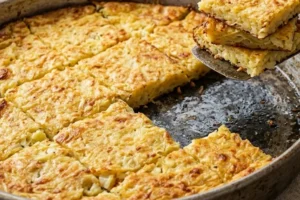
Kljukuša – Bosnian Baked Potato Dish
448.53kcal
Ingredients
Potato Mixture
- 2.65 lb floury potatoes russets are a practical US choice; peeled, then weighed and coarsely grated
- 6.35 oz onion peeled, then weighed; very finely diced or coarsely grated
- 7.05 oz all-purpose flour weighed; plain flour, not self-rising; German Type 405 may be used
- 4.06 fl oz lukewarm water maximum allowance, not a required amount; add gradually only as needed
- 1.35 fl oz sunflower oil for the potato mixture; separate from the pan-and-top oil
- 2 tsp fine table salt defined US interpretation: 6 g per teaspoon; do not substitute kosher salt by volume
- 1 tsp ground black pepper ground, not whole peppercorns; 2.3 g per teaspoon reference
Pan, Surface, and Finish
- 1.35 fl oz sunflower oil divide five-eighths for the pan and three-eighths for the surface; refined oil rated for high-heat cooking
- 1.41 oz butter melted for finishing after baking; plain unsalted is a practical US choice
- 2 tbsp warm water for lightly sprinkling after baking; rounded US measure
Optional Serving Accompaniments
- plain yogurt optional; choose a dairy accompaniment, not required in the mixture
- soured milk optional cultured dairy; an alternative accompaniment
- sour cream optional; an alternative accompaniment
- 1 small garlic clove optional; finely grate into the chosen dairy accompaniment, to taste
Equipment
- Kitchen scale
- Large mixing bowl
- Coarse box grater
- Sharp knife
- Sturdy spoon
- Metal baking pan about 11¾ × 13¾ inches (30 × 35 cm); oven-rated for 450°F (230°C), one pan per base batch
- Pastry brush
- Dry oven mitts
- Second pan for loosely covering after baking
- Instant-read thermometer for reheated leftovers
Method
- Heat the oven and pan. Preheat a conventional oven to 450°F (230°C). Brush about five-eighths of the pan-and-surface oil over the metal pan. Heat the oiled pan in the already hot oven for 8–10 minutes, timing this to finish when the mixture is ready. Use refined sunflower oil suitable for this heat. Do not leave the empty oiled pan heating indefinitely; if oil smokes, stop heating and let it cool safely before proceeding.
- Grate the vegetables. Peel and briefly rinse the potatoes, then coarsely grate them directly into a large bowl. Very finely dice or coarsely grate the peeled onion and mix it into the potatoes immediately. Do not rinse or squeeze the grated mixture; its starch and moisture help bind the dish.
- Mix and adjust the moisture. Mix in the salt, pepper, and the separate potato-mixture oil. Sprinkle over the flour and combine thoroughly. Gradually work in the lukewarm mixing water, starting with about two-thirds of the allowance if needed, then adding the remainder only in small amounts when dry. The mixture should be heavy, moist, and spreadable with a spoon, not a pourable pancake batter. You may not need all the water.
- Fill the hot pan. Using dry oven mitts, set the hot pan securely on a heatproof surface. Carefully spoon in the mixture close to the pan to limit splashing; keep hands and face back from the hot oil. Spread evenly about ¾–1¼ inches (2–3 cm) deep. Brush or drizzle the remaining three-eighths of the pan-and-surface oil over the top. Keep the same depth when scaling by using separate base-size pans.
- Bake until tender. Bake on the middle rack for about 35–45 minutes, until the top is golden, the edges well browned, and the potatoes fully soft. Start checking the center with a knife at about 35 minutes. Hard potato shreds or a raw, pasty center mean it needs more baking; color alone is not enough.
- Butter and rest. Melt the butter. Remove the baked dish from the oven and immediately brush the butter evenly over its surface. Lightly sprinkle with the finishing warm water without flooding it. Loosely cover with a second pan and rest for 10 minutes outside the oven.
- Serve warm. Cut into squares or irregular pieces and serve warm. If desired, offer plain yogurt, cultured soured milk, or sour cream separately. Finely grate the optional garlic into the chosen dairy accompaniment, to taste. These additions are not part of the potato mixture or its nutrition estimate.
Nutrition
Calories448.53kcalCarbohydrates64.63gProtein8.15gFat18.2gSaturated Fat4.75gCholesterol14.33mgSodium787.84mgFiber4.11gSugar2.61g
Notes
- Oil allocation: Keep the potato-mixture oil separate from the pan-and-surface oil. Divide only the latter five-eighths for preheating the pan and three-eighths for the top. Butter and finishing water go on after baking.
- Water: The mixing-water quantity is a maximum, not a target. Potato moisture varies. Add gradually to a thick, spreadable mixture; do not make a runny batter.
- Pan and scaling: Use one 30 × 35 cm metal pan for the base batch, two at 2x, or three at 3x. Divide the mixture and pan oil evenly and keep each layer about 2–3 cm deep. Do not put a doubled or tripled batch into one thick layer. Bake in batches if the pans cannot fit with good airflow; total working time will increase.
- Salt and pepper: The source gives spoon measures without defining salt grain size. Here, fine US table salt is standardized at 6 g per teaspoon (also the King Arthur reference); ground black pepper is 2.3 g per teaspoon from USDA. Different salt crystal sizes have different weights. US ounce and fluid-ounce conversions are rounded; Metric preserves the reference amounts.
- Storage: Portion leftovers into shallow containers and refrigerate promptly at 40°F (4°C) or below, within 2 hours after cooking or 1 hour above 90°F (32°C). Do not wait for the entire pan to become cold on the counter. Use within 2 days.
- Reheating: Warm portions in a 350°F (180°C) oven, starting around 8–10 minutes, until the center reaches 165°F (74°C). Cold, thick portions may need longer. A microwave softens the edges; frozen and thawed potatoes may be wetter.
- Nutrition: Independently calculated per serving using USDA FoodData Central reference foods, all flour, both oil allocations (80 ml total per base batch, modeled at 0.92 g/ml), and all butter. The raw russet flesh-and-skin entry is a composition proxy for peeled potatoes; actual variety and peeling change the result. Fine table salt and unsalted butter are assumed. Some pan oil may remain uneaten. Optional dairy and garlic are excluded.