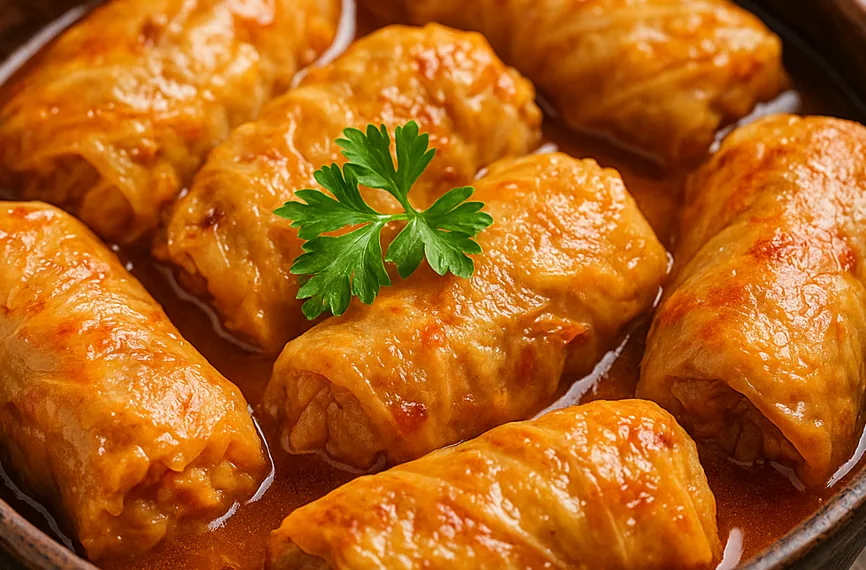
Bosnian Sarma Recipe – Stuffed Sauerkraut Cabbage Rolls
Bosnian sarma are fermented cabbage leaves wrapped around a beef-and-rice filling and slowly simmered until the leaves are tender. This version layers the rolls with smoked beef, chopped sour cabbage, and a little tomato paste. The result is deeply savory and gently tangy, with rice that absorbs the cooking juices inside each roll.
The most important ingredient is whole fermented cabbage, often sold as kiseli kupus at Balkan markets. Its flavor and flexibility are different from fresh cabbage, and shredded sauerkraut cannot replace the wrapping leaves. A little preparation—trimming thick ribs, judging the saltiness, and keeping the filling loose—makes the rolling much easier.
Allow about three hours and twenty minutes, including preparation, a gentle two-hour simmer, and a fifteen-minute rest. The time is a planning estimate, not a guarantee: check the rice, cabbage, and meat separately. The card includes US and Metric quantities, with Metric providing the reference formula.
Bosnian Sarma
Ingredients
- 3 1/3 lb whole fermented cabbage leaves drained usable leaves and trimmings; kiseli kupus
- 3 1/4 tsp sunflower oil for coating the pot; US volume approximate
- 1 1/3 lb ground beef about 20% fat; keep cold
- 2/3 cup long-grain white rice uncooked; US volume approximate, weigh for the source formula
- 7 oz onion finely diced
- 2 cloves garlic about 5 g each; minced
- 7/8 tsp fine salt US measure approximate; weigh accurately
- 1 tsp ground black pepper
- 2 1/4 tsp sweet paprika not hot or smoked paprika
- 5 1/3 oz smoked beef lean, boneless, ready-to-eat product suitable for simmering
- 2 1/2 tbsp tomato paste
- 5 cups hot water main cooking liquid; US cups rounded
- 7/8 cup extra hot water up to this amount, only as needed
- 2 bay leaves
Equipment
- Kitchen scale For drained cabbage, filling, and salt.
- Wide heavy pot with lid At least 6 liters for the base batch; add pots when scaling.
- Heat-safe plate Slightly smaller than the pot; used inverted to hold rolls down.
- Fine-mesh sieve For rinsing rice.
- Knife and cutting boards Keep raw-meat preparation separate.
- Mixing bowl Keep filling cold.
- Food thermometer Check the center of the meat filling.
- Tongs and ladle For careful lifting and serving.
Method
- Prepare the leaves. Separate whole fermented cabbage leaves and select about 18 sound wrapping leaves per base batch. Halve very large leaves. Shave the thick rib flat without cutting through. Taste a clean piece before raw-meat handling; rinse individual leaves briefly only if excessively salty or sour, then drain.
- Chop the trimmings. Coarsely chop small leaves and offcuts, about one fifth of the total cabbage weight, for the bottom and top layers. This is included in the cabbage total.
- Prepare rice and aromatics. Rinse uncooked long-grain rice in a fine sieve until the water runs clearer and drain well. Finely dice onion to about 1/8 inch (3–4 mm) and mince garlic. Do not precook the rice.
- Mix the cold filling. Combine beef, rice, onion, garlic, filling salt, pepper, and paprika just until evenly distributed. Do not knead into a dense paste. Keep filling at 40°F (4°C) or colder until wrapping. Clean hands, utensils, and surfaces after handling raw beef.
- Fill and fold. Lay each leaf inner side up. Place about 1 3/4 oz (45–55 g) filling on the lower third. Fold the bottom over it, fold one side inward, roll loosely, and tuck the open end inside. Leave room for rice expansion. Overlap small sound leaves if necessary. Keep roll size similar when scaling.
- Line the pot. Coat a wide heavy pot with the oil and spread half the chopped cabbage on the bottom. Use at least a 6-liter pot for the base batch; add pots rather than increasing layer depth when scaling.
- Arrange the rolls. Place rolls seam side down, snugly beside one another without crushing them. Add half the smoked beef between the first layer. Complete a second layer with remaining rolls, smoked beef, and bay leaves.
- Cover with cabbage. Spread remaining chopped cabbage and trimmings over the rolls. This protects the top layer during simmering.
- Add the liquid. Whisk tomato paste into the main hot-water quantity and pour down the side of the pot. Liquid should nearly cover the rolls; the precise level depends on pot shape. Do not salt the liquid automatically.
- Weight and heat gently. Place an inverted heat-safe plate slightly smaller than the pot over the cabbage. Cover and bring to a gentle simmer over medium heat, about 15 minutes.
- Simmer without stirring. Lower the heat and simmer covered for about 2 hours. Avoid a rolling boil and do not stir between rolls. Check liquid after about an hour. If rolls are exposed and drying, add some of the separately listed extra hot water down the side.
- Check filling and rice. Lift a large roll carefully. Check the center of the beef filling with a clean thermometer: at least 160°F (71°C). Open it to check that rice is fully tender and cabbage yields easily. If any endpoint is unmet, cover and cook another 15–20 minutes, then check again. Color and elapsed time alone are insufficient.
- Rest and serve. Remove from heat. Carefully lift out the hot plate with suitable utensils, avoiding steam. Rest covered 15 minutes and remove bay leaves. Serve about three medium rolls per person with cabbage, smoked beef, and cooking liquid.
- Cool and store promptly. Divide leftovers into shallow containers and refrigerate within 2 hours, or 1 hour above 90°F (32°C). Store at 40°F (4°C) or colder for 2–3 days. Freeze promptly chilled portions with liquid for longer storage. Thaw in the refrigerator and reheat centers to 165°F (74°C), adding water as needed.
Notes
- Formula: Metric is the reference. US measures are rounded. Cabbage includes about 300 g chopped trimmings, not an additional ingredient.
- Leaves: Whole fermented cabbage gives the intended sour flavor. Shredded sauerkraut cannot wrap filling; fresh cabbage requires another preparation.
- Smoked beef: Use a labeled ready-to-eat product suitable for cooking, not raw cured meat or jerky. Salt varies; do not add salted stock automatically.
- Portions: About 18 medium rolls, six servings of about three. Leaf size changes the count.
- Scaling: Keep roll size and layer depth similar. Add pots; do not multiply cooking time automatically.
- Timing: Cook time includes about 15 minutes to reach simmer plus 2 hours gentle cooking. Tough leaves or rice may need longer.
- Nutrition: Rough per-serving estimate for one sixth of the full batch. Rinsing, cabbage brine, smoked-meat brands, and broth consumed make sodium particularly uncertain. Not laboratory measured.
What Makes This a Bosnian Sarma?
Sarma belongs to a wider family of leaf-wrapped dishes across the Balkans and neighboring cuisines. Cabbage, grape leaves, meat mixtures, seasonings, and serving customs vary. In this Bosnian home version, whole fermented white-cabbage leaves surround a raw beef-and-rice filling, while smoked beef adds flavor between the layers.
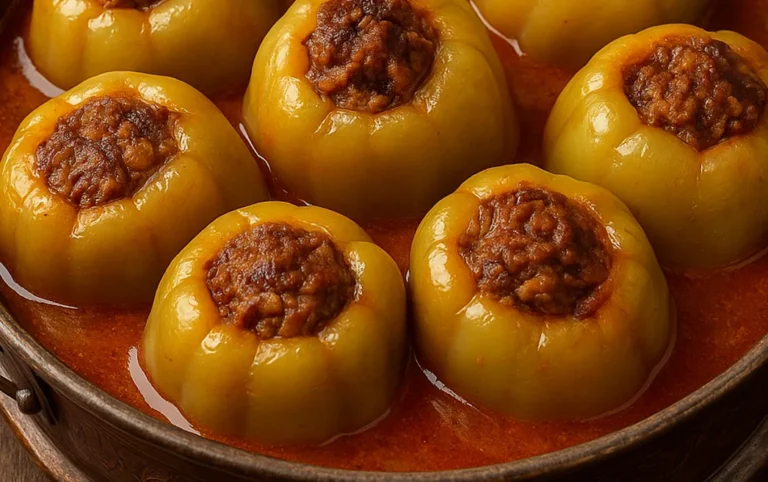
Other households use different meats or more rice, and some regional preparations include pork or smoked ribs. Those differences do not make this all-beef formula universal. It is one clearly defined sour-cabbage version, cooked on the stovetop. For a beef-and-rice filling in sweet peppers instead, see punjene paprike. It is also different from fresh-cabbage rolls: fermenting the cabbage supplies the characteristic acidity rather than relying on a sour tomato sauce to imitate it.
Buy Whole Fermented Cabbage Leaves
What to look for in an American store
Ask a Balkan or Eastern European market for a whole fermented cabbage head or whole sour-cabbage leaves suitable for sarma. Check the label and storage instructions. The recipe needs about 3⅓ pounds (1,500 g) of drained, usable leaves and trimmings, rather than an unspecified head weight that includes brine and a hard core.
Choose broad, flexible leaves with as few tears as possible. Shredded sauerkraut can be useful in other dishes, but it cannot hold this filling. Fresh cabbage needs blanching and a differently balanced cooking liquid; it is not an equivalent swap within this card.
Rinse only when the cabbage needs it
Taste a small clean piece before working with raw beef. Some heads are pleasantly tangy and moderately salted; others are very sharp or salty. Briefly rinse individual leaves under cold water only when necessary, then drain thoroughly. Prolonged soaking or repeated washing can remove much of the flavor you bought fermented cabbage for.
The filling contains a restrained amount of salt because the cabbage and smoked beef contribute their own. Use unsalted water rather than automatically substituting a salty broth. Do not taste the raw meat mixture to adjust seasoning.
Prepare Leaves That Bend Without Splitting
Ease the leaves apart instead of pulling hard at their edges. Lay a leaf flat and shave down its raised central rib with a sharp knife. Remove the thickness while leaving enough leaf intact to support the roll. A stiff rib makes a bulky hinge and can tear the wrapping when you fold it.
Very large leaves can be halved; small sound leaves can overlap to make one wrapper. Keep the trimmings and smaller damaged leaves for the pot. About 300 g of the total cabbage is chopped for the base and protective top layer. This is part of the listed cabbage weight, not an additional amount to buy.
Keep the Beef-and-Rice Filling Tender
Use raw rice and finely cut onion
Rinse long-grain white rice and drain it well before mixing. It goes into the rolls uncooked, then absorbs liquid during the simmer. This is why filling portions and loose wrapping matter. Cooked rice would have a different volume and absorption behavior and is not the formula used here.
Ground beef around 20% fat is a practical choice; US 80/20 ground chuck fits that description. Very lean beef can make a firmer filling. Finely diced onion distributes through the meat and rice without large pieces creating awkward lumps. Mince the garlic so its flavor is spread evenly.
Mix to distribute, rather than to bind like a sausage
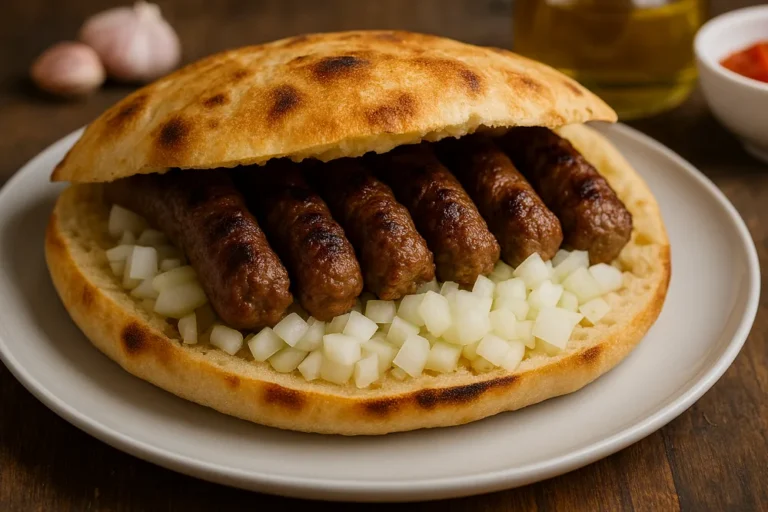
Fold the ingredients together only until rice, vegetables, and seasonings are evenly distributed. Long, forceful kneading makes this filling denser. Unlike ćevapi, the mixture is supported by a cabbage wrapper and does not need to become a sticky, strongly bound meat mass. No egg or breadcrumbs are included.
Keep the filling refrigerated at 40°F (4°C) or colder during preparation delays. Work with clean utensils and wash surfaces after handling raw meat. The slow simmer is a cooking stage, not permission to leave the raw filling on the counter for extended periods.
Roll Sarma with Room for the Rice
Place a leaf inner side up and put a modest strip of filling across its lower third. For a medium wrapper, about 45–55 g of filling is a useful starting point. Fold the lower end over, fold one side inward, roll, and tuck the open side gently into the end. Aim for a closed parcel, not a tightly compressed cylinder.
The rice expands as it cooks. Too much filling or extremely tight wrapping can split the leaf; a roll that barely overlaps may open. Adjust the portion to the actual leaf rather than forcing every leaf to hold the same amount. The base batch makes roughly eighteen medium rolls, but an exact count depends on cabbage size.
Layer the Pot and Simmer Without Stirring
Build a protective base and top
A thin oil coating and a bed of chopped cabbage protect the bottom rolls. Arrange sarma seam side down in snug layers, distributing smoked beef and bay leaves between them. Cover with the remaining cabbage trimmings. The rolls support one another, but should not be crushed into a deep, compact stack.
Use a lean, boneless smoked beef product labeled ready to eat and suitable for simmering. Balkan suho meso varies in salt, dryness, and preparation requirements; read the actual package. Dry jerky or a raw cured product is not an interchangeable ingredient for this timing. The selected ready-to-eat product still needs to be heated through with the dish.
Control liquid and movement
Pour the hot tomato-water mixture down the side so it does not displace the rolls. It should nearly cover them; a very wide pot may require a different arrangement to achieve that level. An inverted heat-safe plate holds the upper cabbage and rolls in place. Use a plate made to tolerate heat, not a fragile decorative plate.
Bring the covered pot to a gentle simmer, then reduce the heat. Occasional small bubbles are appropriate; vigorous boiling can break leaves and open seams. Do not stir between the rolls. Check the liquid level after about an hour and add the reserved extra hot water only if the top is drying. Sarma should not be swimming in a large pot of thin soup.
Check Three Signs of Doneness
The cabbage should be tender enough to cut comfortably, the rice should have no hard center, and the meat filling must reach at least 160°F (71°C). Lift one of the larger rolls and place a clean thermometer into the center of its filling. Then open it to inspect the rice. A warm broth or browned-looking beef does not establish the center temperature.
If rice remains firm or the leaf is tough, continue gentle covered cooking even after the meat reaches its safety endpoint. Check liquid and repeat the test after another fifteen to twenty minutes. Remove the hot plate carefully, avoiding steam, then let the finished pot rest covered for fifteen minutes before serving.
Troubleshooting Sarma
The rolls split or open
Check for an untrimmed rib, too much filling, or tight wrapping that left no space for rice. A rolling boil and stirring can also undo otherwise sound rolls. Use the plate, keep the simmer gentle, and lift cooked rolls with support underneath.
The filling is dense or the rice is hard
A compact meat texture can result from heavy kneading or squeezing. Hard rice usually needs more moisture and cooking time; do not assume the meat temperature alone means the whole roll is ready. Add hot water only as needed to restore the cooking level and continue simmering.
The dish is too sour, salty, or watery
Cabbage and smoked-beef brands are the main variables for sourness and salt. Assess cabbage before assembly and avoid salted broth. After the dish is cooked, extra water may dilute the flavor but cannot remove salt already absorbed into the rolls. Prevent an overly watery result by using a suitably sized pot and checking before every addition of reserved water.
Serving, Refrigerating, and Freezing
Serve roughly three medium rolls per person with some chopped cabbage, smoked beef, and cooking liquid. Bread or plain mashed potatoes absorb the broth; yogurt or sour cream can be offered separately. Keep accompaniments simple so the fermented cabbage remains prominent.
Refrigerate leftovers promptly in shallow containers rather than leaving the whole pot to cool on the counter. Refrigerate within two hours, or one hour above 90°F (32°C), and keep at 40°F (4°C) or colder. Use within two to three days. Freeze promptly chilled portions with a little cooking liquid for longer storage and thaw in the refrigerator. Reheat the filling centers to 165°F (74°C), adding a small amount of water to prevent sticking.
Sarma FAQ
Can I prepare the rolls ahead?
Keep any raw assembled rolls covered and refrigerated and follow the ground-beef package instructions. Cooking the dish completely and chilling it promptly is another practical way to prepare a later meal; it still requires safe cooling and thorough reheating.
Can I use fresh cabbage or shredded sauerkraut?
Neither directly replaces whole fermented wrapping leaves in this recipe. Fresh cabbage requires another preparation and flavor balance; shredded cabbage cannot enclose the filling.
Does doubling the recipe double cooking time?
No. Keep individual roll size and layer depth similar and use additional pots. Each pot may take a different time to reach a simmer, and each needs its own rice and temperature checks.