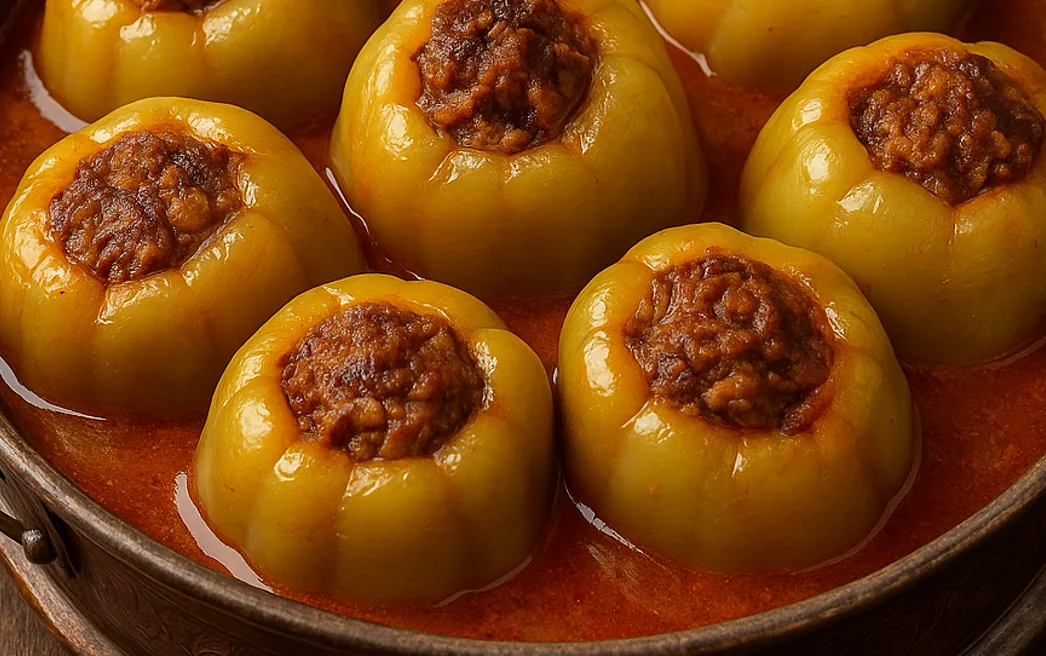
Punjene Paprike Recipe – Bosnian Stuffed Peppers
Punjene paprike are peppers filled with beef, rice, onion, and paprika, then gently cooked in tomato sauce until the peppers soften and the rice becomes tender. This Bosnian-style version uses pale yellow sweet pointed peppers and raw 80/20 ground beef. The rice also goes into the filling raw, so the sauce level and room inside each pepper are important.
The filling is mixed briefly and spooned in loosely, leaving a little headspace for the rice to expand. The peppers sit close together in a covered pot with sauce reaching halfway to two-thirds up their sides. A quiet simmer protects the tender walls while giving the center time to cook.
Plan on about two hours and ten minutes, including preparation and a ten-minute covered rest. Before serving, check that the rice is fully soft and that the center of the beef filling reaches at least 160°F (71.1°C). This recipe makes four substantial servings, with the number of peppers depending on their size rather than a fixed count.
Punjene Paprike
Ingredients
- 2.2 lb pale yellow sweet pointed peppers cleaned weight after removing seeds and inner membranes; keep the tops
- 1.1 lb ground beef 80% lean / 20% fat, raw
- 2.8 oz long-grain white rice regular raw rice, rinsed and drained; not instant or brown rice
- 5.3 oz onion finely diced
- 2 cloves garlic finely minced; clove size varies, so weigh for precision
- 1 large egg about 50 g each without shells
- 1 1/3 teaspoons fine salt for the filling; US measure assumes 6 g per teaspoon
- 7/8 teaspoon ground black pepper for the filling; US measure is approximate
- 2 1/4 teaspoons sweet paprika not hot or smoked paprika; US measure is approximate
- 1 tablespoon sunflower oil rounded US measure; weigh for the exact formula
- 2 1/2 tablespoons tomato paste
- 17.6 oz plain passata smooth strained tomatoes, preferably without added salt; not seasoned pasta sauce
- 2 1/8 cups hot water initial sauce water
- 1 teaspoon fine salt for the sauce
- 1/2 teaspoon ground black pepper scant; for the sauce; weigh for precision
- 1 1/4 teaspoons granulated sugar
- 2 bay leaves remove before serving
- 5/8 cup additional hot water optional, up to the listed amount; add only as needed for the specified sauce height
Equipment
- Wide heavy pot with lid at least 6 liters (about 6½ US quarts), with room to arrange the peppers upright; use additional comparable pots when scaling
- Kitchen scale weigh peppers after cleaning
- Large mixing bowl
- Separate cutting boards and sharp knife keep raw beef and egg separate from vegetables and ready-to-eat food
- Fine-mesh sieve for rinsing rice
- Measuring jug and small whisk or spoon
- Tongs or large serving spoon for lifting tender peppers
- Food thermometer check the center of the meat filling
Method
- Prepare the peppers. Wash the peppers. Cut a lid around each stem and reserve the tops. Carefully remove the seeds and pale membranes without piercing the walls. Weigh the cleaned peppers to match the ingredient list; the number of pods varies with size.
- Rinse rice and chop aromatics. Rinse the raw rice in a fine-mesh sieve until the water runs noticeably clearer, then drain thoroughly. Dice the onion into roughly ⅛-inch (3–4 mm) pieces and mince or press the garlic.
- Briefly cook the tomato paste. Heat the sunflower oil in the wide pot over medium heat. Stir in the tomato paste and cook for about 1 minute without letting it darken or scorch.
- Make the light sauce. Slowly stir in the passata and initial hot water. Add the sauce salt, sauce pepper, sugar, and bay leaves. Bring to a simmer, cook gently for 5 minutes, then temporarily take the pot off the heat.
- Mix the raw filling. Combine the raw ground beef, drained raw rice, onion, garlic, egg, filling salt, filling pepper, and sweet paprika in a bowl. Mix with clean hands only until evenly distributed; do not knead into a dense paste. Wash hands, work surfaces, and utensils thoroughly after handling raw beef and egg.
- Fill loosely. Distribute the mixture loosely among the prepared peppers, leaving about ⅜ inch (1 cm) below each rim. Do not compress the mixture: the rice needs space to expand. Replace the reserved pepper tops.
- Arrange and check the level. Set the peppers close together and as upright as possible in the sauce. It should reach halfway to two-thirds up their height. Add some of the optional hot water only if needed for that level, without submerging or flooding the peppers.
- Return to a gentle simmer. Cover and warm over medium heat, allowing about 10 minutes to return to a gentle simmer. Reduce to low heat so the sauce bubbles lightly rather than boiling hard.
- Braise without stirring. Cook covered at a gentle simmer for 65–70 minutes. Do not stir between the peppers. If needed, carefully shift the covered pot by its handles to redistribute the liquid, without splashing or tilting it dangerously.
- Check the sauce. After about 60 minutes of braising, check the liquid level. If the sauce is reducing enough to catch on the bottom, add a little hot water at the side of the pot. Keep the heat gentle and replace the lid.
- Verify the filling. At about 65 minutes, check a particularly large pepper and other large pieces as needed. The rice must be fully tender, and the center of the beef filling must measure at least 160°F (71.1°C) with a clean thermometer. Do not rely on meat color, pepper softness, or a boiling sauce.
- Continue if needed. If the rice is firm or the filling has not reached the safe temperature, cover and cook for another 10–15 minutes, then check again. Thick-walled or larger peppers can need longer; both checks must pass before resting.
- Rest and serve. Remove the pot from the heat and rest, covered, for 10 minutes. Remove the bay leaves. Lift the peppers gently onto deep plates and divide the peppers and tomato sauce among the servings. Serve hot.
Nutrition
Notes
- Yield and pepper weight. The standard recipe makes about eight medium peppers, or four main-dish servings. Count varies with size: cleaned pepper weight, not a fixed number of pods, determines the meat-to-rice-to-pepper balance. Divide the finished peppers and sauce into the stated servings.
- Rice and filling. Use rinsed, well-drained raw regular long-grain white rice. Do not precook it, pack the filling firmly, or fill to the rim. Leave about ⅜ inch (1 cm) headspace in each pepper for the rice to expand. The egg belongs to this particular formula; other household versions may differ.
- US measurements. US measures are rounded kitchen equivalents; Metric preserves the source formula. Fine salt assumes about 6 g per teaspoon. Spice spoon weights vary. Use the weighed amounts for the most precise result, especially the separate filling and sauce seasonings.
- Pepper choice. Pale yellow sweet pointed stuffing peppers are the intended choice. Look in Balkan or Turkish markets; mild Cubanelle-type peppers can offer a similar thin-walled shape but are not the same cultivar. Avoid hot wax peppers. Thick-walled bell peppers may need more cooking time and can change the number of pieces and pot fit.
- Liquid and scaling. Start with the measured sauce and add the optional extra hot water only if needed to reach halfway to two-thirds up the peppers. Pot shape determines the adjustment; it is not an instruction to dilute automatically at larger scales. At 2x or 3x, divide among two or three comparable wide pots rather than tightly stacking the original pot. Each pot needs its own liquid-level and doneness checks; time does not multiply mechanically.
- Doneness. Use a thermometer in the center of the largest fillings: ground beef must reach at least 160°F (71.1°C). Rice must also be fully tender. Neither sauce bubbling, pepper softness, nor meat color alone proves the center is safe. If either check fails, continue covered for another 10–15 minutes and check again.
- Storage. Keep raw assembled peppers covered in the refrigerator until cooking, and cook within the refrigerated raw ground beef storage window of 1–2 days. Divide cooked leftovers with sauce into shallow containers and refrigerate promptly within 2 hours (1 hour above 90°F/32°C), at 40°F/4°C or below. Use within 2–3 days; reheat filling and sauce to 165°F/74°C. Freeze cooked portions with sauce, thaw in the refrigerator, then reheat thoroughly. No tested freezer-quality duration is specified here.
- Nutrition estimate. Calculated independently from USDA SR Legacy raw-ingredient data for one-quarter of the full recipe, including all beef fat, the full 15 g of added oil, salt, and sauce. Generic yellow sweet pepper and unsalted tomato puree are proxies for the particular peppers and passata used. Brands, pepper variety, portion size, sauce eaten, and any discarded fat change the result. Bay leaves are removed; sides and toppings are excluded.
What makes these Bosnian-style stuffed peppers?
Stuffed peppers are familiar throughout the Balkans, with differences between households in the meat, seasonings, and cooking method. The preparation here is a gentle stovetop braise: raw beef and rice cook together inside sweet peppers in a light tomato sauce. It is related in technique to other filled vegetable dishes, but the sweet pepper flavor and tomato broth give it its own character. For a fermented-cabbage version, try Bosnian sarma.
The egg binds this particular filling. It is part of the formula here rather than a claim that every regional stuffed pepper must contain egg. This version uses beef throughout and does not add bacon or smoked meat to the sauce. The balance of the original ingredients is kept together rather than mixing instructions from several different preparations.
There are also meatless winter dishes made with dried red peppers and bean fillings, as well as stuffed tomatoes and other vegetables. Those use different ingredients and moisture balances. They are separate dishes, not direct substitutions within this beef-and-rice recipe.
Find suitable pale sweet peppers in the US
Thin walls and a roomy cavity
Look for mild, pale yellow or yellow-green sweet pointed peppers suitable for stuffing, especially at Balkan, Turkish, or other European markets. Choose sound peppers with enough cavity to hold the mixture and walls that can be cleaned without tearing. Color alone does not identify sweetness: hot wax peppers can look similar, so check the variety or ask the seller.
Cubanelle-type peppers available in some US markets offer a comparable elongated, thin-walled option, although they are not the same cultivar and mild heat can vary. Select a sweet, sufficiently roomy pepper rather than a very narrow frying pepper that cannot hold the filling. Local availability is seasonal and should not be assumed for every supermarket.
Weigh the peppers after removing the seeds and pale membranes. In the standard recipe, roughly eight medium pods make up the specified cleaned weight, but smaller peppers require more pieces. Keeping the weight and filling ratio consistent is more useful than buying an exact number regardless of size.
Using thick-walled bell peppers
Red, yellow, or green bell peppers can be used in related preparations, but their thicker walls and wider cavities change the pot fit, individual portion size, and time needed to soften. Do not assume that a very large bell pepper cooks like a medium thin-walled pepper. Keep the measured total pepper weight and filling quantities, allow longer if necessary, and check both the shell and the center.
A thicker shell can remain firm even after the meat reaches its safe temperature. Conversely, a soft shell does not prove that the filling is safe. The two observations need to be checked separately. The source photograph illustrates yellow stuffed peppers with a rounder shape; the intended main ingredient remains the pale sweet pointed pepper described in the card.
Keep the beef, raw rice, and pepper proportions together
The base formula uses 1,000 g cleaned peppers with 500 g ground beef and 80 g uncooked long-grain white rice. These are starting weights. The rice absorbs liquid while cooking, and the beef contributes fat and juices, so changing one component can change the texture of the entire filling.
Choose US ground beef labeled 80% lean and 20% fat to match the intended meat. A much leaner product would change both the finished texture and the nutrition estimate. The meat is not browned and drained before filling; that would be a different method with different moisture and fat retention.
Rinse the rice but do not precook it
Use regular raw long-grain white rice rather than instant or brown rice. Measure the rice dry before rinsing. Rinse it in a fine-mesh sieve until the draining water looks noticeably clearer, then drain thoroughly before adding it to the filling. Retained rinse water is not additional rice.
The rice takes up moisture and flavor while enclosed in the peppers. Too much rice relative to the beef can leave the filling dry or tightly packed once it expands. Using cooked rice would also change the starting volume and liquid uptake. Follow this raw-rice formula instead of transferring a cooked-rice quantity from another stuffed pepper recipe.
Mix gently and leave space
Dice the onion finely, about 3–4 mm or roughly ⅛ inch, and mince the garlic. They go into the filling raw with the beef, drained rice, egg, and filling seasonings. Mix only until distributed. Extended kneading can produce a dense, compact center rather than a tender mixture.
Spoon the filling loosely into the cleaned cavities and stop about 1 cm, or ⅜ inch, below the rim. Do not press it down to squeeze in extra filling. The headspace and loose packing allow the rice to expand without forcing open the pepper walls. Replace the reserved tops once filled.
Build a mild tomato sauce with enough liquid
Briefly cook the tomato paste in the sunflower oil over medium heat for about a minute. The aim is to develop its flavor gently, not to brown it dark. Scorched paste can make the sauce bitter. Stir in the passata and hot water gradually, followed by the separate sauce salt, pepper, sugar, and bay leaves.
Plain passata is smooth strained tomato, not a finished pasta sauce with added herbs, oil, or cheese. Prefer a product without added salt so the listed seasonings remain easier to judge. The small quantity of sugar balances the tomato flavor; it does not turn the sauce sweet. Different tomatoes still vary in acidity.
Simmer the sauce gently for five minutes, then take the pot off the heat while finishing the filling and arrangement. It will initially look thinner than a finished tomato sauce. That is intentional: the raw rice needs moisture, and the sauce concentrates during the covered braise. Do not reduce it into a thick paste before the peppers are added.
Arrange the peppers and check the sauce height
Use a wide heavy pot with a lid, at least 6 liters, approximately 6½ US quarts, for the standard recipe. Capacity alone does not guarantee a good fit: the base must also be wide enough to hold the peppers close together and as upright as possible. Choose the pot before filling so you can judge the arrangement without squeezing or damaging the peppers.
The sauce should come halfway to two-thirds up the peppers. They need contact with moist sauce and enclosed steam, but do not need to float submerged. Depending on the pot shape, a small amount of additional hot water may be needed; the source allows up to about 150 ml for the standard arrangement. Add only what is needed for the stated height.
At 2x or 3x, use two or three comparable wide pots and divide the ingredients evenly. Do not crowd the original pot with tight layers or pour in multiplied adjustment water automatically. Each pot needs its own level check, gentle simmer, and filling-temperature checks. A larger batch is not a reason to multiply the cooking time mechanically.
Braise quietly instead of boiling or stirring
Cover and return the filled pot to a gentle simmer, allowing about ten minutes as a guide. Turn the heat low and braise covered for approximately 65–70 minutes. Look for light bubbling rather than a vigorous rolling boil. Hard boiling can break the walls, dislodge the filling, and reduce the sauce too quickly.
Do not stir a spoon between the peppers. If the liquid needs redistributing, carefully shift the covered pot by its handles without splashing. After about sixty minutes, check the sauce level. Add a little hot water at the edge if it is reducing enough to catch, and replace the lid rather than leaving the pot open to evaporate.
The cooking estimate includes making the sauce, returning the filled pot to a simmer, and the covered braise. Exact timing depends on the pepper size, filling density, pot, and stove. The temperature and rice checks take priority over reaching a particular minute on the timer.
Check the center for safety and the rice for tenderness
At about sixty-five minutes of braising, check a particularly large pepper with a clean food thermometer, placing the sensing tip in the center of the meat filling rather than against the pot or only in the sauce. Check other large pieces as needed. Raw ground beef must reach at least 160°F (71.1°C). Meat color, boiling tomato sauce, and a soft pepper are not reliable substitutes for that reading.
Check the rice too: it should be fully soft rather than chalky or hard in the middle. If either condition is not met, cover and cook for another ten to fifteen minutes, then check again. Do not begin the resting period while relying on it to correct an unsafe or undercooked center.
Once both checks pass, take the pot off the heat and rest it covered for ten minutes. Remove the bay leaves, lift the peppers gently, and divide the finished peppers and sauce among the servings. Tender peppers can tear if lifted only by the thin upper edge, so support them with a broad spoon or suitable tongs.
Troubleshooting Punjene Paprike
Hard rice or a tight, dry filling
Check the original rice amount, whether it was measured dry, how firmly the mixture was packed, and whether enough sauce remained. Raw rice needs both time and moisture. Adding extra rice or pressing the filling tightly can create a compact mass even when the shell is tender. Continue gently with adequate liquid instead of turning up the heat to force a faster finish.
Split peppers or filling pushed out
Overfilling, firm packing, and hard boiling are common causes. Leave the headspace, keep the mixture loose, and maintain a quiet simmer. A few imperfect pieces do not require stirring the pot; that is more likely to break additional peppers.
Scorched sauce or excessive reduction
Use a heavy pot and low heat, and check near the end as directed. If the sauce is beginning to reduce too far, add hot water at the side. Avoid scraping a burnt bottom into the sauce. Extra tomato paste thickens the mixture and is not the first solution when the problem is insufficient liquid.
Serving, making ahead, and safe storage
The peppers already provide beef, rice, vegetables, and sauce. Serve them on deep plates with their tomato sauce; bread, mashed potatoes, plain sour cream, or a simple salad can be offered separately. The standard recipe is divided into four main servings, commonly about two medium peppers each, but divide according to actual size and count.
For advance preparation, keep raw filled peppers covered in the refrigerator and cook within the original refrigerated ground-beef storage window of one to two days; assembling them does not restart that clock. Do not leave raw beef-and-egg filling on the counter while waiting for a later meal. Cooking the full dish and reheating portions is another practical approach.
Divide cooked leftovers with sauce into shallow containers and refrigerate promptly, within two hours or within one hour if the surroundings are above 90°F (32°C). Keep at 40°F (4°C) or below and use within two to three days. Do not wait for a large covered pot to cool completely on the counter.
Reheat covered with enough sauce to prevent catching, and check that the center of the filling and the reheated sauce reach 165°F (74°C). Cooked portions can be frozen airtight with sauce after prompt chilling, then thawed in the refrigerator and reheated thoroughly. A freezer-quality duration has not been established for this particular formula.
Questions about the method
Can I cook the rice first?
This recipe is balanced for uncooked white rice. Precooking changes its volume and liquid uptake, so it is not a direct switch within the same formula. Rinse and drain the measured dry rice, then cook it inside the loosely filled peppers.
Can I use the oven?
Oven-baked stuffed peppers are another valid preparation, but this card specifies a covered stovetop braise. An oven version needs its own pan size, liquid amount, covered phase, and doneness checks; no untested oven setting is supplied as an equivalent.
What does the nutrition estimate include?
The estimate covers one-quarter of the full recipe, including all listed beef fat, the full added oil, rice, vegetables, salt, and tomato sauce. It assumes generic yellow sweet pepper and unsalted tomato puree composition. Leaving sauce behind, changing the meat fat percentage, or using salted passata changes the result. Bread, potatoes, sour cream, and other accompaniments are separate.