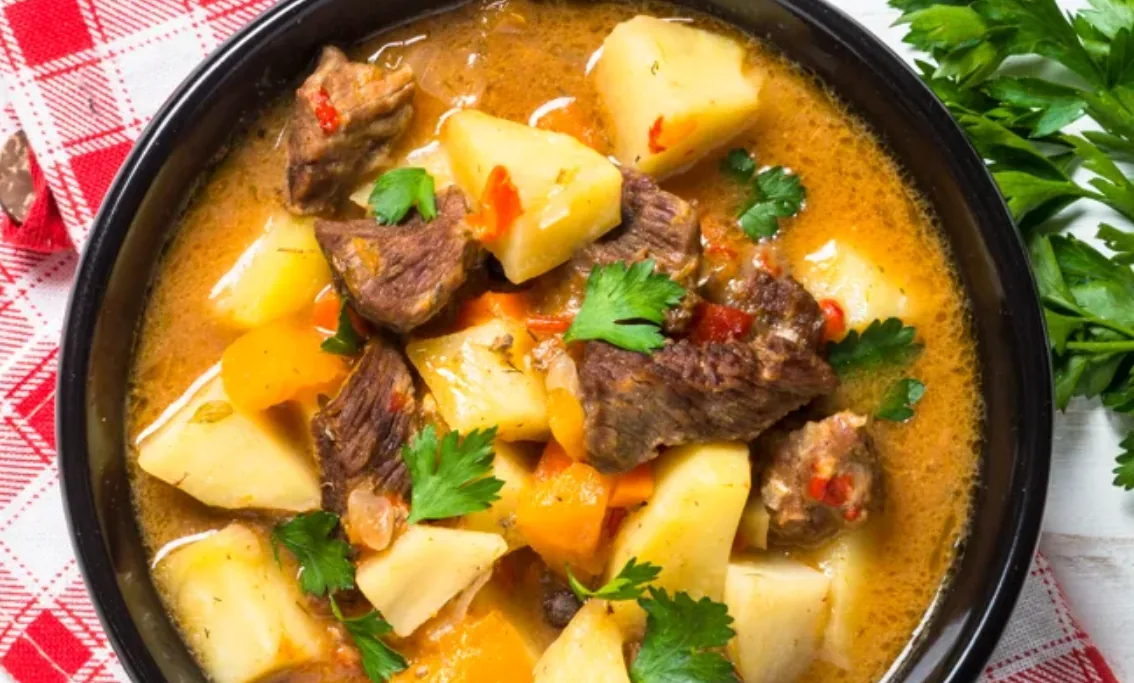
Bosanski Lonac Recipe – Beef and Lamb Vegetable Stew
Bosanski lonac is a slow, covered stew built from generous pieces of meat and vegetables rather than a pot of finely diced ingredients. This version combines beef and lamb shoulder with cabbage, waxy potatoes, carrots, onions, and celeriac. The layers cook together in a modest amount of water, producing a clear, savory broth with the flavor of the ingredients themselves.
The important work happens before the lid goes on: choose braising cuts, cut everything large enough to withstand a long simmer, distribute the seasoning through the layers, and leave enough room in the pot. There is no preliminary browning, flour-thickened gravy, or need to keep stirring. Gentle heat and a well-fitting lid let the meat become tender while the vegetables retain some shape.
The recipe below makes a complete main dish and keeps the beef-and-lamb combination as its base. The sections after the card explain pot capacity, the water level, tenderness checks, regional variations, troubleshooting, and safe leftover handling. US measures are convenient rounded equivalents; switch to Metric for the exact ingredient weights.
Bosanski Lonac
Ingredients
- 14.1 oz boneless beef shoulder braising cut; cut into 1 1/2–2-inch (4–5 cm) chunks
- 14.1 oz boneless lamb shoulder cut into 1 1/2–2-inch (4–5 cm) chunks
- 1 1/3 lb waxy potatoes peeled; quartered or cut into roughly 2-inch (5 cm) pieces
- 1 1/3 lb green cabbage cleaned weight without the core; cut into 2–2 1/2-inch (5–6 cm) pieces
- 10.6 oz carrots peeled; cut into roughly 1 1/4-inch (3 cm) chunks
- 7.1 oz onions peeled; cut into eighths
- 5.3 oz celeriac celery root, peeled; cut into roughly 1 1/4-inch (3 cm) cubes
- 2 cloves garlic peeled and sliced; about 5 g per clove
- 3 3/8 cups hot water initial cooking liquid; the upper vegetable layer should not be fully submerged
- 1 tbsp fine salt US volume assumes fine table salt; weigh the Metric amount for other salt types
- 1 3/8 tsp whole black peppercorns US volume is approximate; do not measure ground pepper by the same volume
- 2 bay leaves remove before serving
- 1 tbsp sunflower oil rounded US measure; Metric weight is the precise amount
Equipment
- Heavy stovetop-safe pot with a tight-fitting lid at least 7 liters; an 8-quart pot is a practical US starting size. Ingredients must fit loosely with headroom. For 2x/3x, use two/three comparable pots rather than crowding one.
- Instant-read food thermometer for checking the centers of the largest meat pieces
- Large cutting board and sharp knife clean and sanitize after contact with raw meat
Method
- Prepare the pot. Choose a heavy stovetop-safe pot with a tight-fitting lid that can hold the loose ingredients with headroom. See the pot-size and scaling notes. Brush the inside bottom with the sunflower oil. Do not brown the meat.
- Cut the meat. Keep the beef and lamb chilled until ready to assemble. Cut into large, similar 1 1/2–2-inch (4–5 cm) chunks. Keep raw-meat utensils separate from prepared vegetables, and wash hands and clean surfaces after handling.
- Prepare the vegetables. Peel the potatoes, carrots, onions, and celeriac. Quarter the potatoes or cut into roughly 2-inch (5 cm) pieces; cut carrots and celeriac into roughly 1 1/4-inch (3 cm) chunks and onions into eighths. Remove the cabbage core and cut the weighed, cleaned cabbage into 2–2 1/2-inch (5–6 cm) pieces. Slice the garlic.
- Build the first layers. Spread about one-third of the cabbage and onions over the bottom. Add half of each meat, then half of the potatoes, carrots, and celeriac. Scatter over part of the salt, peppercorns, and garlic rather than seasoning only the top.
- Complete the layers. Add another layer of cabbage and onions, then the remaining meat and root vegetables. Distribute the remaining salt, peppercorns, garlic, and bay leaves between the layers. Finish with the reserved cabbage on top. Leave headroom; do not force a lid onto an overfilled pot.
- Add the hot water. Pour the measured hot water slowly down the inside edge of the pot. The top vegetable layer should not be completely covered: the cabbage, onions, and meat will release more liquid. Put on the lid.
- Bring to a gentle simmer. Heat over medium until the liquid is gently simmering, allowing about 15 minutes. Then immediately reduce the heat to low. Avoid a rolling boil.
- Simmer without stirring. Cook, covered, at a quiet simmer for about 2 1/2 hours. Keep the lid closed as much as practical and do not stir the layers. If there are signs the bottom is drying out, check carefully and add a little hot water as needed rather than letting it scorch. Do not add water just to submerge the upper vegetables.
- Check safety and tenderness. Begin checking after about 2 hours 15 minutes of gentle simmering. Probe the center of a large piece of each meat with a clean thermometer: whole-cut beef and lamb must reach at least 145°F (62.8°C), followed by at least a 3-minute rest. That safety minimum does not establish tenderness. Both meats should also separate easily with a fork; if firm, continue gently in 15-minute increments, checking the liquid as needed. Potatoes and carrots should be tender throughout.
- Rest the stew. Turn off the heat and let the covered pot rest for 15 minutes. Remove the bay leaves. Taste a little broth and adjust seasoning only after cooking, since evaporation can concentrate salt.
- Serve gently. Use a ladle to lift meat, vegetables, and broth into bowls without vigorously stirring or breaking up the potatoes. Divide into the listed number of servings, giving each a share of both meats and vegetables. Serve warm with bread if desired.
- Cool leftovers promptly. Divide leftovers into shallow containers and refrigerate within 2 hours, or within 1 hour when the surrounding temperature exceeds 90°F (32°C). Do not leave the full deep pot on the counter to cool. Keep refrigerated at 40°F (4°C) or below, use within 2–3 days, and reheat throughout to 165°F (74°C).
Nutrition
Notes
- Timing: Cook time includes about 15 minutes to reach a simmer and about 2 1/2 hours of gentle simmering. Shoulder cuts can need longer; fork tenderness, not the clock alone, determines the finish.
- Scaling and pot size: The base recipe needs a heavy pot of at least 7 liters (an 8-quart pot is a practical US choice), with enough space for the loose layers and headroom below the lid. Actual loading depends on pot shape and chunk size and has not been kitchen-tested here. For 2x or 3x, divide the scaled ingredients between two or three comparable pots. Monitor each pot separately; do not assume a larger batch cooks faster or that one oversized pot heats evenly.
- Clay cookware: Use an earthenware pot on a burner only if its manufacturer explicitly approves that use. Follow its specific heat and preparation instructions. This recipe gives a stovetop method for a suitable heavy pot, not a validated clay-pot oven conversion.
- US measurements: Weights and cup measures are rounded equivalents; the Metric formula is the precise reference. Salt is fine table salt, not an equal volume of coarse or kosher salt. The tablespoon of oil is rounded from 15 g. Whole peppercorns are measured as whole, not ground pepper.
- Food safety: USDA's minimum for whole-cut beef and lamb is 145°F (62.8°C) followed by a 3-minute rest. This stew must also be fork-tender, which takes much longer than merely reaching that temperature. The covered 15-minute rest exceeds the minimum rest period.
- Leftovers: Transfer promptly into shallow containers and refrigerate within 2 hours, or within 1 hour above 90°F (32°C). Keep at 40°F (4°C) or below and use within 2–3 days. Reheat meat, vegetables, and broth throughout to 165°F (74°C). Freeze portions if needed; thaw in the refrigerator. Potato and cabbage texture may soften after freezing.
- Nutrition: Per one-sixth of the complete stew, calculated independently from USDA SR Legacy raw-food records. Includes all meat fat, oil, salt, vegetables, and broth; removed bay leaves are excluded. Assumes beef shoulder with exterior fat trimmed off and lamb shoulder trimmed to 1/8-inch exterior fat. White potato with skin is a composition proxy for peeled waxy potatoes. Actual fat trim, ingredients, retained broth, and serving size change the estimate. No laboratory analysis or personal kitchen testing is claimed.
What makes this Bosanski lonac distinctive
The name refers to both the Bosnian stew and the pot in which it cooks. Layered meat and seasonal vegetables, substantial pieces, and slow cooking under a lid are its defining ideas. Household versions vary, so this recipe is a specific beef-and-lamb preparation rather than a claim that every Bosnian family uses one fixed formula.
Here the flavor comes from beef shoulder, lamb shoulder, cabbage, onions, roots, garlic, whole peppercorns, and bay. The meat goes in raw. Browning would create a different roasted flavor and introduce another cooking stage; it is not part of this method. Nor does this version need paprika powder, tomato sauce, or commercial broth to be complete.
Bosanski lonac is different from grah, which is centered on beans, and from cabbage-forward kalja. Begova čorba is usually a chicken-and-okra soup, while hadžijski ćevap is a different meat-and-vegetable preparation often finished in individual parchment parcels. Those names do not describe interchangeable versions of this stew.
Choosing the meat and vegetables
Use shoulder cuts that reward a long simmer
Buy boneless beef shoulder, often sold as chuck in US meat cases, and boneless lamb shoulder. Ask the butcher for pieces suitable for moist, slow cooking. Shoulder contains connective tissue that needs time to soften; a quick-cooking lean steak is not an equivalent shortcut. Weigh the edible boneless meat rather than buying the same gross weight of a bone-in cut.
Cut the beef and lamb into similar chunks about 1½–2 inches (4–5 cm) across. Small cubes can become dry or disappear among the vegetables before the larger pieces are tender. Remove hard gristle and excessive exterior fat, but do not strip away every seam of fat. The nutrition estimate specifies its fat-trimming assumptions because shoulder cuts vary considerably.
Choose waxy potatoes and weigh the cleaned cabbage
Waxy potatoes hold their shape better during a long simmer than very floury baking potatoes. Peel and quarter them, or cut large potatoes into roughly 2-inch (5 cm) pieces. Keep carrots and peeled celeriac in substantial 1¼-inch (3 cm) chunks; very small dice will soften far earlier than the meat.
Celeriac means celery root: the knobby root sold in many US produce departments, not an equal weight of celery stalks. Peel away the rough exterior before weighing. The roots bring a different texture and flavor from stalk celery, so the base formula keeps celeriac rather than silently substituting it.
The cabbage quantity is its cleaned weight after removing the core and damaged leaves. A half head is not a reliable measurement because heads differ so much in size. Cut broad pieces about 2–2½ inches (5–6 cm) across and leave their layers together where practical. Onions cut into eighths soften into the broth without requiring a sautéing stage.
A suitable pot and a practical plan for larger batches
The source formula calls for a heavy, tightly covered pot of at least 7 liters. An 8-US-quart Dutch oven or similar stovetop-safe pot is a practical starting size, but capacity alone is not a guarantee that loosely cut ingredients will fit. Pot shape, cabbage bulk, and chunk size matter. There must be room for the layers and headroom under the lid; do not compress everything into a pot that is already full to its rim.
This loading has not been physically tested here. If the prepared ingredients do not fit comfortably, use a larger suitable pot or divide them between pots, keeping the proportions of meat, vegetables, seasoning, and water consistent. A tight lid is important because excessive evaporation changes both the liquid level and salt concentration.
For 2x or 3x, use comparable pots
The recipe controls scale the ingredient amounts, but they do not enlarge your cookware or burner. The most practical approach is to divide a doubled or tripled batch evenly between two or three comparable pots. Each then has a similar layer depth and can be monitored independently. More pots may require more preparation time and enough suitable burners; the displayed recipe time does not automatically account for that work.
Do not assume that a single very large stockpot will heat at the same rate or produce the same tenderness on a home stove. A heavier, deeper load changes the time needed to reach a simmer and the way heat reaches the center. Check each pot rather than judging the entire batch from one piece of meat.
Treat earthenware according to its manufacturer
A traditional-looking clay pot is not automatically safe on a direct burner. Use earthenware on the stovetop only when the manufacturer explicitly permits it, and follow its requirements for heat changes, preparation, and any diffuser. This recipe gives a method for a suitable heavy stovetop pot; it does not provide an untested oven-temperature conversion for arbitrary clay cookware.
Building the layers without browning or stirring
Lightly oil the bottom of the pot, then lay down part of the cabbage and onions. Add half of each meat, followed by half of the potatoes, carrots, and celeriac. Scatter some salt, peppercorns, and sliced garlic over this layer. Repeat with the remaining ingredients, distributing the bay leaves and seasoning rather than leaving all the salt on the cabbage cap.
Finish with reserved cabbage on top. The broad pieces help cover the contents, but they do not replace a lid. Keep the chunks distinct and the layers loose. This is the point at which the pot should be checked for comfortable capacity, before liquid and heat make an overfilled pot difficult to handle.
Once cooking starts, resist stirring. A spoon dragged repeatedly through the pot breaks the potatoes and roots and turns a layered stew into a muddier mixture. Gentle ladling at the end brings each portion together. If your heat is uneven, adjust the burner; do not attempt to shake a heavy pot of hot liquid, particularly an earthenware one.
Why the upper vegetables should not be submerged
Pour the measured hot water down the inside edge of the assembled pot. It is an initial cooking liquid, not a target fill line. The cabbage, onions, and meat release moisture under the lid, so covering the top layer with extra water at the beginning can leave the finished stew unnecessarily dilute.
The exact visible level depends on the pot’s width and the spaces between the pieces. Do not add more simply because the top cabbage is above the water. Bring the covered pot to a gentle simmer over medium heat, then reduce the heat promptly. A quiet simmer is enough; hard boiling can break the vegetables and accelerate evaporation.
Leave the lid closed as much as practical. If an unusually dry sound or other sign suggests the bottom is losing liquid, check it carefully and add a small amount of hot water if needed. That is an adjustment to prevent scorching, not an instruction to turn the stew into soup. Water is the base recipe’s liquid; substituting salty broth changes the seasoning balance.
Time, temperature, and the difference between safe and tender
Allow about 15 minutes to bring the covered pot to a simmer and about 2½ hours of gentle cooking after that. With preparation and the covered rest, the planned total is 3½ hours. These are realistic planning times, not a promise that every shoulder cut will soften at exactly the same minute. Meat age, chunk size, pot shape, and actual simmer strength affect the finish.
Begin checking the largest pieces after about 2 hours 15 minutes of simmering. A fork should enter easily and the fibers should separate without a hard, rubbery center. Check both beef and lamb rather than assuming they soften identically. If either is still firm, continue at a quiet simmer in 15-minute increments and make sure the pot still contains enough liquid.
USDA’s minimum safe temperature for whole-cut beef and lamb is 145°F (62.8°C), followed by at least a 3-minute rest. Measure in the center of a large piece of each meat with a clean food thermometer. This is a safety minimum, not the endpoint for a shoulder stew: meat can meet it and still be unpleasantly tough. Continue until both meats are fork-tender. This differs from ground-beef dishes, which require 160°F.
The potatoes and carrots should also be tender through their centers. Turn off the heat and rest the stew, covered, for 15 minutes before removing the bay leaves and serving. Ladle gently so each bowl contains both meats, vegetables, and broth. Do not use a final vigorous stir to redistribute everything.
Troubleshooting the stew
The meat is still firm
Give braising cuts more time at a gentle simmer. Turning the burner high is not a substitute for time and can reduce the liquid too quickly. Check the center of the largest beef and lamb pieces separately; a small sample near the edge of the pot may be misleading.
The meat tastes dry
Very lean cuts, tiny cubes, and a prolonged rolling boil can produce a dry result even in a pot containing broth. Use shoulder suited to braising, keep the pieces large, and control the simmer from the start. Ladling broth over a dry piece can help at serving, but it does not reverse an unsuitable cut or overheated cooking.
The potatoes have broken apart
Check the potato type, piece size, and how often the pot was stirred. Floury potatoes and small pieces lose their shape more readily. Some starch in the broth is normal; the goal is recognizable vegetables rather than a completely puréed base.
The broth is watery
Too much initial water or an unnecessary broth addition is a common cause. First taste the liquid rather than assuming clear broth is a defect: Bosanski lonac is not meant to have a roux-thickened sauce. If it genuinely needs concentrating, carefully lift out the tender meat and fragile vegetables and reduce the broth briefly on its own, then return the solids gently. Watch the salt as the liquid reduces.
The bottom is catching or the stew tastes too salty
Excessive heat, a poorly fitting lid, or too little remaining liquid can make the bottom catch. Lower the heat and check carefully; do not scrape scorched material through the stew. For salt, measure the fine salt accurately and keep the cooking liquid unsalted water. An equal spoonful of a different salt or an added salty stock can change the result. Taste before making any final adjustment.
Cabbage overwhelms the other ingredients
Use the cleaned weight in the card rather than an assumed number of heads. Keep the beef, lamb, roots, and cabbage in their intended balance. A cabbage-heavy household variation is possible, but it is a deliberate change rather than this recipe’s formula.
Variations, serving, and the photograph
Some household versions change the meat combination or add seasonal vegetables such as tomatoes, peppers, or beans. Veal shoulder can appear in place of lamb, and an all-beef preparation is another variation. Those choices should be identified as variations; they are not hidden substitutions in the beef-and-lamb formula or its nutrition estimate. Different cuts and vegetables may also change the cooking time.
Serve the stew as a substantial main dish with bread to catch the broth. Somun, pogača, or another plain bread works well; a small side of pickles can provide contrast. A full bowl already includes meat, potatoes, and vegetables, so it does not require a second heavy side dish.
The original serving photograph is illustrative. Visible garnish and the colors of a plated portion are not a guide to adding ingredients or evidence of the layering technique. Follow the card for this version’s ingredient list. Future preparation photographs can usefully show the raw chunk sizes, the two main layers, the initial water level, and a fork-tender piece of each meat.
Preparing ahead, cooling, and storing
Vegetables can be prepared a few hours ahead and kept refrigerated. If peeled potatoes are held in cold water to prevent discoloration, keep them in the refrigerator and drain well before layering so that soaking water is not added to the cooking liquid. Keep raw meat covered and separate from ready-to-eat foods. USDA advises using refrigerated raw stew meat within 1–2 days, within its original safe storage window.
After serving, transfer leftovers promptly into shallow containers rather than leaving the full deep pot to cool on the counter. Refrigerate within 2 hours, or within 1 hour if the surrounding temperature is above 90°F (32°C). Keep the refrigerator at 40°F (4°C) or below. Use this stew within 2–3 days.
Reheat gently enough to protect the vegetables, but check that the meat, vegetables, and liquid reach 165°F (74°C) throughout. Minimal careful redistribution may be needed during reheating so that a hot edge does not conceal a cold center. A warm-looking broth alone is not a sufficient check.
Freeze cooled portions if they will not be used promptly, and thaw in the refrigerator before reheating. Potatoes and cabbage can become softer after freezing. This article does not assign a personally tested freezer-quality period or claim that a large whole pot cools safely in a specified number of minutes.
Frequently asked questions
Can I make it without lamb?
An all-beef pot is a household variation, but it changes the base recipe and its flavor. The card deliberately retains both beef and lamb shoulder. Do not treat the published nutrient estimate as exact for a different meat combination.
Should I stir it to keep the bottom from burning?
Control the heat and maintain sufficient liquid instead. Frequent stirring breaks the vegetables and disrupts the layers. If the bottom is scorching, stirring burnt material into the broth makes the flavor harder to recover.
Can I use a slow cooker or pressure cooker?
No validated conversion for this exact formula is provided here. Those appliances change evaporation, timing, and loading limits. Follow the covered stovetop method rather than transferring its time or water amount unchanged to a different appliance.
How were the nutrition values obtained?
They were calculated independently from USDA SR Legacy ingredient records for one-sixth of the full recipe, with all cooking oil, salt, meat fat, and broth retained. The estimate assumes specified fat trim on the raw shoulders and uses white raw potato with skin as a composition proxy for peeled waxy potatoes. Actual cuts, brands, trimming, portions, and broth left behind will change the result. The source recipe’s calorie number was not copied, and no laboratory analysis or personal kitchen test is claimed.