Krompiruša Recipe – Bosnian Potato Pie
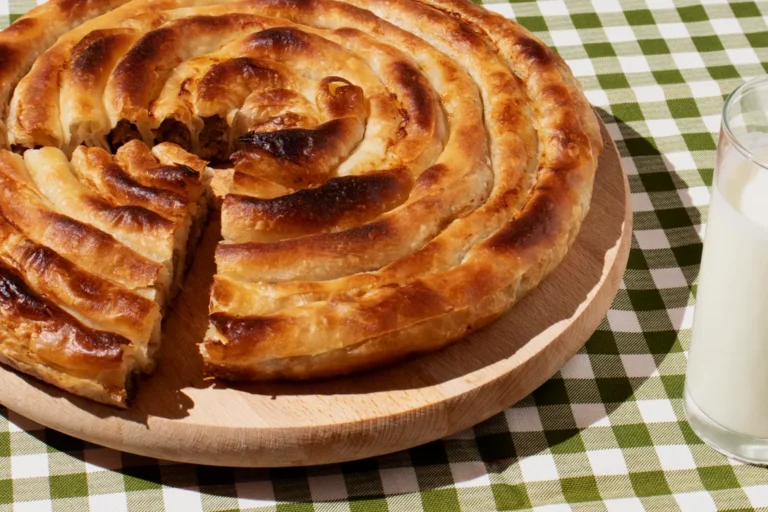
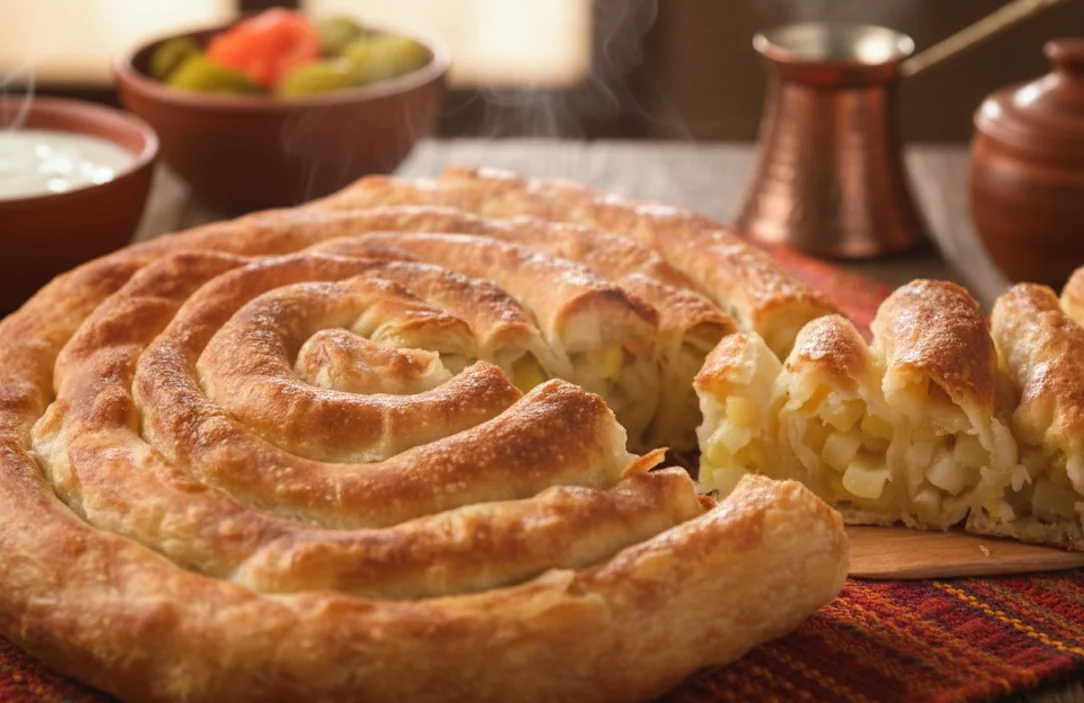
Krompiruša is a Bosnian potato pie made with thin, hand-stretched jufka and a filling of potatoes, onion, sunflower oil, salt, and black pepper. The rolls are arranged in a spiral and baked until golden, with tender potatoes inside. There is no meat or cheese in this version.
The homemade dough starts with flour, water, and salt, then is coated with oil and rested before stretching on a cloth. Each thin sheet becomes two loose rolls, which are laid seam-side down in a round pan. A small hot salted-water-and-oil pour finishes the fully baked pie, followed by a short covered rest that softens the surface slightly.
This recipe keeps that traditional hand-stretched method rather than replacing it with packaged phyllo. The detailed sections after the card explain the dough’s 60% hydration, how much moisture to remove from the potatoes, when to salt the filling, how to roll without making dense layers, and how to check the potatoes before the final pour. A scale is especially helpful for the dough and the peeled potato weight.
Krompiruša (Bosnian Potato Pie)
Ingredients
- 17.6 oz unbleached all-purpose flour not self-rising; weighing recommended
- 1 1/4 cups lukewarm water for the dough
- 1 1/3 tsp fine salt for the dough; US volume assumes fine table salt
- 4 tsp sunflower oil for coating the dough balls after kneading
- 2 1/2 tbsp unbleached all-purpose flour for lightly dusting the cloth; use only as needed from the measured amount
- 2.2 lb medium-starch potatoes peeled weight; yellow potatoes such as Yukon Gold; coarsely grated
- 6.3 oz yellow onion peeled and very finely diced or coarsely grated
- 3 1/3 tbsp sunflower oil for the filling; 1/3 tbsp equals 1 tsp
- 1 2/3 tsp fine salt add immediately before filling; US volume assumes fine table salt
- 1 1/4 tsp freshly ground black pepper US volume approximate; grind size varies
- 4 tsp sunflower oil divide equally between the pan and the top of the assembled pie
- 5/8 cup water for the finishing pour
- 2 tsp sunflower oil for the finishing pour
- 1/3 tsp fine salt for the finishing pour; US volume approximate
Equipment
- Kitchen scale recommended for precise dough hydration, peeled potatoes, salt, and flour
- Large mixing bowl and rolling pin for mixing and initially rolling the dough
- Large clean cotton cloth or tablecloth smooth and lint-free; used for stretching and rolling
- Coarse box grater, strainer, and filling bowl to grate the potatoes and remove freely released liquid
- Round metal baking pan about 12 1/2 inches (32 cm) across for the base recipe. Use comparable separate pans for 2x/3x; do not pile a deeper filling into the same pan.
- Pastry brush and small saucepan for the measured oil and hot finishing liquid
- Wire rack and clean kitchen towel for the final 10-minute rest
Method
- Mix and knead. Mix the dough flour and dough salt in a bowl. Gradually add the lukewarm dough water and mix to form a dough. Knead firmly for 8–10 minutes until smooth, soft, and elastic, without kneading in extra flour. It may be slightly tacky but should not remain a rough, strongly sticky mass.
- Pause and knead again. Cover the dough and let it rest for 5 minutes. Knead again for about 1 minute.
- Coat and rest the dough. For each pan being made, divide its dough into two similar balls. Brush the balls all over with the measured dough-coating oil, dividing the oil evenly. Set apart on a plate or tray, cover so they do not dry out, and rest for 45 minutes at room temperature.
- Prepare the potato filling. Toward the end of the rest, peel and weigh the potatoes, rinse, and dry well. Coarsely grate, then gently squeeze portions by hand to remove only freely released liquid; do not wring completely dry. Mix with the prepared onion, filling oil, and black pepper. Hold back the filling salt until immediately before filling.
- Heat the oven and grease the pan. Preheat a conventional oven to 410°F (210°C). Use half of the pan-and-surface oil to brush the bottom and sides of the pan or pans. Spread a clean cotton cloth on a large table and lightly dust it with part of the measured work-surface flour.
- Begin stretching a sheet. Remove rings, bracelets, and watches. Set a dough ball on the cloth and roll initially to roughly 14–16 inches (35–40 cm) across. Slip the backs of your hands underneath and gently stretch from the center outward. Work gradually around the sheet, keeping the rest of the dough covered.
- Stretch nearly transparent. Continue stretching until the cloth is visible through the dough and the thickness is fairly even. Avoid pulling with fingertips or forcing a resistant patch. Trim only thick edges that will not stretch thin. Small tears are acceptable; do not repeatedly rework the entire sheet.
- Salt and distribute the filling. Immediately before filling, mix the filling salt through the potatoes. Allocate equal filling to each dough sheet. On a stretched sheet, arrange its filling in two even strips along opposite long edges, leaving about 1 inch (3 cm) of dough clear outside the filling.
- Make two loose rolls per sheet. Fold each outer dough edge over its filling. Lift the near side of the cloth to roll that side loosely toward the middle, then repeat from the opposite side. Cut along the clear center to separate the two rolls. Do not compress them tightly.
- Arrange the spiral. Place a roll seam-side down around the outer edge of the pan and continue inward with the next. Cut to manageable lengths if necessary and gently close open ends. Repeat stretching and rolling with the remaining dough and filling. Fill each pan evenly without crowding or making a deeper pile. Brush the top with the remaining pan-and-surface oil.
- Bake in two stages. Bake on a lower-middle rack for 15 minutes at 410°F (210°C). Reduce to 390°F (200°C) and bake for about 25 minutes more, until evenly golden. Check the filling at an inconspicuous point with a thin knife: the potatoes must be completely tender, with no firm or crunchy center. If not, bake in additional 3–5-minute intervals before using the pour.
- Boil the finishing liquid. During the final baking minutes, combine the finishing water, finishing oil, and finishing salt in a small saucepan. Bring to a full boil, then remove from the heat.
- Pour over the baked pie. Carefully remove the fully baked pie from the oven. Slowly distribute the hot finishing liquid over the hot pie, moistening the spaces between the rolls as well as the surface. Take care around steam and splashes. Return to the 390°F (200°C) oven for 3 minutes.
- Rest and portion. Set the pan on a wire rack, loosely cover with a clean kitchen towel, and rest for 10 minutes. Divide the whole pie into the listed servings, cutting portions into smaller pieces if desired. Serve warm; refrigerate leftovers promptly as described in the notes.
Nutrition
Notes
- Exact formula: The dough uses 300 ml water per 500 g flour, approximately 60% hydration. The dough-coating oil is brushed on after kneading, not mixed into the flour. Use unbleached all-purpose wheat flour, not self-rising or gluten-free flour. US weights and volumes are rounded; Metric is the precise reference.
- Oil allocation: Keep the coating, filling, pan-and-top, and finishing oil separate. Split the pan-and-top oil equally between greasing the pan and brushing the pie. One-third of a US tablespoon equals one teaspoon; all oil volumes are rounded US equivalents of the Metric amounts.
- Dough portions and scaling: The base recipe uses two dough balls for one pan; each stretched sheet makes two rolls. For 2x/3x use two/three comparable pans and four/six similar dough balls. Keep thickness and filling depth comparable. Oven space and sequential baking can extend total elapsed time.
- Potatoes: The listed weight is after peeling. Medium-starch yellow potatoes, such as Yukon Gold, are a practical US choice. Drain only freely released liquid; do not squeeze completely dry. Salt immediately before filling. A finely diced variation uses pieces no larger than about 3/16 inch (5 mm); its timing still requires a tenderness check.
- Timing: The 43-minute bake includes 15 minutes at 410°F (210°C), 25 minutes at 390°F (200°C), and 3 minutes after the hot pour. Additional baking may be needed for tender potatoes. Custom rest time includes the initial 5-minute pause, 45-minute oiled-dough rest, and 10-minute final rest. Total is a conservative sum; some preparation can overlap.
- Finishing: Check potato tenderness before adding the hot finishing liquid. The pour moistens an already baked pie; it does not cook a raw center. Pour slowly to avoid splashing hot liquid or oil.
- Serving: Divide the complete pie into the listed number of portions. Cut each portion into smaller pieces if desired rather than relying on a fixed total piece count. Yogurt, ayran, sour cream, and salad are optional accompaniments, not part of the formula or nutrition.
- Storage: Refrigerate portions promptly in shallow containers within 2 hours, or within 1 hour above 90°F (32°C). Keep at 40°F (4°C) or below and use within 2 days. Reheat throughout to 165°F (74°C), in an oven around 350°F (180°C) or carefully in a covered skillet. Freeze portions for about 2 months for quality; thaw in the refrigerator. No personal storage test is claimed.
- Nutrition: Independently calculated from USDA SR Legacy records per one-eighth of the complete pie. Counts all flour, including work-surface flour, and all oil. Oil density is approximated as 0.92 g/ml; the full recipe uses 100 ml, approximately 92 g. Raw white potato with skin is a composition proxy for peeled yellow potatoes. Unused flour, trimmed dough, squeezed potato liquid, and oil left in the pan can lower actual intake. No laboratory analysis or personal kitchen test is claimed.
Krompiruša and the names of Bosnian pita
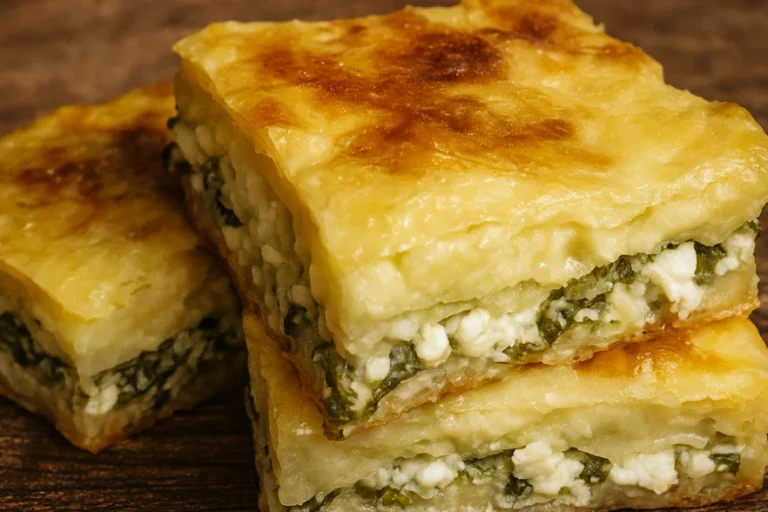
The name comes from krompir, meaning potato. In Bosnian cooking, different pita fillings commonly have their own names: burek has a meat filling, sirnica a cheese filling, zeljanica a greens-and-cheese filling, and krompiruša a potato filling. Using the specific name is more informative than calling every version “burek.”
Shapes and household methods vary. Potato pita may be arranged as a spiral, separate rolls, or another pan layout, and the potatoes may be grated or finely diced. The method here uses a spiral of loosely rolled homemade sheets with coarsely grated potatoes. The filling is intentionally simple; its success depends on dough thickness, moisture, and complete baking rather than additional rich ingredients.
In kljukuša, a separate Bosnian dish, grated potatoes, onion, and flour are mixed directly and baked without a jufka wrapper.
Flour, water, and the texture of the jufka dough
Understand the 60% hydration
The precise dough formula uses 300 ml of water for 500 g of flour. Water weighs approximately one gram per milliliter for this kitchen calculation, giving about 60% hydration. That percentage refers to water relative to flour weight; the oil brushed over the rested balls is separate and does not count as water.
US unbleached all-purpose wheat flour is a practical starting choice for this adaptation of the German Type 550 formula. Brands absorb water differently, so no claim is made that every US flour has identical protein content or handling. Avoid self-rising flour, which adds leavening, and do not assume gluten-free flour can stretch in the same way.
Weighing the flour is more reliable than scooping cups, particularly for a dough whose ability to stretch matters. The US card therefore gives the main flour amount by weight. Keep the measured work-surface flour separate: it lightly dusts the cloth, rather than becoming an extra addition kneaded into the dough.
Knead, pause, then give the oiled dough its full rest
Knead for 8–10 minutes until the dough is smooth, soft, and elastic. A slightly tacky feel is different from a rough mass that sticks heavily to the hands. Do not keep adding flour simply to make the surface dry; that changes the ratio and can leave a stiff dough that resists stretching.
Cover for the initial 5-minute pause, knead again for about a minute, then divide into similar balls. The base pan uses two balls. Coat their entire surfaces with the measured dough oil and cover for 45 minutes at room temperature. The coating helps prevent a dry skin while the rest lets the worked dough relax.
If a rested sheet springs back strongly, do not pull harder at one point. Keep it covered and allow a little more rest before trying again. A crusted surface, insufficient kneading, or inadequate rest can all make stretching more difficult. Extra resting time is an adjustment to handling, not a reason to change the flour-and-water formula without checking the measurements.
Choosing and preparing the potatoes
Weigh them after peeling
The potato amount in the card is the cleaned, peeled weight. Buy a little extra to allow for skins and trimming; the source’s base shopping allowance is roughly 1.1–1.15 kg to obtain 1 kg peeled, but the actual yield depends on the potatoes. The weighed amount after peeling is what determines the filling ratio.
Medium-starch yellow potatoes, such as Yukon Gold, are a practical US choice. They combine enough starch to soften with enough structure to keep the filling from becoming completely mashed. Very floury baking potatoes can produce a drier or more broken-down filling; very watery potatoes require particular attention to draining. This is a variety-based adaptation, not a claim of a personal baking comparison.
Drain freely released water without wringing dry
Rinse the peeled potatoes, dry them well, and coarsely grate near the end of the dough rest. Gently squeeze small handfuls just enough to remove loose liquid. The goal is to prevent water pooling inside the pastry, not to remove every trace of moisture from the potato shreds.
Mix with very finely diced or coarsely grated onion, the filling oil, and black pepper. The onion contributes flavor and moisture. Keep the oil allocation intact rather than trying to correct a completely dry filling with an arbitrary extra amount later.
Salt immediately before filling
Salt draws water from grated potatoes. Leave the filling salt out until you are ready to distribute the potatoes over a stretched sheet, then mix it through evenly. Do not prepare a salted bowl hours ahead and expect the same moisture balance. For several pans, working in manageable portions helps keep the prepared filling from standing unnecessarily.
Finely diced potatoes are a separate variation: keep the pieces no larger than about 3/16 inch (5 mm) and check tenderness carefully. Larger chunks may remain firm after the pastry has browned. The serving photograph illustrates a diced filling; the main written method uses grated potatoes for more even distribution.
Stretching the jufka on a cloth
Use a large, clean, smooth cotton cloth or tablecloth on a table with room to work around it. Lightly dust with some of the measured work flour. Remove rings, bracelets, and watches before handling the sheet; a sharp edge can catch the dough precisely when it is becoming delicate.
Roll one ball initially to about 14–16 inches (35–40 cm) across. Slip the backs of your hands underneath and stretch gently from the center outward, moving around the sheet rather than pulling one spot until it tears. Support the dough over a broad surface and let it settle back onto the cloth as it grows.
The target is a nearly transparent sheet through which the cloth can be seen. “Thin” should not mean a thick center surrounded by fragile edges. Work gradually toward a reasonably even thickness. Tiny tears are usually hidden when the sheet is rolled, so they do not require starting over or repeatedly gathering the dough into a new ball.
Trim only stubbornly thick edges that will not stretch thin. Leaving a heavy rim creates a dense band in the finished roll, but cutting away large amounts of usable dough changes the dough-to-filling balance. Keep the next ball covered until needed so it does not develop a skin while you work.
Two rolls from each sheet and a loose spiral
Allocate the filling evenly among the sheets you are making. On one stretched sheet, place its share in two long, even strips near opposite long edges. Leave about 1 inch (3 cm) of dough outside each strip so the edge can fold over the potatoes. Avoid a few large heaps surrounded by bare stretches of dough.
Fold the near edge over its filling, then lift the cloth to roll that side gently toward the middle. Repeat from the opposite side. The two rolls should meet near the middle with a clear strip where they can be separated by a knife. This makes two rolls from each sheet; it does not mean two rolls for every possible batch size.
Let the cloth help rather than gripping and compressing the rolls with your hands. A tight roll packs thin dough layers into a dense band and can make the filling bake unevenly. The rolls should be secure enough to transfer while retaining a little space within their layers.
Grease the pan with half of the pan-and-surface oil. Lay a roll seam-side down around the outer edge and continue inward with the next, adding the remaining rolls to complete the spiral. Cut a long roll into a manageable section if necessary and gently close an open end. Fill the pan evenly without forcing the rolls into a deep, compressed pile. Brush with the remaining pan-and-surface oil.
Keep the oil groups separate
The Metric base recipe uses 20 ml to coat the dough balls, 50 ml in the potato filling, 20 ml for the pan and top together, and 10 ml in the finishing pour. That is 100 ml in total, not an extra amount to be added at each brushing step. The pan-and-top allocation is split evenly: half for each task.
The ingredient groups prevent the same oil from being counted twice or borrowed from the finishing liquid before that stage. The US volumes are rounded equivalents. For a tablespoon measure shown in thirds, one-third of a US tablespoon equals one teaspoon; the exact Metric quantities remain the reference for the formula and calculation.
Two-stage baking and a real potato-tenderness check
Use a preheated conventional oven at 410°F (210°C), with the pan on a lower-middle rack. Bake for 15 minutes, then reduce to 390°F (200°C) and continue for about 25 minutes. The US temperatures are close practical equivalents, not an untested convection conversion.
The top should be evenly golden, but color alone does not establish that the raw potato filling has cooked. At an inconspicuous point, use a thin knife to check the filling inside a roll. The potatoes should offer no firm or crunchy resistance. Check a thicker area rather than only a thin end.
If the potatoes are still firm, continue baking in 3–5-minute intervals before using the pour. Actual time depends on the oven, roll thickness, potato cut, moisture, and how tightly the pan was packed. Do not rely on the final liquid to finish cooking a raw center.
The hot finishing pour and the final rest
During the last baking minutes, combine the finishing water, finishing oil, and finishing salt in a small saucepan and bring to a full boil. Remove from the heat. Once the pie is golden and its potatoes are completely tender, carefully take the pan from the oven.
Distribute the hot liquid slowly over the hot pie, moistening the spaces between rolls as well as the surface. Be careful around steam, splashes, and hot oil. Return to the 390°F (200°C) oven for 3 minutes, then place the pan on a rack and loosely cover with a clean kitchen towel for 10 minutes.
The pour and rest soften the surface slightly while the filling remains moist. They are finishing stages, not substitutes for proper baking. A loosely covered rest also differs from sealing a steaming pie tightly for a long time, which can make the pastry wetter than intended.
Timing, pan size, and larger batches
The base recipe uses a round pan about 12½ inches (32 cm) across. For a doubled or tripled recipe, use two or three comparable pans and keep the roll thickness and filling depth similar. Do not pack all the scaled filling into the original pan or expect a much deeper pie to bake on the same schedule.
Each base pan uses two dough balls, and each sheet makes two rolls. Maintaining that per-pan relationship produces similar sheets for 1x, 2x, or 3x. A larger batch also needs more table space, assembly time, oven space, or sequential baking; the ingredient controls cannot provide those automatically.
The displayed times include 50 minutes of active preparation, 43 minutes of baking including the 3-minute return after the pour, and 60 minutes of rests: 5 minutes initially, 45 minutes for the coated dough, and 10 minutes after baking. The conservative total is 2 hours 33 minutes. Some preparation can overlap the long dough rest, while unfamiliar stretching or additional potato cooking can extend the time. No personally timed kitchen trial is claimed.
Troubleshooting the dough and filling
The dough tears or springs back
Check the flour and water weights, kneading, coverage, and full rest before changing the recipe. Stretch with broad support from the backs of the hands, not sharp fingertips. If it is simply resisting, let it relax under cover a little longer; repeatedly forcing a small patch usually makes the sheet less even.
The center is heavy or the pastry seems doughy
Look for thick edges, a thick central sheet, tightly compressed rolls, or too much filling piled into one area. These problems cannot always be solved by browning the top harder. Thin sheets, even filling strips, loose rolling, and suitable pan capacity need to be established before baking.
The filling is watery or the bottom is soggy
Dry washed potatoes before grating, remove freely released liquid gently, and salt close to filling time. Do not let a salted filling stand unnecessarily. Check that the potatoes and pie are fully baked before adding the finishing liquid, and use that measured liquid rather than an extra unmeasured splash.
The pie is too dry or the potatoes stay firm
Over-squeezing, omitting part of the oil, very dry potatoes, and excessive baking can reduce moisture. Firm potato pieces may instead be too large or buried in a dense roll. Check tenderness before the pour and extend baking as needed. Keep the final covered rest, but do not treat it as a way to cook raw potatoes.
Serving, leftovers, and nutrition
Serve warm, divided into eight equal portions for the base recipe; smaller cut pieces can be grouped into a portion. Plain yogurt, ayran, sour cream, or a simple salad are traditional-style accompaniments. The potato filling is substantial, so a heavy additional side is unnecessary. These accompaniments are not included in the recipe’s nutrition.
Refrigerate leftover portions promptly in shallow containers within 2 hours, or within 1 hour above 90°F (32°C). Keep at 40°F (4°C) or below and use within 2 days. Do not leave a whole deep pan on the counter until completely cold before refrigerating it.
Reheat in an oven around 350°F (180°C), checking that the center reaches 165°F (74°C). A covered skillet can work for individual portions if they heat through without scorching the bottom. A microwave is convenient but usually makes the pastry softer. Freeze portions for about 2 months for quality and thaw in the refrigerator; this is not a claim of personal freezer testing.
The independent nutrition estimate divides the full recipe by eight. It counts all the work-surface flour and all the oil, with oil density approximated at 0.92 g/ml. USDA raw white potato with skin is used as a composition proxy for peeled yellow potatoes. Flour left on the cloth, trimmed dough, squeezed liquid, or oil left in the pan can reduce actual intake. The figures are estimates rather than laboratory measurements.
Frequently asked questions
Can I use packaged phyllo?
It can be used in a different potato-pie preparation, but it is not an automatic substitute for these hand-stretched sheets. Sheet count, oil distribution, and handling would need their own instructions. The main recipe deliberately keeps homemade jufka.
Can I use diced potatoes instead of grated?
Yes, as the stated variation, with pieces no larger than about 3/16 inch (5 mm). They still need to be completely tender before the hot pour. The photograph shows a diced-potato version.
Does the hot water cook the filling?
No. The potatoes must already be tender and the pie golden. The measured hot pour provides the finishing moisture before a brief return to the oven and the covered rest.
Is there meat or cheese in Krompiruša?
Not in this potato-and-onion version. Those fillings belong to other named Bosnian pita preparations and are not missing ingredients here.