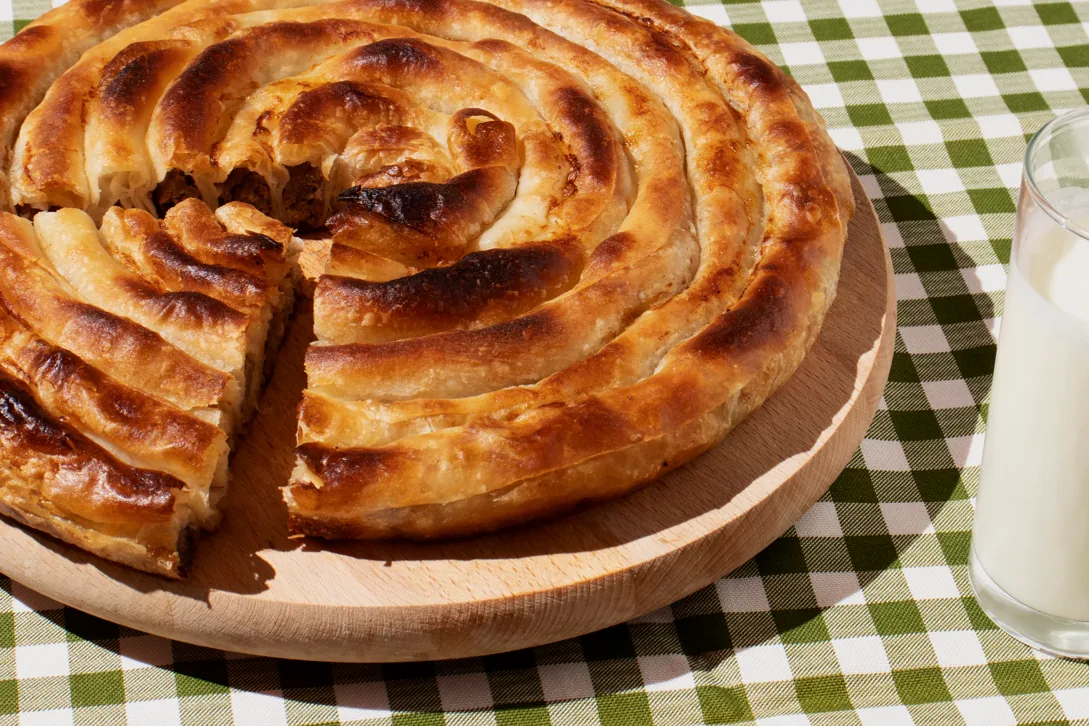
Bosnian Burek Recipe – Beef-Filled Spiral Pie
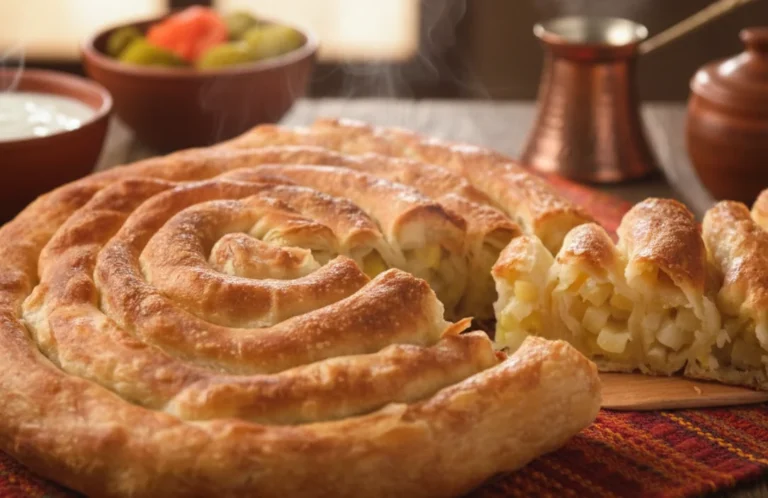
Bosnian burek is a savory meat pie made with paper-thin jufka wrapped around a juicy beef-and-onion filling. The rolls form a loose spiral that bakes until the surface is deeply golden and the bottom is crisp. A glass of plain yogurt is a simple accompaniment to the rich pastry.
This from-scratch recipe uses flour, water, salt, and sunflower oil for the dough. The filling goes into the pastry raw, so the beef and finely diced onion cook together inside the rolls. The seasoning stays focused on salt and black pepper, with no extra spice mixture needed.
Allow about 2 hours and 50 minutes, including the dough rests and a short rest after baking. Hand-stretching takes practice, and a first attempt may take longer. Read through the shaping steps, clear a large table, and keep the filling refrigerated while the dough relaxes.
Bosnian Burek
Ingredients
- 17 2/3 oz all-purpose flour unbleached; for the dough
- 1 2/3 tsp fine salt for the dough
- 1 1/4 cups lukewarm water for the dough
- 3 1/4 tsp sunflower oil for kneading into the dough
- 2 1/4 tsp sunflower oil for coating the dough balls
- 1 1/3 lb ground beef about 20% fat; for the filling
- 10 1/2 oz onions very finely diced; for the filling
- 2 tsp fine salt for the filling
- 1 1/3 tsp ground black pepper for the filling
- 10 tsp cold water for the filling
- 1 1/8 tsp sunflower oil for greasing the pan
- 1 3/4 oz sunflower oil for stretching, drizzling, and brushing
Equipment
- Kitchen scale Recommended for flour, oil, and salt.
- Mixing bowls Keep the raw beef filling covered and refrigerated.
- Bench scraper For dividing the dough and trimming thick edges.
- Cotton tablecloth Clean and large enough to stretch the jufka.
- Rolling Pin For the first rolling stage.
- Round metal baking pan About 12½–13 inches (32 cm) across. Use more pans at larger scales, keeping the same pie depth.
- Pastry brush For the oil coating.
- Food thermometer Check the filling in thick sections, without touching the pan.
Method
- Mix and knead the dough. Combine the flour and dough salt. Gradually add the lukewarm dough water, then knead for 8–10 minutes. After about 5 minutes, work in the oil listed for kneading. The dough should become soft, smooth, and elastic.
- Divide and rest. Divide into balls weighing about 14½ oz (410–415 g) each, keeping the same ball size when scaling. Coat with the oil listed for coating, cover, and rest at room temperature for 45 minutes.
- Mix the cold filling. Finely dice the onions to about ⅛ inch (2–3 mm). Gently mix with the raw ground beef, filling salt, pepper, and cold filling water just until combined. Do not knead it into a paste. Cover and refrigerate at 40°F (4°C) or colder until shaping. Clean hands, utensils, and surfaces after handling raw beef.
- Roll and relax again. On a clean cotton-covered table, roll each ball into a round about 12 inches (30 cm) across. Lightly oil the rounds using a little of the stretching oil, cover, and rest for 15 minutes. Preheat the oven to 390°F (200°C), conventional heat, or 355°F (180°C) with convection. Grease shallow metal pans with the pan oil.
- Stretch the jufka. Work with one round at a time, keeping the others covered. Slide the backs of your hands under the dough and stretch gently from the center outward until almost transparent and about 35–39 inches (90–100 cm) across. Trim the thick outer rim. Small edge tears are manageable; avoid large holes where the filling will sit.
- Fill and roll loosely. Reserve about one fifth of the stretching-and-brushing oil for the final surface. Distribute the remainder across the stretched sheets, including the oil already used on the rounds. Divide the chilled filling evenly among the dough pieces, placing a loose, narrow line along one side of each sheet. Leave about 2 inches (5 cm) clear at each end. Fold in the ends, then lift the cloth to roll the dough loosely around the filling.
- Coil without crowding. Loosely coil the first roll in the center of a greased round metal pan about 12½–13 inches (32 cm) across. Arrange another roll around it without compressing the pastry. At larger recipe scales, use additional pans and repeat; do not build a deeper pie. Brush with the reserved surface oil.
- Bake and check the center. Bake on a lower-middle rack for about 40–45 minutes, checking the browning after 30 minutes. If needed, shield the top loosely with foil. Check the beef filling in thick sections with a thermometer: it must reach at least 160°F (71°C). Continue baking if the filling is not hot enough or the bottom remains pale; allow an extra 5–10 minutes as needed.
- Rest and serve. Rest in the pan for 10 minutes, then cut into portions and serve warm. Leave uncovered during the short rest to keep the crust crisper. Yogurt is a customary accompaniment.
- Chill leftovers promptly. Divide leftovers into shallow portions and refrigerate within 2 hours, or within 1 hour above 90°F (32°C). Keep at 40°F (4°C) or colder and use within 2–3 days. Reheat in a 340°F (170°C) oven until the center reaches 165°F (74°C). For longer storage, freeze promptly chilled portions and thaw in the refrigerator before reheating.
Nutrition
Notes
- Dough: This formula uses homemade, hand-stretched jufka. Packaged phyllo or yufka needs a separately adjusted method and oil allowance.
- US ingredients: Unbleached all-purpose flour is a practical starting point for German Type 550; absorption varies. Use 80/20 ground beef. US measures are rounded, so select Metric and use a scale for the source formula.
- Balance: The source uses 60% dough hydration, with beef at 120% and onion at 60% of flour weight. Keep the filling loose and distribute it evenly; do not pack thick lumps into the rolls.
- Resting: The custom time includes a 45-minute dough-ball rest, 15-minute rest after rolling, and 10-minute rest after baking. Preparation and baking times are estimates; first-time stretching and additional pans may take longer.
- Scaling: Keep dough balls and pan depth the same size. Add pans and bake in batches rather than making a thicker coil. Keep the unused beef filling refrigerated while working on each sheet.
- Doneness: The raw filling must reach at least 160°F (71°C) in thick sections. A browned crust alone does not confirm the center is cooked.
- Nutrition: Approximate per serving, calculated from the source metric ingredients. Trimmed dough, fat left in the pan, and the actual portion size vary. Yogurt served alongside is excluded.
What Makes This Bosnian Burek?
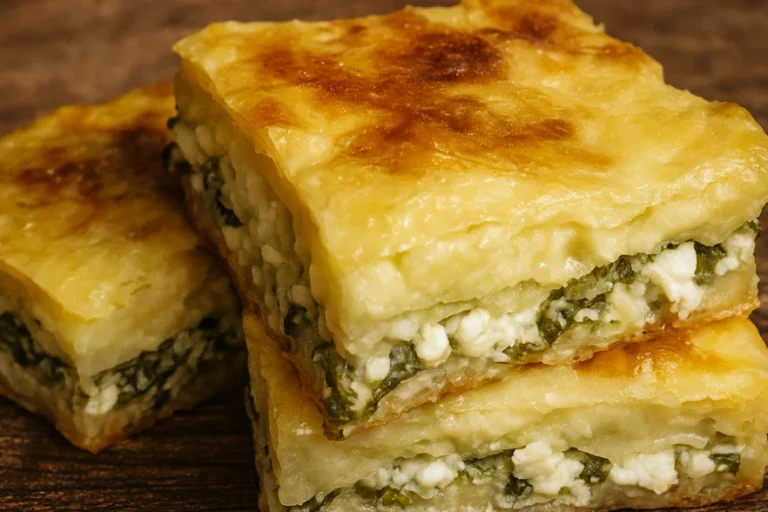
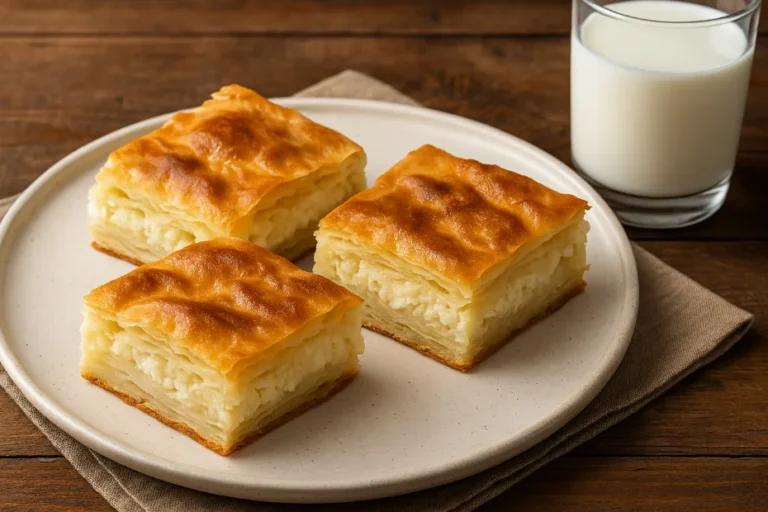
In Bosnian usage, burek is the meat-filled member of the pita family. Cheese-filled pita is called sirnica, while potato and spinach versions have their own names. Spinach-and-cheese pita is called zeljanica. The naming matters here because this recipe follows the beef-filled preparation rather than using “burek” as a general name for every filled pastry.
The dough is rolled briefly, rested, and then stretched by hand until nearly transparent. A cloth helps roll it around the filling without squeezing out the juices. Homemade jufka is central to this particular formula.
Flour, Water, and the Dough-to-Filling Balance
Unbleached US all-purpose flour is a practical starting point for hand-stretched jufka, although flour brands absorb water differently. Weigh the flour rather than packing it into measuring cups. For the closest match to the intended dough texture, use the Metric setting and the specified gram and milliliter amounts; US measures are rounded for convenience.
The dough has 60% water relative to the flour weight. Beef weighs 120% of the flour weight and onion 60%. These proportions give enough filling for a substantial pie without turning the rolls into thick, dense logs. The oil quantities have separate jobs: kneading, coating the dough, greasing the pan, and lubricating the thin sheets.
Build Elastic Dough, Then Let It Relax
What the dough should feel like
Kneading gives the dough the strength to hold together as it is stretched. After the full 8–10 minutes, look for a smooth surface and a soft, elastic feel rather than a rough ball that splits when pulled. Work in the kneading oil at the stage specified in the card. Avoid repeatedly dusting in flour just to make handling easier: a much firmer dough is harder to stretch into a thin sheet.
Flour absorption varies, so judge the dough after kneading, not immediately after the water goes in. The weighed Metric quantities are the reference formula. The dough should be supple without sticking heavily to your hands; the aim is neither a dry, stiff ball nor a wet batter.
Why both rests matter
The first 45-minute rest lets the kneaded dough relax before rolling. Coat the balls with their allotted oil and cover them so the surface does not dry into a skin. Keep the remaining balls covered while you work. A dry surface cannot stretch as evenly as the soft dough underneath.
Rolling the balls into roughly 12-inch (30 cm) rounds tightens them again, which is why the second, 15-minute rest comes before hand-stretching. If a round springs back strongly, cover it and give it a little more time rather than pulling harder. The listed rests are a starting point; extra relaxation may extend the preparation time. Keep the meat filling in the refrigerator during any delay.
Stretch Paper-Thin Jufka Without Tearing It
Set up the table and support the sheet
Spread a clean, smooth cotton tablecloth over a large table and clear enough space to work around the dough. Remove rings and keep fingernails away from the sheet. Slide the backs of your hands under the rested round and ease it outward from the center in small sections. Supporting a broad area spreads the pull; gripping one thin spot with fingertips concentrates it and can make a hole.
Move around the sheet rather than pulling one side to its final size immediately. Once a section is thin, work on a thicker neighboring section. Let the sheet settle onto the cloth between stretches. Use the oil already assigned to stretching, drizzling, and brushing; these stages share that allowance rather than each receiving an extra quantity.
How thin is thin enough?
Aim for an almost transparent sheet through which the cloth is visible, roughly 35–39 inches (90–100 cm) across for each dough ball of the size specified in the card. Even thinness matters more than a perfect circle or an exact diameter. Opaque, heavy patches will bake differently from the delicate surrounding dough, so ease those areas outward gently before filling.
A few small tears near the edge do not ruin the sheet. Stop pulling at a tear and work elsewhere so it does not spread. Avoid placing filling directly over a large opening. If the whole sheet keeps resisting and tearing, pause and cover it; more force will not make tight dough more extensible.
Remove the thick outer rim
The edge often stays thicker even when the middle is translucent. Trim that dense rim with a bench scraper or knife before adding the filling. Leaving it in place rolls a thick cord of dough into the pie, where it can remain chewy. Trim the rim only; there is no need to cut away sound thin dough to make the sheet perfectly round.
Keep the Beef Filling Loose and Cold
US 80/20 ground beef is a practical choice for this filling. Very lean meat can produce a drier result. Dice the onions finely enough that they distribute evenly without puncturing the delicate jufka.
Mix only until the ingredients are combined. Thorough kneading is useful for some meat preparations, but here it makes a denser filling. Keep the mixture refrigerated and take out only what you need for the sheet you are filling. Wash hands and equipment after contact with raw beef.
Roll the Filling with the Tablecloth
Distribute the cold filling in a narrow, loose line along one side of each sheet, dividing it evenly among the dough pieces. Avoid thick clumps: they make the roll harder to handle and the center slower to cook. Leave about 2 inches (5 cm) clear at both ends and fold those ends inward to help contain the filling.
Lift the near edge of the cloth gradually so the pastry turns over the filling. Continue lifting and advancing the cloth to roll the sheet into a long rope. Let the cloth carry the fragile pastry instead of pulling the dough with your fingers. Keep the roll loose enough to preserve the thin layers; squeezing it into a tight log can force juices through weak spots.
Coil Gently and Bake Through
Arrange a shallow, loose spiral
Use a shallow round metal pan and leave the filled rolls loose enough to expand. When scaling the recipe, use additional pans with the same depth. Packing all the extra pastry into one deep coil changes how the center and underside bake.
Check the crust, underside, and meat separately
Preheat the oven fully and use the lower-middle rack so the base has time to bake as the top colors. Start checking the surface after about 30 minutes. It should become evenly golden to deep golden, with distinct crisp layers rather than a pale, soft surface. A shallow metal pan is a practical choice for browning the base.
Carefully lift an accessible edge with a spatula to inspect the underside without damaging the coil. A pale, damp-looking base needs more baking even if the top looks ready. Shield a rapidly browning top loosely with foil and continue baking as directed. Do not pour on extra water or cover the hot pie tightly if you want to keep the crust crisp.
Look for a browned surface and cooked underside, then check thick sections of the filling with a thermometer. The US ground-beef endpoint is at least 160°F (71°C); crust color alone does not establish doneness. Allow extra baking time if necessary, shielding the top loosely with foil when it browns ahead of the center.
Serving and Leftovers
Rest the baked burek uncovered for ten minutes before cutting. It is crispest soon after this rest; a tight cover traps steam and softens the crust.
Refrigerate leftover portions promptly in shallow containers and use within 2–3 days. Reheat in the oven until the center reaches 165°F (74°C). For longer storage, freeze chilled portions airtight and thaw them in the refrigerator before reheating.
Frequently Asked Questions
Can I substitute packaged phyllo directly?
This formula is designed for hand-stretched dough. Packaged sheets need different handling and an adjusted oil allowance; they are not a direct swap within these instructions.
Should I brown the beef first?
No. This version uses raw filling, which cooks inside the rolls. Keep it cold during preparation and verify the finished internal temperature.
Why does my dough tear?
It may need more resting, gentler stretching, or a different flour adjustment. Work gradually and keep unused dough covered.
Can I make a larger batch in one pan?
Use additional pans of similar size and depth. Making one much thicker pie can leave the middle or bottom underdone.