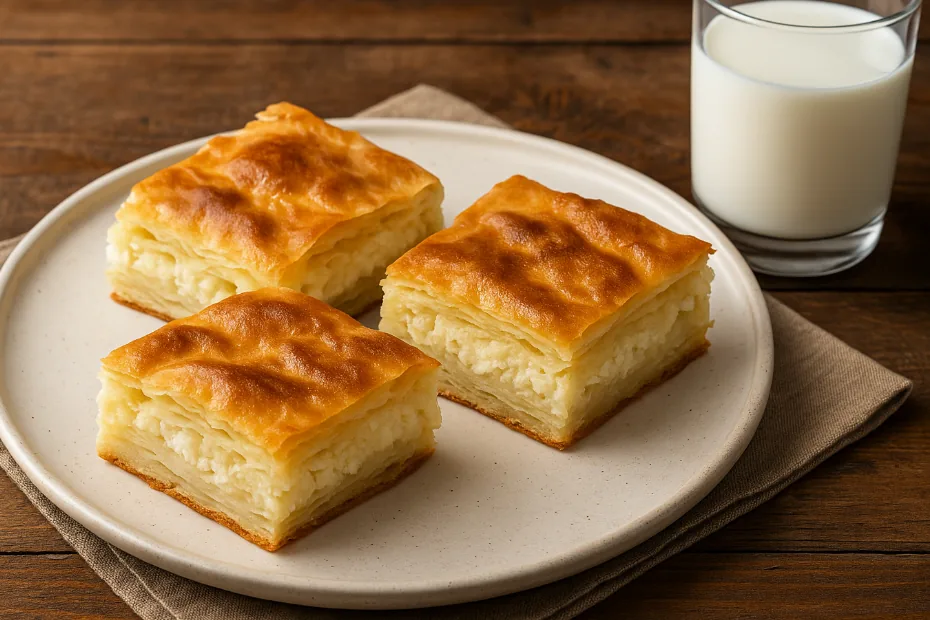
Sirnica Recipe – Bosnian Cheese Pie
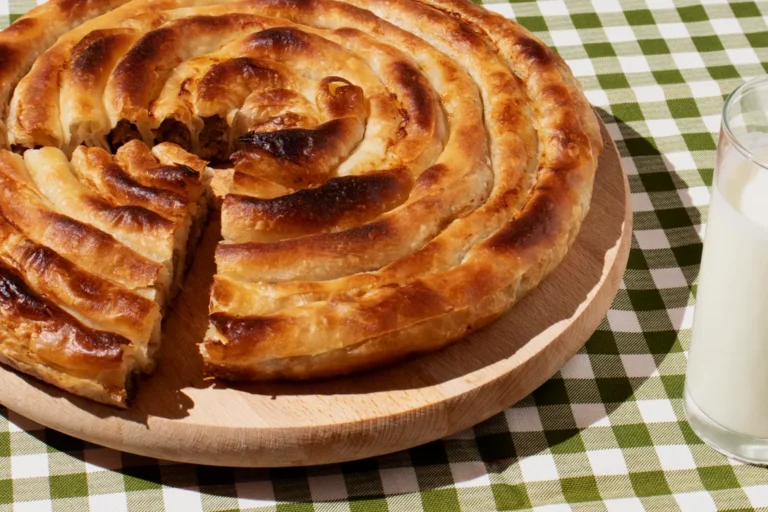
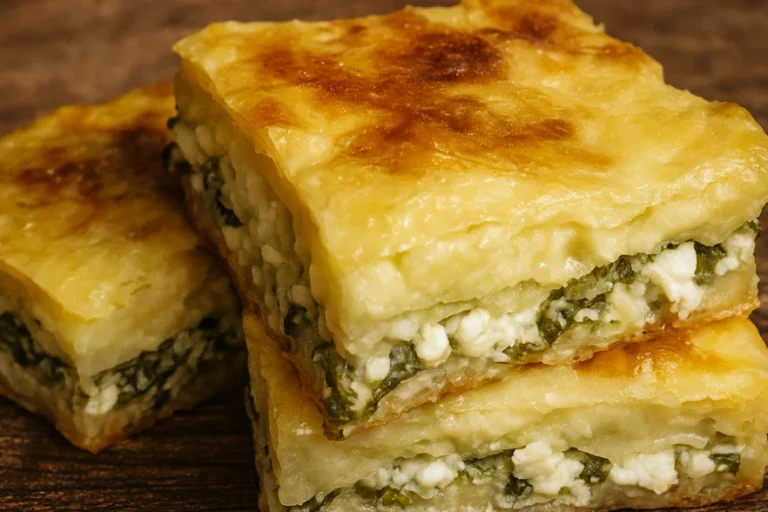
Sirnica is Bosnian cheese pita: thin pastry wrapped around a creamy white-cheese filling and baked until golden. It belongs to the same family of savory pies as meat-filled burek, but in Bosnian usage the cheese version has its own name. A warm slice with plain yogurt makes a satisfying lunch, breakfast, or simple supper.
Traditional sirnica is made with hand-stretched jufka. This version uses ready-made phyllo or thin Balkan pita yufka filled with white brined cheese, yogurt, and eggs. The filling stays mild and moist, while a light oil-and-sparkling-water brushing helps separate the layers. It is a convenient approach with a different pastry texture from freshly stretched dough.
The main decisions happen before assembly: choose a creamy cheese, drain it well, thaw the pastry properly, and check its sheet size and thickness. US phyllo can be much thinner than Balkan pita sheets, so work by weight as well as sheet count. The recipe takes about 95 minutes once the sheets are thawed; allow the package’s full thawing time separately.
Sirnica – Bosnian Cheese Pie
Ingredients
- 14 oz white brined cheese pasteurized; drained weight; mild Balkan-style cheese or feta in brine
- 7 oz plain whole-milk yogurt unstrained; about 3.5% milkfat
- 2 large eggs about 50 g each without shells
- 1/3 tsp fine salt optional; use less or omit with salty cheese
- 17 2/3 oz phyllo dough thawed according to package; or thin Balkan pita yufka
- 14 tsp sunflower oil divided between the pan and brushing
- 20 tsp sparkling water divided between brushing and finishing
Equipment
- Kitchen scale For drained cheese and pastry; sheet counts vary by brand.
- Mixing bowls One for the filling and a small bowl for the brushing mixture.
- Fork or Whisk For mashing the cheese and mixing the filling.
- Pastry brush Use a light touch to avoid tearing the sheets.
- Round metal baking pan 13-inch (32 cm) diameter; use additional pans when scaling.
- Parchment Paper or Plastic Wrap For covering unused pastry; use parchment, never plastic, over the hot baked pie.
- Clean Kitchen Towel Barely damp over unused sheets; dry for covering the baked pie.
- Food thermometer Check the center of the cheese-and-egg filling.
- Sharp knife For cutting the rested pie.
Method
- Thaw and plan ahead. Thaw the closed phyllo package exactly as directed by its manufacturer, allowing any required refrigerator thaw and room-temperature tempering before assembly. The listed preparation time starts with pliable, thawed sheets; package thawing is additional. Keep the cheese, yogurt, and eggs refrigerated until needed.
- Make the cheese filling. Drain and weigh the cheese, then mash it with a fork. Taste the cheese before adding the raw eggs; add the optional salt only if needed. Stir in the yogurt and eggs until thick, creamy, and spreadable, not watery. Refrigerate the filling while arranging the pastry. Do not taste it after adding raw eggs.
- Heat the oven and mix the brush-on liquid. Heat a conventional oven to 390°F (200°C), with a rack in the lower-middle position. Use about one-seventh of the oil to lightly grease a 13-inch (32 cm) round metal pan, adding more pans when scaling. Whisk the remaining oil with four-fifths of the sparkling water; reserve the remaining water for after baking. Rewhisk before each brushing.
- Cover and portion the pastry. Open the pastry only when ready to work. Cover unused sheets with parchment or plastic wrap and a barely damp towel on top; keep the damp towel from touching the dough. Plan roughly 3 ounces (83 g) pastry per roll and six rolls per 13-inch (32 cm) pan. Divide the filling evenly among the planned rolls. Sheet counts vary: thicker Balkan sheets may need a pair per roll, while very thin US phyllo may need several sheets to reach the same weight.
- Layer and fill each roll. Lay out the sheets for one roll, brushing each very lightly with the oil-water mixture before adding the next. Keep enough mixture for the remaining rolls and the top. Spread a portion of filling in a 2-inch (5 cm) strip along one long edge, leaving about 3/4 inch (2 cm) bare at each end. Fold the ends inward and roll loosely from the filled edge.
- Form a loose spiral. Coil the first roll gently in the middle of the greased pan. Wrap the next rolls around it, continuing the spiral without packing them tightly. Leave a little expansion space between rolls. Keep the pie at the same depth when scaling and use additional pans. Brush the top lightly with the remaining oil-water mixture.
- Bake until golden and set. Bake for 35–40 minutes, checking from 30 minutes, until the top and edges are golden and the inner pastry is cooked. Check the cheese-and-egg filling in several central spots with a food thermometer; it must reach at least 160°F (71°C). If the surface colors before the center is ready, shield it loosely with foil and continue baking, checking every 5 minutes. Color alone does not confirm doneness.
- Sprinkle lightly and rest. Remove the baked pie from the oven and sprinkle the reserved sparkling water evenly over the surface without pooling. Cover first with parchment, then with a clean kitchen towel, keeping both away from heat and flames. Rest for 20 minutes for a softer crust. For a crisper top, uncover after 5 minutes and finish the remaining rest uncovered.
- Cut and serve warm. Cut along the rolls or into portions and serve warm, with plain yogurt or a simple salad if desired. The filling should be set and moist, with distinct pastry layers.
- Refrigerate leftovers promptly. Cut leftovers into portions and refrigerate in shallow containers within 2 hours of cooking, or within 1 hour if the room is above 90°F (32°C). Keep at 40°F (4°C) or colder and use within 2 days. Do not wait for the whole pie to cool completely on the counter. Reheat in a 355°F (180°C) oven until the center reaches 165°F (74°C); allow about 10–20 minutes for chilled portions, checking rather than relying on time alone.
Nutrition
Notes
- Version: This card follows BalkanKueche’s ready-made-sheet method. Traditional hand-stretched jufka requires a separate dough formula and is not a direct substitute.
- Pastry: Weigh the sheets rather than assuming a fixed count. The source uses thicker large sheets; very thin US phyllo needs more layers per roll. The US sheet adaptation has not been kitchen-tested across brands.
- Cheese: Use drained, pasteurized white brined cheese. Feta in brine is a practical alternative, but salt and moisture vary; avoid dry precrumbled cheese. Taste before adding eggs and omit extra salt when unnecessary.
- Measurements: Metric weights preserve the source ratios. US ounces are rounded; a fine-salt teaspoon is estimated at 6 g. Oil and water use 5 ml teaspoons. Use plain unstrained whole-milk yogurt.
- Timing: The 95-minute total includes a 20-minute baked-pie rest but excludes package-specific thawing and tempering. Oven time is an estimate; check the center rather than relying on browning alone.
- Scaling: Use additional pans with similar roll size and pie depth. Ingredient amounts scale; oven time does not multiply. Keep unused filling refrigerated.
- Nutrition: Approximate per serving, calculated from source metric inputs using generic feta, plain whole-milk yogurt, eggs, phyllo, 64.4 g oil (about 70 ml), and the full optional salt allowance. Cheese and pastry brands change the result, especially sodium. Serving accompaniments are excluded.
Sirnica and the Bosnian Pita Tradition
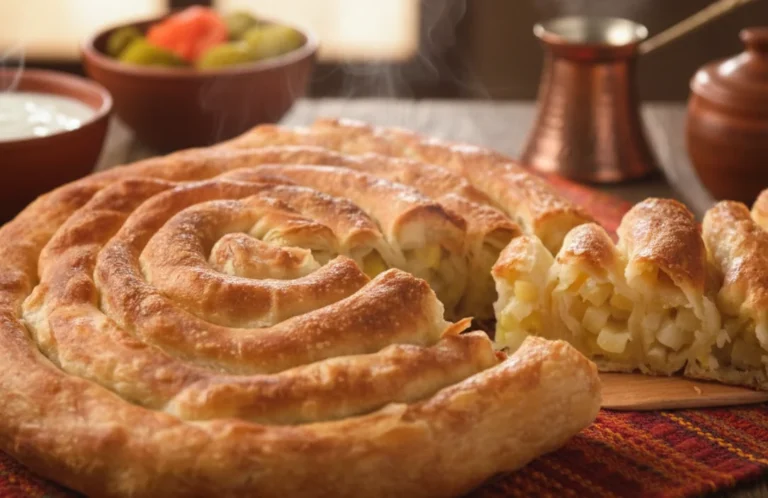
In Bosnia, burek means the meat-filled pie, while sirnica is filled with cheese. Spinach-and-cheese pita is zeljanica, and potato pita is krompiruša. These names describe the fillings within a shared pastry tradition. Calling this dish sirnica keeps that distinction clear, even though “cheese burek” is used elsewhere.
Rolling the filled sheets into long ropes and arranging them as a loose spiral gives each portion a balance of pastry and filling. Avoid squeezing the rolls or forcing them into a small pan. The inner layers need room to expand and bake through.
Choosing Cheese and Yogurt in the US
Look for a pasteurized white brined cheese at a Balkan, Mediterranean, or Middle Eastern market. Choose a creamy, relatively mild block and weigh it after draining. Feta sold in brine is an accessible alternative, but its tang, salt, and firmness vary. Dry precrumbled feta can produce a firmer filling and is a less suitable first choice.
Use plain, unstrained whole-milk yogurt, ideally around 3.5% milk fat. Greek yogurt is thicker and is not a direct equivalent here. Taste the cheese before adding the eggs, then decide whether any extra salt is needed. Once raw eggs are mixed in, stop tasting the filling. It should hold a soft strip on the pastry rather than release a puddle of liquid.
Read the filling before rolling
The filling should be thick and creamy enough to sit in a soft strip, with small cheese pieces held together by yogurt and egg. It should neither crumble into dry granules nor spread into a watery puddle. Drain the brined cheese before weighing the specified amount, and pour off any loose whey sitting on top of the yogurt before measuring it. Keep the filling refrigerated while preparing the sheets.
A dry, strongly salted feta can make a firm, sharply flavored filling even when the quantities are correct. Choose a milder, moister block in brine for this formula and crumble it finely enough to distribute evenly. Use the full measured yogurt rather than adding extra oil to the filling; the oil belongs to the brushing allowance. Greek yogurt, cream cheese, and dry precrumbled feta change the texture and are not direct equivalents.
If the mixture looks watery, check whether undrained brine or unusually thin yogurt was included. Do not pour loose liquid onto the sheets or try to absorb it with extra pastry scraps. Correct the ingredient preparation before assembling rather than inventing an unmeasured flour or breadcrumb binder. Conversely, extra unmeasured yogurt can turn a dry-looking filling runny. A suitable cheese and the weighed formula are the starting point for a repeatable result.
Balancing the Sheets and Filling
This recipe uses 500 g pastry, 400 g cheese, 200 g yogurt, and two eggs. That is roughly 700 g filling before optional salt, or 1.4 times the pastry weight. Changing the cheese’s moisture or using only part of the pastry changes that balance. Metric weights are the most reliable guide; the ounce amounts are practical rounded equivalents.
Roughly twelve substantial Balkan pita sheets can be paired into six rolls. A US box of tissue-thin phyllo can contain many more sheets for the same weight. Divide the weighed pastry into roughly 83 g bundles for each roll, using several thin sheets where needed, and divide the filling evenly among those bundles. Because US phyllo varies in thickness and size, use the pastry weight as your guide and check that the rolls remain pliable and fit loosely in the pan.
Keeping Phyllo Flexible
Follow the package’s thawing instructions and keep it closed until the sheets are pliable. Cover the open stack with parchment or plastic wrap, then a barely damp towel. The towel should never touch the sheets directly. Uncover only what you need, and brush gently from the edges inward.
Oil and sparkling water separate quickly, so whisk again before brushing. Use a light coating, not enough to soak the dough. Small tears can be tucked inside a roll. Puff pastry has a different structure and is not a substitute for phyllo or pita yufka in this method.
Baking, Resting, and Serving
A metal pan helps the base bake. Start checking before the estimated baking time is up: the edges should be golden, the pastry cooked through, and the cheese-and-egg filling set. Check several central spots with a thermometer for at least 160°F (71°C). If the top browns early, shield it loosely with foil while the center finishes.
A light sprinkle of the reserved water and a covered rest soften the top. For a crisper finish, remove the covering after five minutes and complete the rest uncovered. Serve warm with plain yogurt, ayran, or salad.
Check the underside as well as the top
Preheat the oven fully and use the lower-middle rack specified in the card. Loosely arranged rolls let the inner pastry bake; packing them into a tight, deep coil can leave damp layers beneath an attractive browned top. Carefully lift an accessible outer edge with a spatula to inspect the base. It should be set and browned rather than pale and wet. A browned top alone does not establish that the egg filling is cooked.
If the top colors before the base and center are ready, shield it loosely with foil and continue baking, checking the filling temperature separately. Oven and pan differences can change the finish time. Apply the reserved finishing water as a fine, even sprinkle, not a pool in the middle; excess water can undo the crisp base. A short covered rest softens the upper layers, while leaving the pie covered longer traps more steam.
Storing and Reheating Sirnica
Portion leftovers into shallow containers and refrigerate within two hours, or one hour above 90°F (32°C). Do not leave the entire pie on the counter until completely cold. Store at 40°F (4°C) or colder and use within two days. Reheat portions in a 355°F (180°C) oven until the center reaches 165°F (74°C); thickness and starting temperature affect the time. The oven preserves the pastry better than the microwave.
Sirnica FAQ
Can I use homemade jufka?
Traditionally, yes, but this card is written for ready-made sheets. Freshly stretched dough has different handling and brushing needs. A homemade-dough version needs its own quantities and resting instructions rather than a direct sheet-for-sheet swap.
Why is the filling watery?
Undrained brined cheese or unusually thin yogurt can add too much liquid. Drain the cheese before weighing it, use plain unstrained yogurt, and keep the filling thick and spreadable. Do not pour loose whey over the pastry.
Can I double or triple the recipe?
Scale the ingredient quantities and use more pans, keeping the rolls and pie depth similar. Baking time does not multiply with the ingredients. If pans share the oven, check each one separately for even browning and filling temperature.
Does sparkling water make the pastry rise?
This is not a yeast dough. The brushing mixture moistens the sheets, and the final sprinkle softens the baked surface. Do not expect carbonated water to replace proper layering, loose shaping, or a fully heated oven.