Balkan Potato Moussaka Recipe – Musaka with Ground Beef
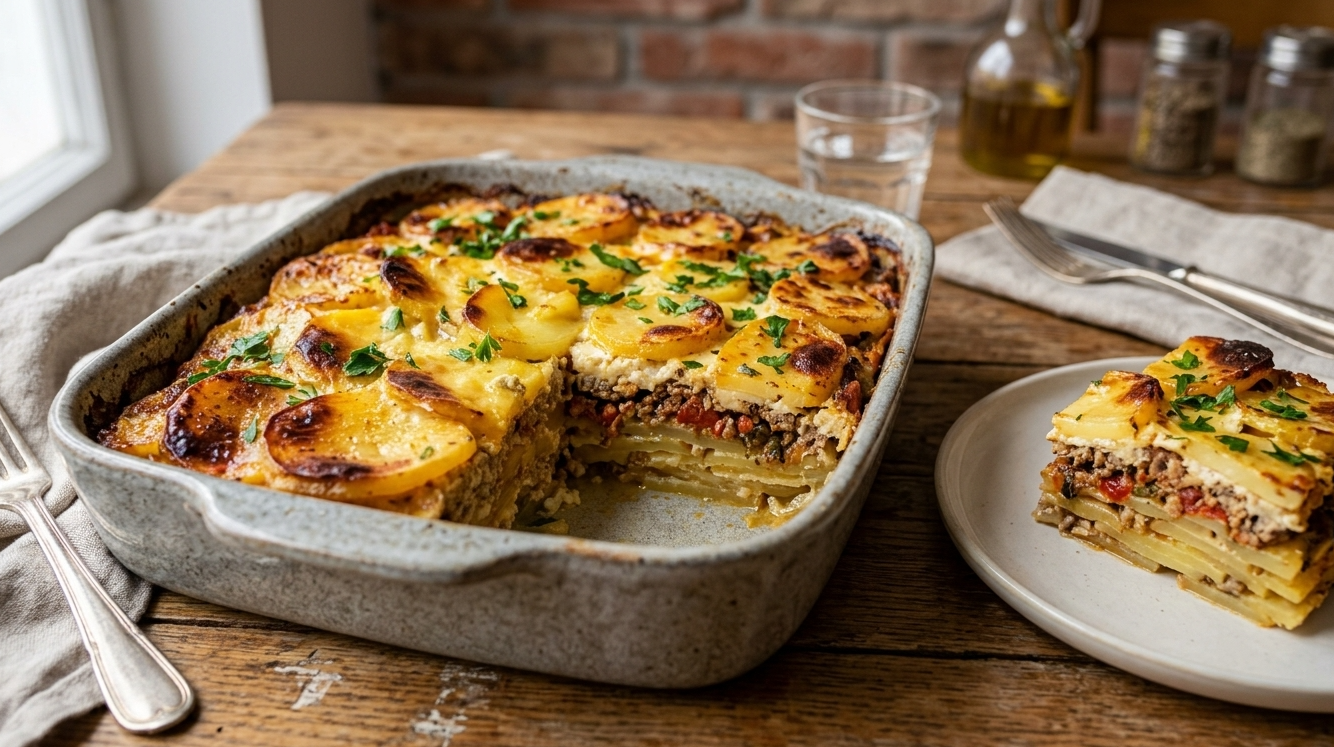
Balkan potato moussaka is a layered casserole of thinly sliced potatoes and seasoned ground beef, finished with an egg, yogurt, and milk topping. Often called musaka, this version uses everyday ingredients and bakes until the potatoes are tender and the top is golden. It has neither eggplant nor béchamel.
The details that matter are even potato slices, fully cooked beef, and a shallow, evenly filled baking dish. Yukon Gold potatoes give the layers a creamy texture while still holding their shape. Plain whole-milk yogurt makes a lightly tangy topping that sets around the potatoes without a flour-based sauce.
This Balkan potato moussaka recipe makes four portions, with separate US Customary and Metric measures. Allow about an hour and forty minutes, including the stovetop work and a short rest before cutting. It is a practical family meal for a cold evening, served with a simple fresh salad.
Balkan Potato Moussaka (Musaka)
Ingredients
- 17 1/2 oz Yukon Gold potatoes Peeled weight; slice evenly about 1/8 inch (3 mm) thick.
- 14 oz ground beef 92% lean beef is the nutrition reference; no pork.
- 1 medium yellow onion Peeled and finely chopped.
- 1 clove garlic Peeled and finely chopped.
- 1 tbsp sunflower oil Use a little of this measured oil for the baking dish and the rest in the skillet.
- 1 tsp fine table salt For the beef mixture; measured separately from the topping salt.
- 1/2 tsp ground black pepper For the beef mixture.
- 1 tsp sweet paprika Mild, not hot or smoked.
- 1/2 tsp dried oregano Optional; add with the beef seasonings if using.
- 2 large eggs Ordinary US large eggs.
- 6 3/4 fl oz plain whole-milk yogurt Unsweetened regular yogurt, not Greek; whisk smooth and measure by volume.
- 3 1/3 fl oz whole milk Measure by volume.
- 1/4 tsp fine table salt For the topping only.
- 1/8 tsp ground black pepper For the topping only.
Equipment
- 8-inch square baking dish About 2 quarts, at least 2 inches deep; use one equivalent dish per base batch.
- Large skillet
- Chef’s knife or mandoline with hand guard For even potato slices.
- Cutting board
- Mixing bowl and whisk
- Kitchen scale and liquid measuring cup
- Instant-read food thermometer Check both the beef and the center of the baked casserole.
- Aluminum foil For tenting if the top browns before the potatoes soften.
Method
- Heat the oven. Heat the oven to 400°F (200°C), conventional, with a rack in the middle. Brush the baking dish with a thin film taken from the measured oil. Reserve the remaining oil for the skillet. For scaled batches, prepare separate matching dishes as described in the notes.
- Prepare the vegetables. Peel the potatoes, weigh the edible amount listed, and cut into even rounds about 1/8 inch (3 mm) thick. Finely chop the onion and garlic. If using a mandoline, use its hand guard. Keep utensils used for raw beef separate from ready-to-eat foods.
- Soften the onion. Heat the remaining measured oil in the skillet over medium heat. Add the onion and cook for about 4–5 minutes, stirring, until softened. Add the garlic and stir for about 30 seconds without letting it burn.
- Cook the beef. Add the ground beef and break it into small crumbles. Cook for about 8–10 minutes, stirring, until cooked through and the released watery liquid has mostly evaporated. Add the measured beef-mixture salt, pepper, and paprika, plus the oregano only if using, during the final minute. Check that the beef reaches at least 160°F (71°C); color alone is not a reliable test.
- Layer the musaka. Divide the potatoes into three roughly equal portions and the beef mixture into two. Arrange a thin, lightly overlapping potato layer in the dish, spread with beef, and repeat. Finish with the remaining potatoes. Keep layers even rather than piling the center higher. At larger scales, divide everything evenly among the separate dishes.
- Whisk and pour. Whisk the eggs, plain yogurt, milk, and the separately measured topping salt and pepper until smooth. Pour evenly over the layers, letting the mixture settle into the gaps. Do not add béchamel or cheese.
- Bake until fully cooked. Bake for about 50–65 minutes, beginning checks around 45 minutes. If the surface browns too quickly, tent loosely with foil and continue baking. A thin knife must pass easily through the potato layers in the center with no firm or crunchy resistance. The topping must be set, the top golden, and the center must reach at least 165°F (74°C). Keep baking if any check fails; check every dish when scaling.
- Rest and serve. Remove from the oven and let stand for about 10 minutes before cutting into the selected number of servings. The rest helps the layers hold together, but it does not replace the doneness checks. Serve warm with a fresh salad if desired.
Notes
Choose potatoes that make even layers
Yukon Gold is a useful US choice because its dense, creamy flesh becomes tender without turning the layers into loose mash. Other ordinary yellow potatoes can work, but their cooking time may differ. Weigh the potatoes after peeling so the casserole receives the intended edible amount.
Cut rounds about 1/8 inch (3 mm) thick, keeping them as uniform as possible. A mandoline can help, provided you use its hand guard. Thick rounds hidden in the middle can remain firm after the surface has browned, so checking the center matters more than matching a photograph.
Use beef and a clearly defined yogurt topping
The meat here is beef only. The nutrition calculation uses a checked 92% lean ground-beef label; a different fat percentage changes the estimate. Soften the onion before adding the beef, break the meat into small crumbles, and let watery pan juices evaporate. Check for at least 160°F (71°C) with a food thermometer rather than relying on brown color.
Keep the mild paprika away from prolonged high heat by stirring it in near the end of the skillet cooking. Oregano is listed separately as an optional seasoning. The salt and pepper for the topping are measured independently, so they do not accidentally disappear into the meat mixture.
Use plain, unsweetened, regular whole-milk yogurt. This base recipe does not use Greek yogurt or sour cream, which are thicker and would make a different topping. Whisk the yogurt smooth before measuring it by volume, then combine it with the eggs and milk. The recipe contains milk and eggs.
Build a shallow casserole and check the center
Use an 8-inch square dish about 2 quarts in capacity and at least 2 inches deep. Divide the potatoes into three portions and the beef into two, then alternate them to finish with potatoes. Lightly overlapping slices are useful; tightly stacked piles create uneven depth. Use a little of the measured oil to coat the dish rather than adding an uncounted extra pour.
Pour the topping evenly over the assembled layers and allow it to run into the gaps. Bake at 400°F (200°C) in a conventional oven. Begin checking around forty-five minutes, but plan roughly fifty to sixty-five minutes. If the top is already golden while the middle potatoes resist a knife, cover loosely with foil and continue baking.
Before removing the dish, confirm three things: the center reaches at least 165°F (74°C), the egg topping is set, and a thin knife slides through the central potato layers without a crunchy or firm core. Temperature alone does not prove the potatoes are soft. Let the finished musaka rest for about ten minutes so portions are easier to lift.
Understand the timing and larger batches
The card includes twenty minutes for preparation and assembly, about fifteen minutes for the onion and beef, fifty-five minutes as a working baking estimate, and ten minutes of rest. That totals one hour and forty minutes. A fifty- to sixty-five-minute bake gives an approximate total of one hour thirty-five minutes to one hour fifty minutes; an oven or thicker slices can require longer. This adaptation has been checked editorially and has not been kitchen-tested.
For eight portions, use two dishes of the base size; for twelve, use three. Divide the scaled ingredients evenly so the layers remain the same depth. Brown the beef in manageable skillet batches. Leave room for hot air around the baking dishes, rotate them if necessary, and check every center separately. More pans may take longer, while the final rest remains about ten minutes.
How musaka differs from other Balkan potato dishes
Musaka keeps potatoes and beef in distinct layers under an egg-and-dairy topping. Krompiruša wraps a potato filling in thin pastry, while kljukuša uses grated potatoes in a baked mixture. These dishes share an ingredient, but their structure and preparation are different.
Serve kupus salata for a crisp contrast to the soft casserole. Keep the side simple so the potato, beef, and yogurt layers remain the center of the meal. Musaka is a main dish rather than a potato side to serve alongside another substantial meat entrée.
Cool leftovers promptly and reheat thoroughly
Divide leftovers into shallow containers and refrigerate promptly at 40°F (4°C) or below. Do this within two hours of cooking or serving, or within one hour above 90°F (32°C). Do not leave the entire casserole on the counter until it reaches room temperature. Use refrigerated portions within three to four days.
Reheat covered in a 350°F (175°C) oven, or use the microwave with a cover and rotate portions for even heating. Check that the center reaches at least 165°F (74°C). A small splash of milk can help dry edges; the time depends on the portion size and starting temperature.
What the nutrition estimate assumes
The estimate is per quarter of the base recipe and assumes all measured oil and meat juices are eaten. It uses checked labels for Laura’s Lean 92% lean beef, Stonyfield plain whole-milk yogurt, and Horizon whole milk, together with reference data for peeled gold potatoes, ordinary large eggs, onion, garlic, sunflower oil, and spices. Optional oregano is excluded.
Yogurt is measured by volume in the recipe; its estimated weight in the nutrition calculation is approximate. Product labels are rounded, onions and eggs vary, and any fat left in the skillet changes the final amount consumed. The card documents the working amounts and label references, so its figures should be read as estimates rather than a measured analysis.