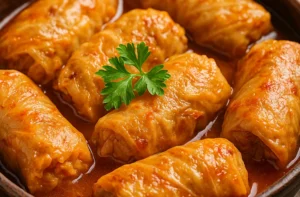
Bosnian Sarma
430kcal
Ingredients
Cabbage and Pot
- 3 1/3 lb whole fermented cabbage leaves drained usable leaves and trimmings; kiseli kupus
- 3 1/4 tsp sunflower oil for coating the pot; US volume approximate
Beef and Rice Filling
- 1 1/3 lb ground beef about 20% fat; keep cold
- 2/3 cup long-grain white rice uncooked; US volume approximate, weigh for the source formula
- 7 oz onion finely diced
- 2 cloves garlic about 5 g each; minced
- 7/8 tsp fine salt US measure approximate; weigh accurately
- 1 tsp ground black pepper
- 2 1/4 tsp sweet paprika not hot or smoked paprika
Layering and Cooking
- 5 1/3 oz smoked beef lean, boneless, ready-to-eat product suitable for simmering
- 2 1/2 tbsp tomato paste
- 5 cups hot water main cooking liquid; US cups rounded
- 7/8 cup extra hot water up to this amount, only as needed
- 2 bay leaves
Equipment
- Kitchen scale For drained cabbage, filling, and salt.
- Wide heavy pot with lid At least 6 liters for the base batch; add pots when scaling.
- Heat-safe plate Slightly smaller than the pot; used inverted to hold rolls down.
- Fine-mesh sieve For rinsing rice.
- Knife and cutting boards Keep raw-meat preparation separate.
- Mixing bowl Keep filling cold.
- Food thermometer Check the center of the meat filling.
- Tongs and ladle For careful lifting and serving.
Method
- Prepare the leaves. Separate whole fermented cabbage leaves and select about 18 sound wrapping leaves per base batch. Halve very large leaves. Shave the thick rib flat without cutting through. Taste a clean piece before raw-meat handling; rinse individual leaves briefly only if excessively salty or sour, then drain.
- Chop the trimmings. Coarsely chop small leaves and offcuts, about one fifth of the total cabbage weight, for the bottom and top layers. This is included in the cabbage total.
- Prepare rice and aromatics. Rinse uncooked long-grain rice in a fine sieve until the water runs clearer and drain well. Finely dice onion to about 1/8 inch (3–4 mm) and mince garlic. Do not precook the rice.
- Mix the cold filling. Combine beef, rice, onion, garlic, filling salt, pepper, and paprika just until evenly distributed. Do not knead into a dense paste. Keep filling at 40°F (4°C) or colder until wrapping. Clean hands, utensils, and surfaces after handling raw beef.
- Fill and fold. Lay each leaf inner side up. Place about 1 3/4 oz (45–55 g) filling on the lower third. Fold the bottom over it, fold one side inward, roll loosely, and tuck the open end inside. Leave room for rice expansion. Overlap small sound leaves if necessary. Keep roll size similar when scaling.
- Line the pot. Coat a wide heavy pot with the oil and spread half the chopped cabbage on the bottom. Use at least a 6-liter pot for the base batch; add pots rather than increasing layer depth when scaling.
- Arrange the rolls. Place rolls seam side down, snugly beside one another without crushing them. Add half the smoked beef between the first layer. Complete a second layer with remaining rolls, smoked beef, and bay leaves.
- Cover with cabbage. Spread remaining chopped cabbage and trimmings over the rolls. This protects the top layer during simmering.
- Add the liquid. Whisk tomato paste into the main hot-water quantity and pour down the side of the pot. Liquid should nearly cover the rolls; the precise level depends on pot shape. Do not salt the liquid automatically.
- Weight and heat gently. Place an inverted heat-safe plate slightly smaller than the pot over the cabbage. Cover and bring to a gentle simmer over medium heat, about 15 minutes.
- Simmer without stirring. Lower the heat and simmer covered for about 2 hours. Avoid a rolling boil and do not stir between rolls. Check liquid after about an hour. If rolls are exposed and drying, add some of the separately listed extra hot water down the side.
- Check filling and rice. Lift a large roll carefully. Check the center of the beef filling with a clean thermometer: at least 160°F (71°C). Open it to check that rice is fully tender and cabbage yields easily. If any endpoint is unmet, cover and cook another 15–20 minutes, then check again. Color and elapsed time alone are insufficient.
- Rest and serve. Remove from heat. Carefully lift out the hot plate with suitable utensils, avoiding steam. Rest covered 15 minutes and remove bay leaves. Serve about three medium rolls per person with cabbage, smoked beef, and cooking liquid.
- Cool and store promptly. Divide leftovers into shallow containers and refrigerate within 2 hours, or 1 hour above 90°F (32°C). Store at 40°F (4°C) or colder for 2–3 days. Freeze promptly chilled portions with liquid for longer storage. Thaw in the refrigerator and reheat centers to 165°F (74°C), adding water as needed.
Notes
- Formula: Metric is the reference. US measures are rounded. Cabbage includes about 300 g chopped trimmings, not an additional ingredient.
- Leaves: Whole fermented cabbage gives the intended sour flavor. Shredded sauerkraut cannot wrap filling; fresh cabbage requires another preparation.
- Smoked beef: Use a labeled ready-to-eat product suitable for cooking, not raw cured meat or jerky. Salt varies; do not add salted stock automatically.
- Portions: About 18 medium rolls, six servings of about three. Leaf size changes the count.
- Scaling: Keep roll size and layer depth similar. Add pots; do not multiply cooking time automatically.
- Timing: Cook time includes about 15 minutes to reach simmer plus 2 hours gentle cooking. Tough leaves or rice may need longer.
- Nutrition: Rough per-serving estimate for one sixth of the full batch. Rinsing, cabbage brine, smoked-meat brands, and broth consumed make sodium particularly uncertain. Not laboratory measured.