Gibanica Recipe – Serbian Cheese Phyllo Pie
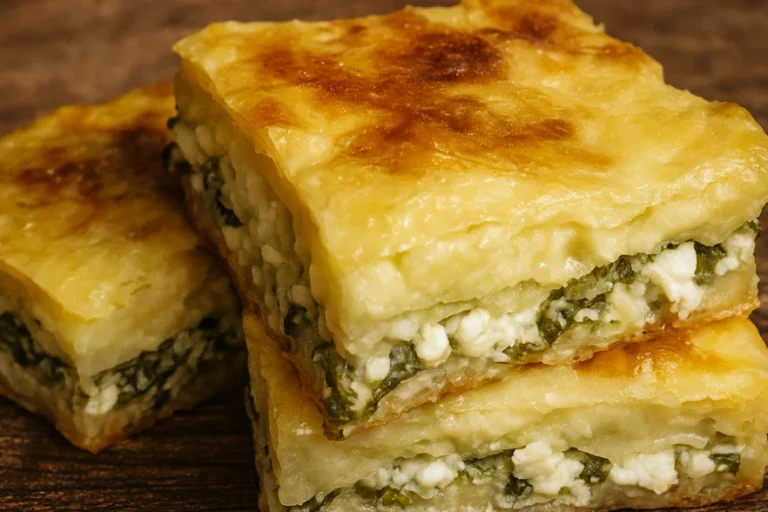
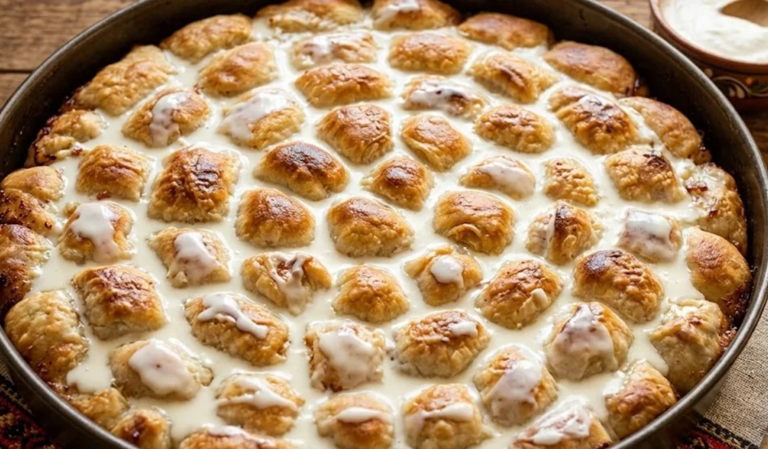
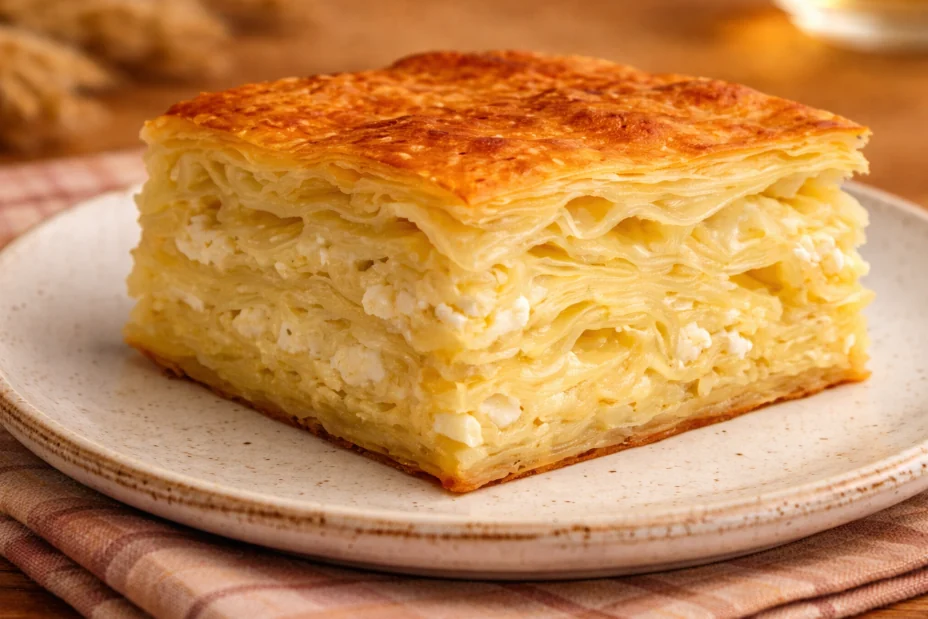
This gibanica recipe makes a golden Serbian cheese phyllo pie with a tender, gently puffed center. It uses the gužvara method: most of the sheets are loosely crumpled, dipped into an egg-and-yogurt filling with white brined cheese, and placed together without packing them down.
The cheese matters as much as the pastry. Choose a drained Balkan white cheese made from pasteurized cow’s milk, along with plain whole-milk yogurt and thin, unsweetened phyllo. Sparkling mineral water loosens the filling; a small portion of the smooth mixture is reserved before the cheese goes in and brushed over the top.
Allow about 1 hour 25 minutes once the phyllo is ready to use, including a 15-minute rest after baking. The pan yields approximately 12 pieces; one piece is the nutrition serving, while the number of pieces for a meal depends on appetite and accompaniments. A fresh kupus salata makes a crisp, simple contrast.
Gibanica – Serbian Cheese Phyllo Pie
Ingredients
- 17 1/2 oz thin unsweetened phyllo sheets thawed as directed on the package; weigh rather than count sheets
- 17 1/2 oz Balkan white brined cow’s-milk cheese pasteurized; drained before weighing; not cottage cheese or cream cheese
- 4 extra-large eggs about 55 g without shell per egg; beat and weigh for the closest source match
- 14 oz plain whole-milk yogurt about 3.5% milkfat; regular yogurt, not Greek
- 3 1/2 fl oz sparkling mineral water strongly carbonated; Metric water weight is equivalent to approximately the same number of milliliters
- 6 tbsp refined sunflower oil divided: one-eighth for the pan, the remainder for the filling; US spoon measure is approximate
- 1/3 tsp fine table salt not the same volume of coarse or kosher salt
Equipment
- 1 Baking pan About 14 × 10 × 2 inches / 35 × 25 × 5 cm per base batch; use more comparable pans when scaling.
- 1 Kitchen scale For drained cheese, phyllo, egg weight, and the proportional topping.
- 1 Mixing bowl Large enough to dip a loosely crumpled sheet.
- 1 Small bowl For the reserved smooth topping.
- 1 Strainer Drain cheese before weighing.
- 1 Pastry brush
- 1 Food thermometer Check the center without touching the pan.
Method
- Prepare the pan and cheese. Drain the cheese in a strainer for 10 minutes before weighing. Heat a conventional oven to 375°F (190°C), with a rack in the middle. Brush a 14 × 10 × 2-inch pan (about 35 × 25 × 5 cm) with one-eighth of the measured oil. For larger batches, use additional pans of the same size.
- Mix the smooth filling. Whisk the eggs until blended, about 1 minute. Whisk in the yogurt, sparkling water, remaining oil, and salt until smooth. Before adding cheese, weigh and reserve approximately one-eighth of this smooth mixture in a separate bowl for the surface. Keep the same proportion at every batch size.
- Fold in the cheese. Crumble the drained cheese into small pieces about ½ inch across and fold into the larger bowl of filling. Leave some visible cheese pieces rather than blending everything smooth.
- Line the pan. Reserve two whole sheets for the bottom and one for the top of each pan. Keep unused phyllo covered with plastic wrap and a barely damp towel so it stays flexible. Overlap the bottom sheets to cover the pan, letting the edges extend over the sides.
- Crumple and dip. Loosely gather each remaining sheet, dip it individually into the cheese mixture, and let it drip for 2–3 seconds. Place the dipped sheets next to one another in the pan without squeezing or packing them down. Spread any remaining cheese filling over the crumpled sheets.
- Close and coat. Fold the overhanging edges inward. Lay the reserved top sheet over the filling and gently tuck its edges down the sides. Brush the reserved smooth egg-yogurt mixture evenly over the top, including the corners.
- Bake until set. Bake for about 45 minutes, avoiding opening the oven during the first 35 minutes. If the surface darkens too quickly, loosely tent with foil. The top should be golden and the middle set, with no liquid egg mixture. Check the center with a food thermometer: it must reach at least 160°F (71°C). If necessary, bake another 3–5 minutes and check again.
- Rest and portion. Rest uncovered for 15 minutes on a heatproof surface. Cut each pan into approximately equal pieces and serve warm. The serving count is a piece count, not a claim that each piece is a full meal.
Notes
Gibanica and the gužvara method
Gibanica is particularly associated with Serbian cooking, with related cheese-pastry preparations across the region. Gužvara describes the crumpled-sheet approach used here. The individual folds hold filling and leave room for the pie to expand; they should look loose before baking rather than like tightly squeezed balls.
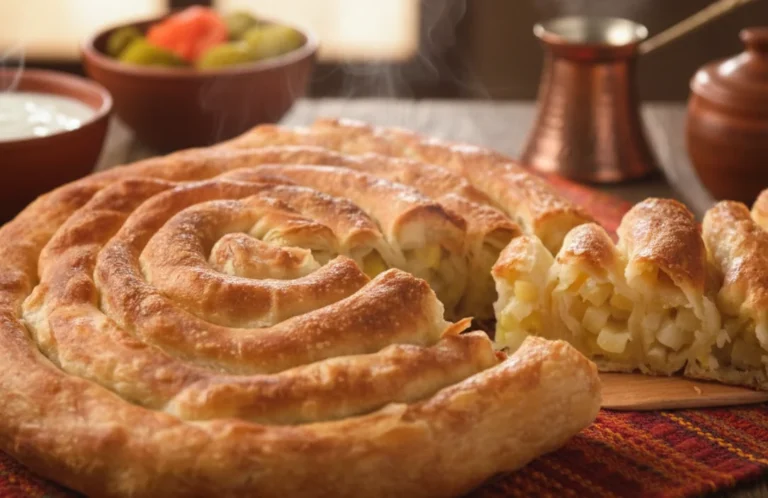
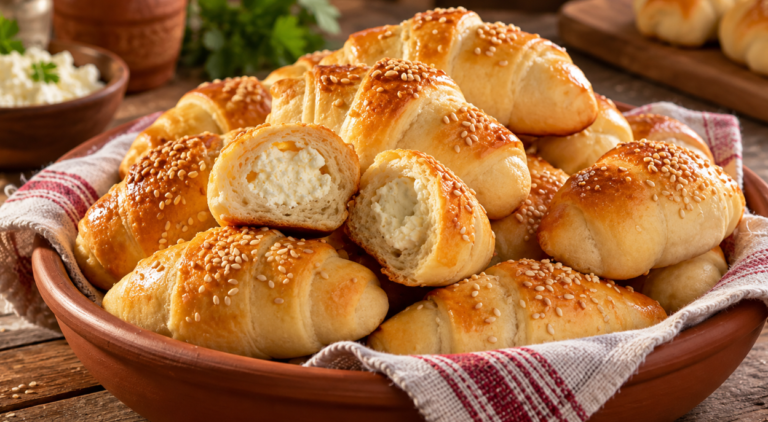
The method differs from our Bosnian sirnica, where cheese-filled pastry sheets are rolled, and from our Bosnian beef burek, shaped into a spiral. Those are comparisons of these particular recipes, rather than a rule that every household uses the names or shapes in exactly the same way.
Finding phyllo, white cheese, and yogurt in the US
Look for thin jufka or phyllo sheets rather than puff pastry, shortcrust, or sweetened dough. Refrigerated jufka is convenient; frozen phyllo is a practical option when thawed exactly as its package directs. Large sheets are easier to overlap across the pan. Weigh the required pastry: a typical US one-pound package is lighter than the source quantity, and sheet counts vary by brand and thickness.
At Balkan, Eastern European, and Mediterranean grocery stores, ask for white brined cow’s-milk cheese and check that the milk is pasteurized. Hebros Foods Bulgarian White Brined Cow’s Milk Cheese is one US-market example of this category. Its recorded label contains about 14 g fat and 1,320 mg sodium per 100 g, so it is already distinctly salty. Availability and labels can change; check the tub you buy. Feta, cottage cheese, and cream cheese have different milk, moisture, or texture characteristics and are not automatic equivalents.
Drain the cheese before weighing it. Taste a small piece of the cheese before handling the raw eggs, so you know how salty the brand is; the card keeps the source’s measured salt rather than calling for an additional unmeasured pinch. If your cheese is overwhelmingly salty, choose a better-suited white brined cheese for this formula. Use regular plain whole-milk yogurt at about 3.5% milkfat. Thick Greek yogurt or reduced-fat yogurt changes the moisture and texture.
The source’s shell-free egg target is about 55 g per egg. US extra-large eggs are the nearest practical size, but weighing the beaten egg gives a closer match than relying on carton sizing. Metric preserves the source weights. US ounce and spoon measures are rounded approximations, so use a scale when precise ratios matter.
Reserve the topping before adding cheese
Whisk the eggs, yogurt, mineral water, filling oil, and salt until smooth, then reserve approximately one-eighth of that smooth mixture by weight. Only afterward fold the cheese into the larger portion. This gives the top sheet a fluid coating without large cheese lumps and keeps the reserved amount proportional for a doubled or tripled recipe.
The oil is also divided by purpose: one-eighth greases the pan, and the remainder goes into the smooth filling. Neither the topping nor the pan oil is an extra ingredient beyond the measured formula.
Crumple loosely and bake the center through
Use a pan close to 14 × 10 × 2 inches, or 35 × 25 × 5 cm. A much smaller pan makes the center deeper and may leave it wet before the top is browned. For larger batches, use additional comparable pans rather than forcing all the mixture into one deep dish.
Keep the unused sheets covered with plastic wrap and a barely damp towel. Dip each loosely gathered sheet separately, let excess filling drip briefly, and place it beside the others without pressing. Fold in the bottom overhang, tuck in the final sheet, and distribute the reserved topping all the way to the edges.
Bake on the middle rack at 375°F (190°C) in a conventional oven. The surface should turn golden while the center becomes set. A browned top alone does not prove the egg mixture is cooked: check the center with a food thermometer for at least 160°F (71°C), and make sure there is no liquid egg mixture. Loosely tent with foil if the top colors before the middle is ready.
Troubleshooting dry pastry, a dense middle, or excess salt
Dry sheets: Open the package only when the filling and pan are ready, and keep unused pastry covered. The towel should be barely damp, not wet enough to make the sheets glue together. Small tears in sheets that will be crumpled are less important than keeping enough intact pastry for the bottom and top.
A compact or wet center: Avoid squeezing the dipped sheets and use the stated pan dimensions. Give the center extra oven time if it is not set. The 15-minute uncovered rest helps the filling settle for cutting, but it does not replace adequate baking.
An overly salty pie: Brined cheeses vary considerably. Start with a suitable cow’s-milk white cheese, drain it, and keep the measured salt controlled. Do not taste the filling once raw eggs have been added.
Serving, cooling, and reheating
Rest the baked pie uncovered for 15 minutes, then cut into approximately equal pieces. Serve warm as a main dish with salad, or in smaller portions as part of a larger spread. The piece count is an estimated cutting yield, not a measured portion weight.
Refrigerate leftovers in shallow containers promptly, within 2 hours of cooking or within 1 hour if the room or outdoor temperature exceeds 90°F. Keep at 40°F (4°C) or below and use within 2 days for best quality. Do not leave the egg-and-cheese mixture sitting at room temperature while preparing other dishes.
Reheat portions in an oven set to at least 325°F until the center reaches 165°F (74°C); loosely cover if needed to prevent excessive browning. A microwave is convenient but softens the pastry, so cover and rotate portions and check that they are hot throughout.
Practical questions
Can I use frozen phyllo? Yes, if it is thin, unsweetened phyllo and fully thawed according to its package instructions. Thawing is additional to the displayed preparation time; do not try to unfold sheets with a frozen center.
Can I double the recipe? Use two comparable pans and keep the same depth and per-pan arrangement. Ingredient totals and the proportional topping increase; oven temperature and the rest per pan stay the same. More baking batches can extend the overall time.
How precise is the nutrition? It is a calculation per one of 12 assumed equal pieces, using checked phyllo and white-cheese matches and the exact Metric formula. The card explains the products, yogurt-fat approximation, and full oil-retention assumption. Cheese salinity and the size of the cut pieces can change the result substantially.