Zeljanica Recipe – Bosnian Spinach and Cheese Pie
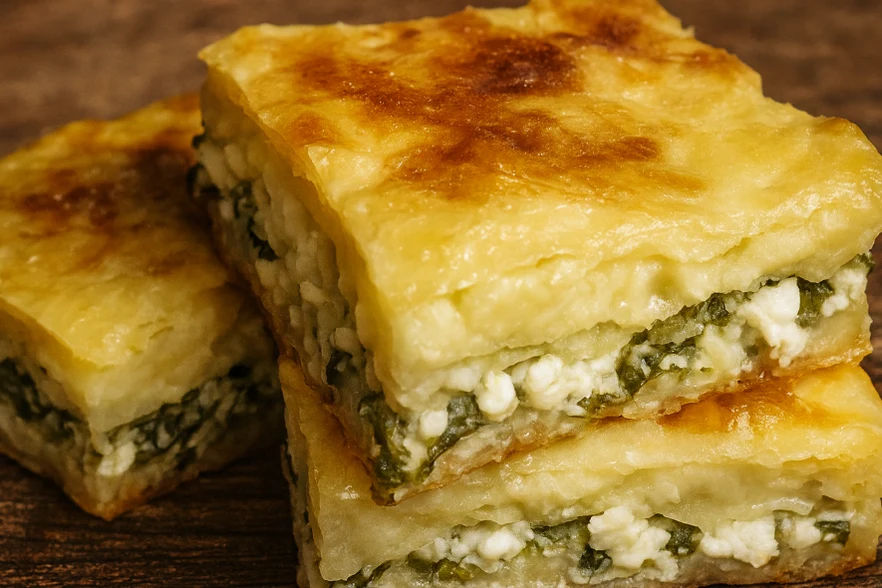
Zeljanica is a Bosnian spinach and cheese pie made with thin pastry sheets and a moist, savory filling. In this layered version, fresh spinach, mild white cheese, quark, and egg sit between lightly brushed phyllo sheets. The top bakes golden, then softens slightly during a short covered rest.
This is a ready-made-sheet recipe, not a hand-stretched spiral. The useful work is drying and squeezing the spinach, keeping the cheese mixture free of loose liquid, and dividing the filling into four thin layers. A separate yogurt, oil, egg, and sparkling-water mixture moistens the pastry without soaking it.
Allow about 1 hour and 35 minutes, including the full 20-minute rest after baking. Frozen pastry needs its package’s thawing time before that. The recipe makes eight portions in a shallow rectangular metal pan; use the Metric weights for the closest match to the formula and the US setting for practical rounded equivalents.
Zeljanica – Bosnian Spinach and Cheese Pie
Ingredients
- 17.6 oz fresh spinach washed, dried, tough stems removed; weigh before salting
- 10.6 oz mild white cheese well drained; Balkan white cheese preferred
- 5.3 oz plain quark German 20% fat in dry matter; see shopping notes
- 1 large egg for the filling
- 1/2 tsp fine salt for wilting the spinach
- 1/2 tsp ground black pepper approximately; Metric weight is the reference
- 7.1 oz plain whole-milk yogurt regular, unstrained; about 3.5% fat
- 1 large egg for the brushing mixture
- 6 tbsp sunflower oil US volume rounded; use Metric for the exact formula
- 3 1/3 tbsp sparkling mineral water plain; 1/3 tablespoon equals 1 teaspoon
- 17.6 oz thin phyllo or pita yufka sheets fully thawed according to package directions
- 2 tsp sunflower oil for the pan
Equipment
- Kitchen scale
- Colander or salad spinner
- Mixing bowls
- Whisk
- Pastry brush
- Metal baking pan about 15 × 11 inches (38 × 28 cm)
- Food thermometer
Method
- Thaw the pastry. Thaw frozen phyllo fully according to its package directions before starting; thawing time is additional. Keep the package closed until the filling, brushing mixture, and pan are ready.
- Dry and salt the spinach. Wash the spinach, dry thoroughly, remove tough stems, and cut into strips about ½–¾ inch (1–2 cm) wide. Toss with the filling salt and massage for about 1 minute. Let stand for 10 minutes, then squeeze firmly in small handfuls to remove released liquid.
- Mix the filling. Mash the drained white cheese finely with a fork. Stir in the quark, the filling egg, and black pepper. Loosen the squeezed spinach and fold it through. The filling should be moist and spreadable without free liquid. Keep refrigerated while preparing the other components.
- Whisk the brushing mixture. Whisk the yogurt with its separate egg until smooth. Gradually whisk in the brushing oil, then briefly mix in the sparkling water. Stir again regularly during layering so the oil stays distributed.
- Heat and prepare the pan. Preheat a conventional oven to 400°F (200°C), a practical Fahrenheit rounding. Use a lower-middle rack. Thinly coat a metal baking pan about 15 × 11 inches (38 × 28 cm) with the pan oil.
- Divide pastry and filling. Trim or arrange the sheets to cover the pan; usable offcuts can lie flat between intact sheets. Reserve roughly one-quarter of the pastry for the bottom and one-quarter for the top. Divide the remaining half into three similar intermediate bundles. Divide the filling into four equal portions. Keep waiting sheets under parchment topped with a barely damp towel, without the towel touching the pastry.
- Build the bottom. Lay in the bottom bundle one sheet at a time, brushing each lightly with the yogurt mixture. Spread the first portion of filling evenly and loosely over it. Avoid pressing it into a dense layer.
- Add the middle layers. Add the first intermediate bundle sheet by sheet, brushing each lightly, then spread the second filling portion. Repeat with the second bundle and third portion, then the third bundle and final filling portion. Keep the four filling layers thin and even.
- Cover and brush the top. Add the reserved top sheets individually, brushing each lightly all the way to the edges. Distribute any remaining brushing mixture evenly across the surface rather than leaving a puddle in one place.
- Bake until set. Bake about 35–40 minutes, until the top and edges are evenly golden and the bottom is baked. Check the central egg-and-cheese filling for at least 160°F (71°C). If the surface browns early, tent loosely with foil for the final baking stage and continue until the center and base are done.
- Rest and portion. Let the baked pie stand uncovered for 5 minutes. Cover the pan with parchment and then a clean, dry kitchen towel for another 15 minutes. Divide into the number of servings shown and serve warm. Uncover after resting to avoid trapping excess steam.
Notes
- Use the weighed Metric quantities as the reference; US ounces are rounded weights. One 1-pound package is only 454 g, so it does not supply the full pastry amount. Count and divide your actual sheets rather than using a universal sheet count.
- Quark labeled 20% Fett i.Tr. has 20% fat in its dry matter; the finished product may contain roughly 4–5 g fat per 100 g. A smooth, unsalted cultured farmer cheese is a possible US adaptation, with different moisture and fat; it is not a guaranteed identical substitute. Avoid hard aged farmer cheese, cream cheese, and puff pastry.
- Use mild cheese and taste it before adding raw egg. If exceptionally salty, select a milder cheese; the measured spinach salt is already part of the formula. Do not add extra salt automatically.
- For larger batches, use additional pans of similar size and depth. Baking time does not multiply with ingredient quantities. The 20-minute rest is 5 minutes uncovered plus 15 minutes covered; the spinach's 10-minute stand occurs within preparation.
- Refrigerate leftovers promptly in shallow containers within 2 hours, or 1 hour above 90°F (32°C). Keep at 40°F (4°C) or colder and use within 2 days. Reheat at 355°F (180°C), allowing about 8–10 minutes as a starting guide, until the center reaches 165°F (74°C).
- Nutrition is a label-based estimate for one-eighth of the recipe, using specified reference products for phyllo, feta-style white cheese, quark, and yogurt, plus USDA egg, oil, and pepper composition. All oil and salt are counted; spinach liquid losses and brand differences change actual values. It is not a laboratory result.
Zeljanica in the Bosnian pita family
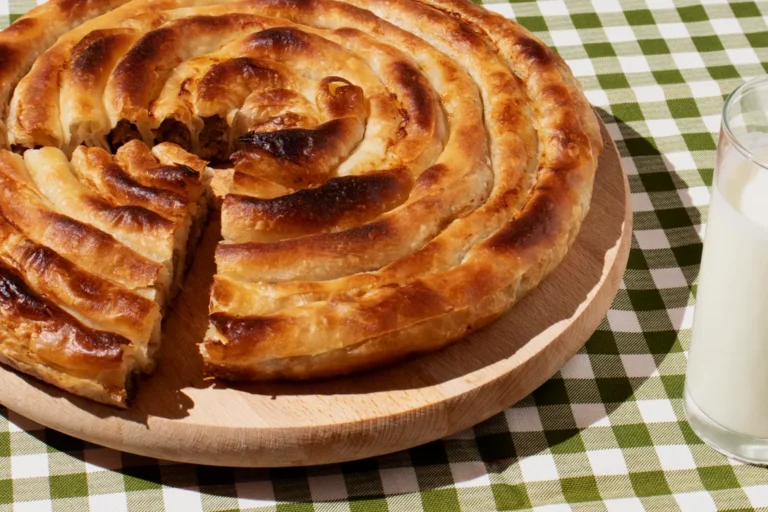
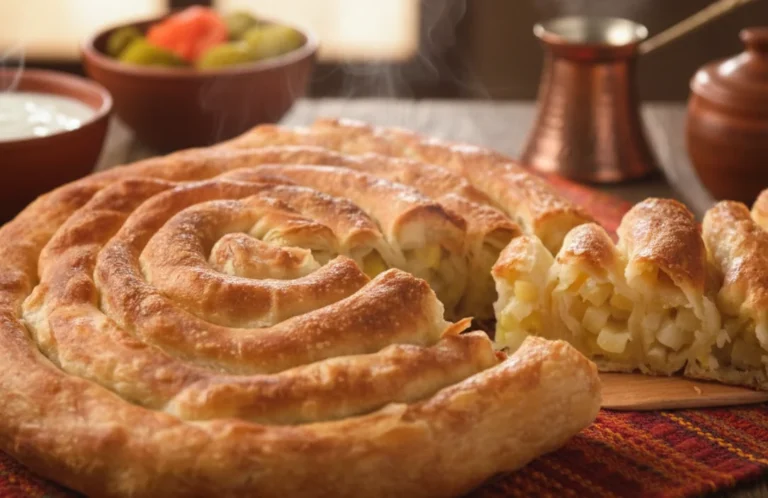
In Bosnian usage, the filling gives each pita its name. Burek contains meat, sirnica contains cheese, and krompiruša contains potatoes. Zeljanica combines leafy greens with cheese. Calling all four dishes burek loses that useful distinction.
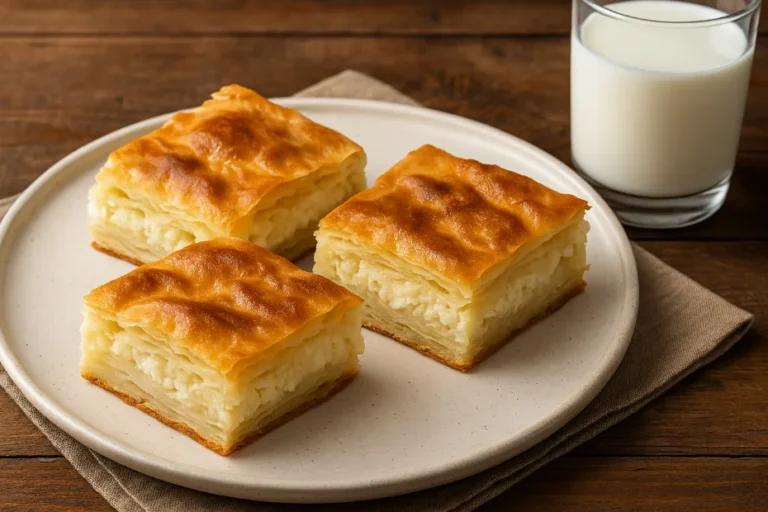
Spinach is the green used here. Chard and other suitable leafy greens appear in household versions, and some zeljanica is rolled in homemade jufka. Those are variations within the tradition, not instructions to replace this recipe’s layered, ready-made pastry method. The photograph illustrates cut layered pieces, not a guide to changing the filling proportions.
Buying white cheese and quark in the United States
Choose mild cheese before adding raw egg
Look for a pasteurized Balkan white cheese at a Balkan, Mediterranean, or Middle Eastern grocery. Buy a creamy, relatively mild cheese and drain it before weighing. Feta in a block is an accessible adaptation, but saltiness, firmness, and moisture differ between products. Dry precrumbled feta is less helpful for a soft, cohesive filling.
Taste a clean piece of cheese before adding the raw egg. Very salty cheese can dominate the pie even though the filling contains no additional salt beyond the measured salt used on the spinach. Choose a milder product first rather than automatically increasing the quark or yogurt and changing the moisture balance. Do not taste the filling once raw egg is mixed in.
Understand the quark label
The source ingredient is plain German-style quark labeled 20% Fett i.Tr., meaning fat in dry matter. That does not mean the entire product is 20% fat. For example, MILRAM’s 20% quark contains 4.3 g fat per 100 g. Look for plain, smooth, lightly tangy quark at a European grocery or specialty dairy counter; avoid flavored dessert quark.
A smooth, unsalted cultured farmer cheese can be considered as a US adaptation when quark is unavailable. The name farmer cheese covers very different products: a spreadable cultured curd is more suitable than a hard, aged block or an extremely dry pressed cheese. Match a thick, creamy texture with no pooled whey, and expect differences in fat and moisture. This is an adaptation, not a tested identical replacement. Cream cheese, cottage cheese with loose curds and liquid, and very thick strained yogurt are not automatic equivalents.
Remove spinach water before mixing the filling
Wash fresh spinach thoroughly and dry it in a spinner or colander. Surface water adds to the moisture the leaves release after salting. Remove tough stems, cut the leaves into strips, massage with the measured salt for about a minute, and leave them for ten minutes.
Squeeze small handfuls firmly with both hands, letting the released liquid drain away. Then loosen the compacted greens before folding them into the cheese mixture. Salting without squeezing simply moves water out of the leaves and into the bowl; it does not remove it from the pie.
The base recipe uses the fresh spinach weight before salting. Frozen spinach is a separate option requiring complete thawing and thorough squeezing, but its compacted weight is not automatically the same as the fresh-leaf shopping weight. No direct frozen-weight conversion is established here. Avoid creamed or seasoned frozen spinach.
Keep the filling separate from the yogurt brushing mixture
The filling combines drained white cheese, quark, its own egg, pepper, and the squeezed spinach. It should spread from a spoon without flowing across the bowl or leaving a puddle. Mash the cheese before adding the spinach so there are no large, dry cheese lumps surrounded by wet greens.
The second egg belongs to the separate yogurt mixture. Use plain, regular, unstrained whole-milk yogurt, around the source’s 3.5% fat, and whisk it smooth before gradually adding its oil and sparkling water. Stir again during assembly because the oil can separate while the bowl stands.
Sparkling water thins the mixture so it spreads easily; it is not yeast or baking powder. Each pastry sheet needs a light coating. Pouring a large amount into one layer can make the bottom wet and greasy even when the total ingredients are correct. Keep the pan-greasing oil separate from the brushing oil.
Choose thin pastry and divide it by proportions
Use thin phyllo, filo, or pita-style yufka intended for this kind of pie. Puff pastry has a different structure and is not a substitute. Package sizes vary: 1 pound is about 454 g, less than the 500 g required here. Weigh the sheets rather than assuming one box supplies the recipe.
Thaw fully according to the label and open the pack only when ready to assemble. Keep waiting sheets beneath parchment with a barely damp towel above it. The towel should not touch the pastry directly, which can make sheets stick together. Fit smaller sheets with flat overlaps, distribute usable offcuts between intact sheets, and avoid thick folded corners.
Reserve about one-quarter of the pastry for the base and one-quarter for the top. Divide the remaining half into three intermediate bundles. Four equal filling portions go between those five pastry bundles. This relationship works across different sheet counts; a fixed instruction such as use two sheets per layer may not suit your package.
Bake the base and center, then complete the full rest
Preheat a conventional oven to 400°F (200°C), a practical Fahrenheit rounding, and use a lower-middle rack. A shallow metal pan approximately 15 × 11 inches (38 × 28 cm) supports more even bottom baking than a very deep dish. For larger batches, use additional comparable pans rather than making one thicker pie.
Start checking around 35 minutes. Look for an evenly golden top and edges, a baked underside, and a set filling. Check the central egg-containing filling for at least 160°F (71°C), consistent with USDA guidance for egg dishes. A dark top alone does not establish that the middle and base are ready. Tent loosely with foil if the surface browns early.
After baking, rest uncovered for five minutes, then cover with parchment and a clean, dry towel for fifteen more. This is twenty minutes in total, not an additional twenty minutes under the towel. The filling settles and the upper sheets soften slightly. Remove the covering afterward so steam does not keep accumulating.
Troubleshooting the layers and filling
A watery middle or sticky inner sheets
Check spinach drying and squeezing, drained cheese, thick filling patches, and pooled brushing mixture. A deep pan or underheated oven can also delay the center. Keep the four filling layers thin and judge the underside as well as the surface. Extra egg is not a remedy for excess water.
Dry, brittle top sheets
Waiting sheets may have dried uncovered, or the upper layers may have received too little brushing mixture. Moisten the top evenly to the edges using the measured allowance. Preserve the post-bake covered stage rather than adding unmeasured oil afterward.
Overly salty filling
The white cheese is the main variable. Taste it before the eggs enter the mixture and select a mild product. Adding more dairy to a finished oversalted filling also changes the recipe’s moisture and quantity; it is not a guaranteed correction within the original formula.
Uneven browning or pieces that fall apart
Distribute the filling and pastry evenly, avoid dense offcut piles, and use the specified shallow pan. A browned top with a pale base needs more attention to baking, not immediate cutting. Complete the full rest and cut with a sharp knife without crushing the layers.
Serving, refrigerating, and reheating
Serve warm with plain yogurt, cultured sour milk, ayran, or a simple tomato-and-cucumber or green salad. If several pita varieties share the table, offer smaller pieces. The extra yogurt and salad are accompaniments, not ingredients in the nutrition estimate.
Refrigerate leftovers promptly in shallow containers within two hours, or one hour above 90°F (32°C), and keep at 40°F (4°C) or below. Do not wait for an entire deep pan to become completely cold on the counter. Use refrigerated portions within two days.
Reheat at 355°F (180°C), starting with the source’s approximate eight to ten minutes for individual pieces, and check the center reaches 165°F (74°C). Cold, thick portions may take longer. The microwave heats quickly but softens the pastry. Cooked portions can be frozen airtight after prompt cooling, then thawed in the refrigerator and reheated; no personally tested freezer-quality duration is claimed.
What the nutrition estimate represents
The estimate divides the full weighed recipe into eight portions. It uses manufacturer labels for Athens 14 × 18-inch phyllo, Président feta chunk as a white-cheese reference, MILRAM 20% quark, and Stonyfield regular whole-milk plain yogurt, with USDA composition for whole egg, sunflower oil, and black pepper. Oil is calculated at approximately 0.92 g/ml. These reference products define an estimate, not required brands or a claim that every white cheese has the same composition.
All listed oil is counted. Discarded spinach liquid, pastry trimming, label rounding, and actual dairy brands affect what reaches the plate. Calories and macronutrients are calculated independently rather than copied from the German recipe. No measured cooked serving weight or laboratory analysis is claimed.