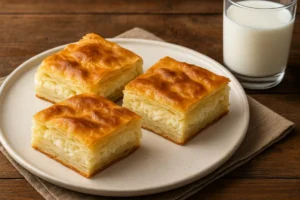
Sirnica – Bosnian Cheese Pie
423.66kcal
Ingredients
Cheese Filling
- 14 oz white brined cheese pasteurized; drained weight; mild Balkan-style cheese or feta in brine
- 7 oz plain whole-milk yogurt unstrained; about 3.5% milkfat
- 2 large eggs about 50 g each without shells
- 1/3 tsp fine salt optional; use less or omit with salty cheese
Pastry, Brushing, and Finishing
- 17 2/3 oz phyllo dough thawed according to package; or thin Balkan pita yufka
- 14 tsp sunflower oil divided between the pan and brushing
- 20 tsp sparkling water divided between brushing and finishing
Equipment
- Kitchen scale For drained cheese and pastry; sheet counts vary by brand.
- Mixing bowls One for the filling and a small bowl for the brushing mixture.
- Fork or Whisk For mashing the cheese and mixing the filling.
- Pastry brush Use a light touch to avoid tearing the sheets.
- Round metal baking pan 13-inch (32 cm) diameter; use additional pans when scaling.
- Parchment Paper or Plastic Wrap For covering unused pastry; use parchment, never plastic, over the hot baked pie.
- Clean Kitchen Towel Barely damp over unused sheets; dry for covering the baked pie.
- Food thermometer Check the center of the cheese-and-egg filling.
- Sharp knife For cutting the rested pie.
Method
- Thaw and plan ahead. Thaw the closed phyllo package exactly as directed by its manufacturer, allowing any required refrigerator thaw and room-temperature tempering before assembly. The listed preparation time starts with pliable, thawed sheets; package thawing is additional. Keep the cheese, yogurt, and eggs refrigerated until needed.
- Make the cheese filling. Drain and weigh the cheese, then mash it with a fork. Taste the cheese before adding the raw eggs; add the optional salt only if needed. Stir in the yogurt and eggs until thick, creamy, and spreadable, not watery. Refrigerate the filling while arranging the pastry. Do not taste it after adding raw eggs.
- Heat the oven and mix the brush-on liquid. Heat a conventional oven to 390°F (200°C), with a rack in the lower-middle position. Use about one-seventh of the oil to lightly grease a 13-inch (32 cm) round metal pan, adding more pans when scaling. Whisk the remaining oil with four-fifths of the sparkling water; reserve the remaining water for after baking. Rewhisk before each brushing.
- Cover and portion the pastry. Open the pastry only when ready to work. Cover unused sheets with parchment or plastic wrap and a barely damp towel on top; keep the damp towel from touching the dough. Plan roughly 3 ounces (83 g) pastry per roll and six rolls per 13-inch (32 cm) pan. Divide the filling evenly among the planned rolls. Sheet counts vary: thicker Balkan sheets may need a pair per roll, while very thin US phyllo may need several sheets to reach the same weight.
- Layer and fill each roll. Lay out the sheets for one roll, brushing each very lightly with the oil-water mixture before adding the next. Keep enough mixture for the remaining rolls and the top. Spread a portion of filling in a 2-inch (5 cm) strip along one long edge, leaving about 3/4 inch (2 cm) bare at each end. Fold the ends inward and roll loosely from the filled edge.
- Form a loose spiral. Coil the first roll gently in the middle of the greased pan. Wrap the next rolls around it, continuing the spiral without packing them tightly. Leave a little expansion space between rolls. Keep the pie at the same depth when scaling and use additional pans. Brush the top lightly with the remaining oil-water mixture.
- Bake until golden and set. Bake for 35–40 minutes, checking from 30 minutes, until the top and edges are golden and the inner pastry is cooked. Check the cheese-and-egg filling in several central spots with a food thermometer; it must reach at least 160°F (71°C). If the surface colors before the center is ready, shield it loosely with foil and continue baking, checking every 5 minutes. Color alone does not confirm doneness.
- Sprinkle lightly and rest. Remove the baked pie from the oven and sprinkle the reserved sparkling water evenly over the surface without pooling. Cover first with parchment, then with a clean kitchen towel, keeping both away from heat and flames. Rest for 20 minutes for a softer crust. For a crisper top, uncover after 5 minutes and finish the remaining rest uncovered.
- Cut and serve warm. Cut along the rolls or into portions and serve warm, with plain yogurt or a simple salad if desired. The filling should be set and moist, with distinct pastry layers.
- Refrigerate leftovers promptly. Cut leftovers into portions and refrigerate in shallow containers within 2 hours of cooking, or within 1 hour if the room is above 90°F (32°C). Keep at 40°F (4°C) or colder and use within 2 days. Do not wait for the whole pie to cool completely on the counter. Reheat in a 355°F (180°C) oven until the center reaches 165°F (74°C); allow about 10–20 minutes for chilled portions, checking rather than relying on time alone.
Nutrition
Calories423.66kcalCarbohydrates36.07gProtein13.98gFat24.55gSaturated Fat9.28gCholesterol94.25mgSodium1000.64mgFiber1.19gSugar1.32g
Notes
- Version: This card follows BalkanKueche’s ready-made-sheet method. Traditional hand-stretched jufka requires a separate dough formula and is not a direct substitute.
- Pastry: Weigh the sheets rather than assuming a fixed count. The source uses thicker large sheets; very thin US phyllo needs more layers per roll. The US sheet adaptation has not been kitchen-tested across brands.
- Cheese: Use drained, pasteurized white brined cheese. Feta in brine is a practical alternative, but salt and moisture vary; avoid dry precrumbled cheese. Taste before adding eggs and omit extra salt when unnecessary.
- Measurements: Metric weights preserve the source ratios. US ounces are rounded; a fine-salt teaspoon is estimated at 6 g. Oil and water use 5 ml teaspoons. Use plain unstrained whole-milk yogurt.
- Timing: The 95-minute total includes a 20-minute baked-pie rest but excludes package-specific thawing and tempering. Oven time is an estimate; check the center rather than relying on browning alone.
- Scaling: Use additional pans with similar roll size and pie depth. Ingredient amounts scale; oven time does not multiply. Keep unused filling refrigerated.
- Nutrition: Approximate per serving, calculated from source metric inputs using generic feta, plain whole-milk yogurt, eggs, phyllo, 64.4 g oil (about 70 ml), and the full optional salt allowance. Cheese and pastry brands change the result, especially sodium. Serving accompaniments are excluded.