
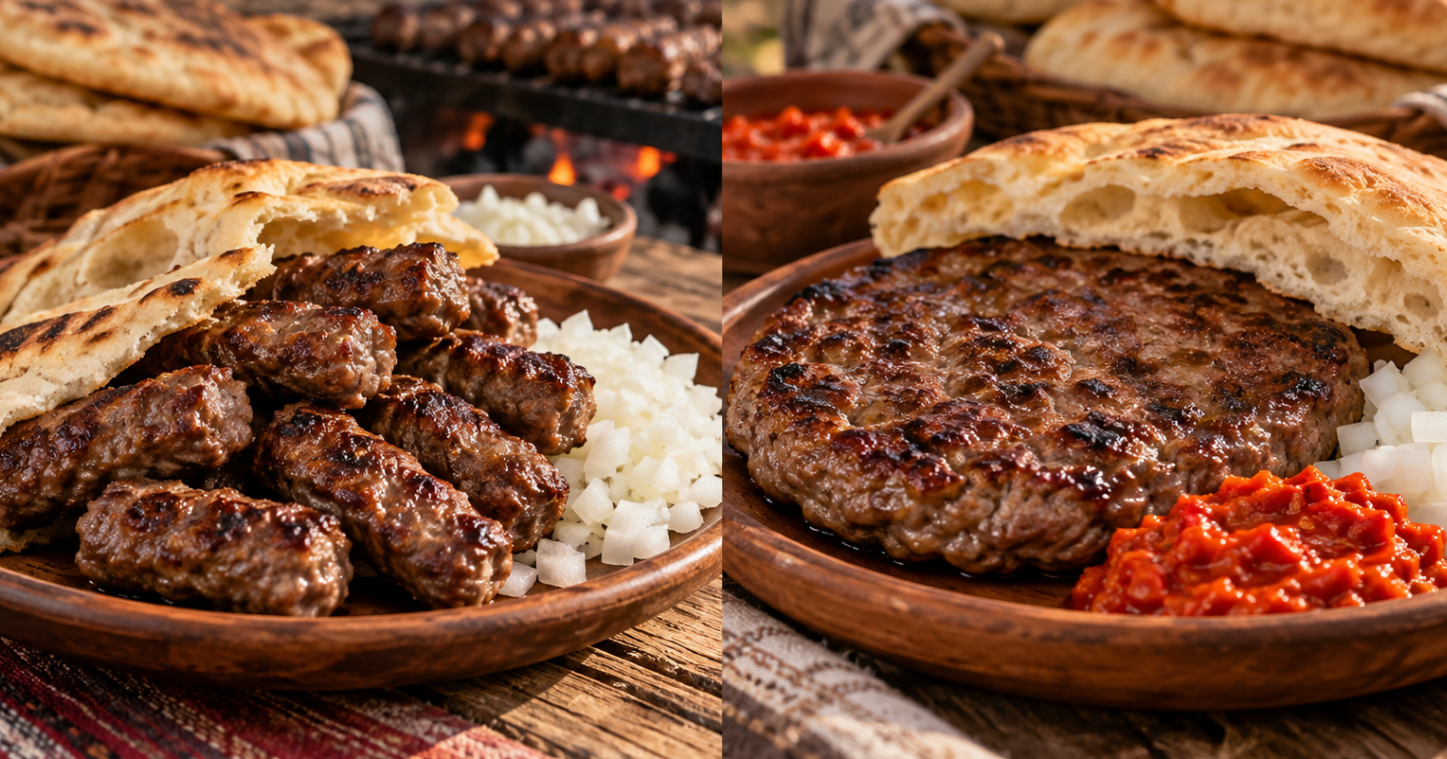
Ćevapi or Pljeskavica? What to Make for Your Next Balkan Cookout
Planning a weekend roštilj and deciding whether to make ćevapi or pljeskavica? Both belong on a Balkan grill, and neither needs to compete with the other. The more useful question is what kind of meal you want to serve—and how much room you have to cook it.
Ćevapi are small, hand-shaped rolls of ground meat. Pljeskavica is a broad, flat patty. Both are familiar across the Balkans, but their ingredients and preparation vary by region and household. Here, we’re talking about the two specific recipes on BalkanFeast, not claiming one universal formula for either dish.
For a cookout in an American backyard—or a family lunch made on a stovetop—the choice comes down to portions, shaping, grill space, and what you’ll put on the table. The same readily available 80/20 ground chuck works as the starting point for both of our recipes.
Choose by the kind of meal you’re serving
Make ćevapi for a platter people can share
A batch of Bosnian ćevapi gives you many small pieces to divide among guests. You can tuck several into warm bread with chopped onion or serve them on a platter so everyone builds their own plate. They’re especially convenient when you want people to take different-sized portions.
There’s more individual shaping and turning at the grill, though. Each piece needs room to brown, and a small pan may require several batches.
Make pljeskavica when you want one substantial patty per person
Our pljeskavica recipe makes four large, thin patties. Each works as the centerpiece of an individual plate or a generously filled lepinja. You shape fewer pieces, but they need a broad cooking surface and enough support to turn without breaking.
Choose it when you have room for those wide patties and want to serve distinct individual portions rather than a platter of smaller grilled pieces.
What changes between our two recipes?
| Practical detail | Ćevapi | Pljeskavica |
|---|---|---|
| Shape | Small, elongated meat rolls | Wide, thin patties |
| Meat | Ground beef, ideally around 80/20 | Ground beef, ideally around 80/20 |
| Seasoning in this recipe | Beef and salt | Beef, salt, onion, sweet paprika, black pepper, and cold sparkling water |
| Shaping | Many evenly sized pieces | Four large patties in the base recipe |
| At the grill | Turn small pieces regularly | Support each broad patty with a wide spatula |
Both BalkanFeast recipes call for thorough mixing and two refrigerated rests: 90 minutes before shaping and 30 minutes afterward. Neither is a mix-it-and-grill-it-immediately recipe. The differences in the table describe our particular recipes; they are not rigid rules about every Bosnian, Serbian, Croatian, or other regional preparation.
Plan the cooking around your grill
With ćevapi, the challenge is keeping numerous small pieces evenly browned without crowding. A flat griddle, heavy grill pan, or suitable grill surface gives you more control. Turn them as needed, and keep uncooked pieces refrigerated while earlier batches finish.
Pljeskavica asks for space instead of frequent small-piece handling. A patty that’s roughly 6–7 inches wide needs enough room to lie flat. Let the underside brown before turning, lift it with a wide spatula, and avoid pressing out the juices. If your skillet holds only one or two patties, account for extra batches.
Whichever you choose, cook ground beef to 160°F (71°C) at the center, checked with a food thermometer. For a thin pljeskavica, insert a suitable probe from the side. Browning and grill marks don’t establish safe doneness. These are practical home-cooking precautions, not differences between the two dishes.
Bread and sides make it a Balkan grill meal
Warm Bosnian somun and lepinja both work with either meat. Somun is closely associated with Bosnian ćevapi, while a soft lepinja is particularly handy for wrapping around a large pljeskavica. The names and serving habits overlap across the region; you don’t need two kinds of bread for one meal.
Put finely chopped raw onion on the table, and offer ajvar for roasted-pepper flavor. Kupus salata adds a crisp, refreshing contrast to the grilled beef. Kajmak is another familiar accompaniment if you have a suitable product available. Serve the extras separately so guests can put together their own plates.
If you want a simple menu, choose one meat, one bread, onion, and one or two sides. You don’t need a large assortment to make the meal feel complete.
Can you put both on the same grill?
Absolutely. A mixed platter makes sense for a larger gathering, provided you plan the cooking space. Serve smaller portions of each instead of assuming every guest needs a full-sized pljeskavica and a full serving of ćevapi.
Prepare the two meat mixtures according to their own recipes—don’t divide one seasoned batch into two shapes and expect identical results. Keep the raw meat cold, cook in manageable batches, and use clean utensils and platters for the finished food. Set out the warm bread and sides only when the meat is nearly ready.
Frequently asked questions
Is pljeskavica just a Balkan hamburger?
Both are made from ground meat and shaped into patties, but pljeskavica has its own Balkan grilling tradition. Our version is especially broad and thin, with a thoroughly mixed beef base, onion, spices, and a short addition of sparkling water. It isn’t simply a hamburger with a different name.
Can I use the same American ground beef for both?
Yes. Both of our recipes use ground beef with around 18–20% fat, so 80/20 ground chuck is a practical US grocery-store choice. Follow the different seasonings, shaping instructions, and refrigerated resting stages for each dish.
Can I make either dish without an outdoor grill?
Yes. A hot, suitable griddle or heavy skillet works for ćevapi, and a large skillet or flat griddle works for pljeskavica. Don’t crowd the pan, keep waiting portions refrigerated, and check the safe internal temperature before serving.
Which one should I make first?
If you’re serving a sharing platter and like smaller portions, start with ćevapi. If you want an individual patty served in bread or on a plate, make pljeskavica. Once you know both methods, a mixed Balkan grill is a natural next option.