Vanilice Recipe – Balkan Jam Sandwich Cookies
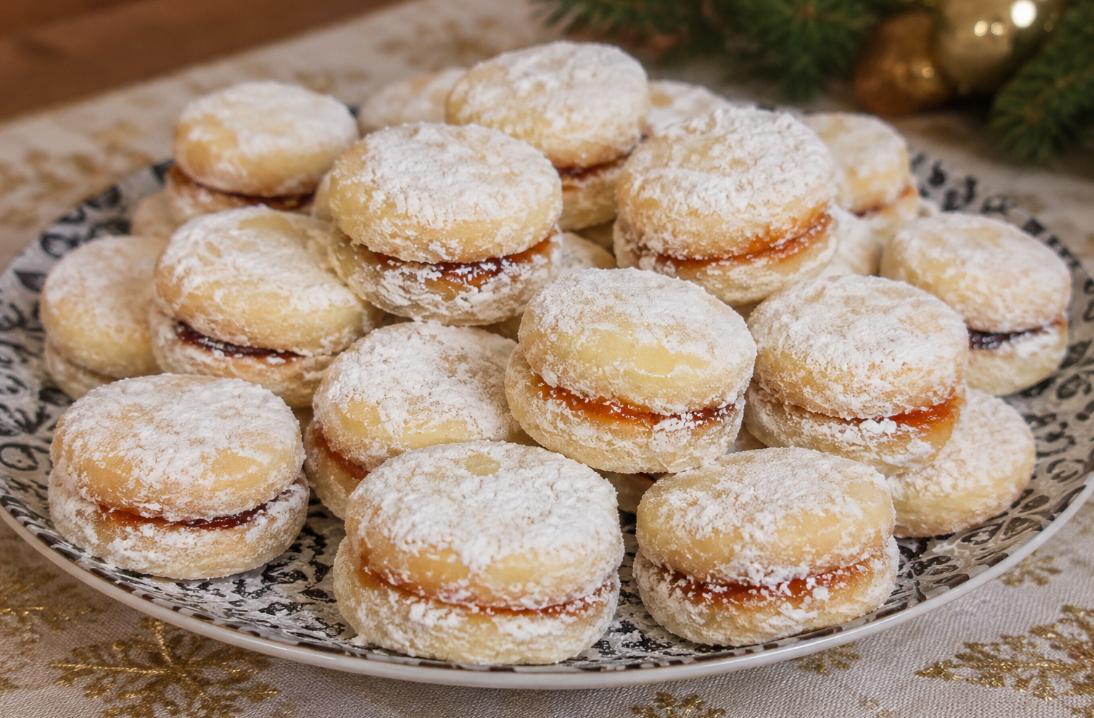
Vanilice are small Balkan sandwich cookies with a tender walnut-and-butter dough, smooth apricot filling, and a coat of vanilla powdered sugar. Two pale baked rounds make each finished cookie. The walnuts and lemon are part of this version’s flavor, alongside vanilla sugar in both the dough and the outer coating.
This vanilice recipe uses butter, one whole egg, and an additional yolk to make a dough that rolls after chilling. The cookies should stay light on top, with only a hint of gold underneath. Let the halves cool completely before filling so they can be handled without crumbling.
Plan ahead for the overnight rest: these cookies are assembled first, then refrigerated while the filling and crumb settle together. The base formula targets about forty finished sandwich cookies, with US Customary measures and the exact Metric formula available in the card. They fit naturally on a winter cookie platter or beside Bosnian coffee.
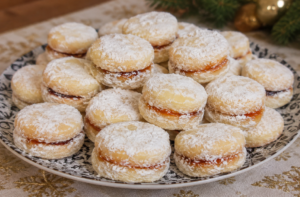
Vanilice – Balkan Jam Sandwich Cookies
Ingredients
- 3 1/3 cups all-purpose flour Spoon and level; weighing is most reliable.
- 7 oz unsalted butter Softened to about 68°F (20°C), not melted.
- 3 1/2 oz walnuts Finely ground; weigh rather than estimating ground-nut volume.
- 1/2 cup fine granulated sugar
- 1 large whole egg About 50 g without the shell; practical US equivalent of the source medium egg.
- 1 large egg yolk Additional yolk, about 18 g each; not another whole egg.
- 2 tsp vanilla sugar For the dough; weigh for accuracy because packet sizes vary.
- 5 tsp fresh lemon juice Weight is more precise than the rounded spoon amount.
- 2 1/2 tsp finely grated lemon zest Yellow part only, from a washed lemon; loosely filled spoon, preferably weighed.
- 1/6 tsp fine table salt Best weighed on a fine-resolution scale; not coarse kosher salt.
- 5 1/4 oz smooth apricot preserves Plain preserves with no large fruit pieces; puree chunky preserves smooth before weighing.
- 1/2 cup powdered sugar Measure unsifted, then sift if lumpy; weighing is most reliable.
- 2 tsp vanilla sugar For the coating; separate from the dough portion.
Equipment
- Digital kitchen scale Use for flour, ground walnuts, and small ingredient weights; a 0.1 g scale helps with salt.
- Food processor Pulse walnuts finely without making nut butter; also useful for smoothing chunky preserves.
- Mixing bowls Separate bowls for dry ingredients, dough, and coating.
- Electric mixer Hand or stand mixer.
- Fine grater For the yellow lemon zest only.
- Rolling Pin Thickness guides are helpful.
- Round cookie cutter About 1.6 inches (4 cm) across; keep this size at every scale.
- Half-sheet baking pans Two large pans for the base estimate; bake in uncrowded batches.
- Parchment paper For rolling, baking, and separating stored layers.
- Wire rack Cool the baked halves completely before filling.
- Small offset spatula Or a teaspoon for the preserves.
- Airtight container For refrigerated overnight maturation and storage.
Method
- Prepare the ingredients. Have the butter softened to about 68°F (20°C), pliable but not shiny or melted. Finely grind the walnuts in short pulses without making a paste. Wash and dry the lemon, then measure the yellow zest and juice. Combine the flour, ground walnuts, and salt in a separate bowl.
- Cream the butter and sugars. Beat the butter with the dough portion of granulated sugar and vanilla sugar for about 3 minutes on medium speed, scraping the bowl as needed, until creamy and evenly combined.
- Add the eggs and lemon. Beat in the whole eggs, then the additional yolks, until incorporated. Briefly mix in the measured lemon juice and zest.
- Mix the dough. Add the dry mixture in several additions on low speed. Stop as soon as the dough holds together, finishing with a spatula if needed. Do not knead for several minutes or taste the raw dough.
- Chill the dough. Shape into a flat disk about 1 inch (2–3 cm) thick, wrap, and refrigerate for about 60 minutes. Divide a larger batch into several disks so they chill evenly.
- Roll and cut. Heat the oven to 340°F (170°C), conventional, and line baking pans with parchment. Work with half of a base batch or one manageable portion at a time, keeping the rest chilled. Roll between parchment sheets to an even 3/16 inch (5 mm), and cut circles about 1.6 inches (4 cm) across. Gather scraps gently and reroll once. Cut an even number of circles so every finished cookie has two halves. Keep about 1/2 inch (1.25 cm) between circles and use additional trays rather than crowding.
- Bake gently. Bake one tray at a time on the middle rack for about 10–12 minutes, until the tops remain pale and the undersides are only very lightly golden. Rotate if the oven browns unevenly. Repeat with the remaining trays; the displayed baking time is for the base batch and increases with more batches.
- Cool completely. Let the baked halves firm on the tray for about 5 minutes, then move carefully to a wire rack. Allow at least 20 more minutes and longer if needed until completely cool. Earlier trays can cool while later trays bake.
- Fill the cookies. Pair fully cooled halves of similar size. Stir the smooth preserves, then spread a thin layer on the flat underside of a supported cookie half. Set its partner on top, flat side toward the filling, and join with very gentle pressure. Distribute the measured filling across the selected yield.
- Coat with sugar. Mix the powdered sugar and the separate coating portion of vanilla sugar in a shallow bowl. Gently cover the top, bottom, and sides of each assembled cookie. Lift carefully and shake off loose excess without squeezing the sandwich.
- Allow the flavor to develop. Arrange in a clean airtight container, using parchment between layers. Refrigerate promptly at 40°F (4°C) or below for about 12 hours before serving so the filling and cookie texture can settle together. Follow the preserves label and the storage notes; do not leave the filled cookies on the counter overnight.
Notes
Choose flour, walnuts, and vanilla sugar carefully
US all-purpose flour is a practical match for German Type 405 in this adaptation, but the names do not describe identical milling standards. Weighing is the best way to keep the flour quantity consistent. If using cups, spoon the flour into the cup and level it; packing flour into a measuring cup can make the dough dry.
Use fresh walnuts and grind them finely in short pulses. Stop before they become oily nut butter. Large pieces catch at the cut edges and make thin rounds harder to handle, while finely ground nuts blend into the dough. Do not replace them with a different nut or leave them out of this fixed formula.
Vanilla sugar is dry sugar flavored with vanilla or vanillin. Dr. Oetker is one practical US option, sold through baking aisles and European grocery suppliers. Check the package: a US pouch may hold 9 g rather than the 8 g needed for each base-recipe portion. Weigh the required amount instead of assuming that one packet is interchangeable. Liquid extract is not part of this recipe.
Measure the small ingredients without guessing
The US teaspoons for vanilla sugar, lemon juice, and zest are practical approximations; the Metric selector keeps their original weights. Zest varies with the grater and how tightly the spoon is filled. Grate only the yellow surface of a washed lemon, avoiding the bitter white pith, and weigh the zest when possible.
Fine table salt is modeled at 6 g per teaspoon, making the base amount one-sixth teaspoon. That is an awkward spoon measure, so a scale with 0.1 g resolution is preferable. Coarse kosher salt has a different bulk density. Powdered sugar also changes with packing and sifting; measure it unsifted if using the cup amount, then sift out lumps.
Walnuts are listed in ounces by weight in the US system because their volume changes after grinding. The whole egg and the extra yolk remain separate in both systems. A US large whole egg, about 50 g without its shell, is the practical counterpart used here; the additional yolk is approximately 18 g.
Keep the dough cool and mix it briefly
The butter should be soft enough to beat smoothly at about 68°F (20°C), without being melted or glossy. Cream it with the dough sugars, incorporate the eggs and lemon, then add the flour mixture only until the dough comes together. Long kneading encourages a firmer, less tender cookie.
A flat wrapped disk chills more evenly than a thick ball. Keep the unused portion refrigerated while rolling, especially in a warm kitchen. If the dough becomes greasy or sticks badly to the parchment, pause and chill it again instead of working in repeated handfuls of extra flour. Raw flour and eggs make the unbaked dough unsuitable for tasting.
Bake pale rounds and count finished sandwiches
Keep the dough about 3/16 inch (5 mm) thick and use a cutter about 1.6 inches (4 cm) across. These dimensions stay the same when the ingredient quantities increase. Roll scraps gently once; repeated rerolling and warming make the dough harder to handle.
Bake uncrowded trays one at a time at 340°F (170°C), conventional heat. Begin checking at ten minutes. The tops should remain pale and the undersides should have only very light color. Leave the fragile rounds on the tray for about five minutes before transferring them to a rack.
The target is about eighty baked circles for forty finished cookies. At 2x, plan about 160 circles for eighty sandwiches; at 3x, about 240 circles for 120 sandwiches. Cutter size, rolling thickness, and scraps can change the actual count. The serving selector refers to finished cookies, each made with two halves, rather than unfilled rounds.
Fill and coat without breaking the cookies
Use plain apricot preserves with a smooth texture. If the jar contains large pieces, puree the preserves before measuring the filling; do not leave chunks between the delicate halves. Spread a thin layer on the flat underside of a completely cooled cookie, support it on the work surface, and gently add its matching half. Apricot jam also fills palačinke, where it is spread over thin pan-cooked crepes and rolled instead of joining tender cookie halves.
A thick lump of preserves can squeeze out and wet the sugar coating. Heavy pressure can crack the rounds. Handle the assembled cookies from underneath, turn them gently in the powdered-sugar and vanilla-sugar mixture, and shake off loose excess.
Allow time for cooling and the overnight rest
The total shown is fourteen hours and thirty-five minutes: forty-five minutes of active work, about twenty-five minutes of baking batches, one hour of dough chilling, a conservative twenty-five-minute cooling allowance after the final tray, and twelve hours of refrigerated maturation. Cooling earlier trays can overlap later baking, but the last tray must still cool before filling.
This schedule starts with softened butter ready to use. Extra trays, a slow oven, or a larger batch can take longer. Doubling or tripling increases the amount of rolling and baking; it does not multiply the dough chill or overnight rest. The timing and yield are editorial estimates, not results of a kitchen test.
Serve a small platter and keep the cookies refrigerated
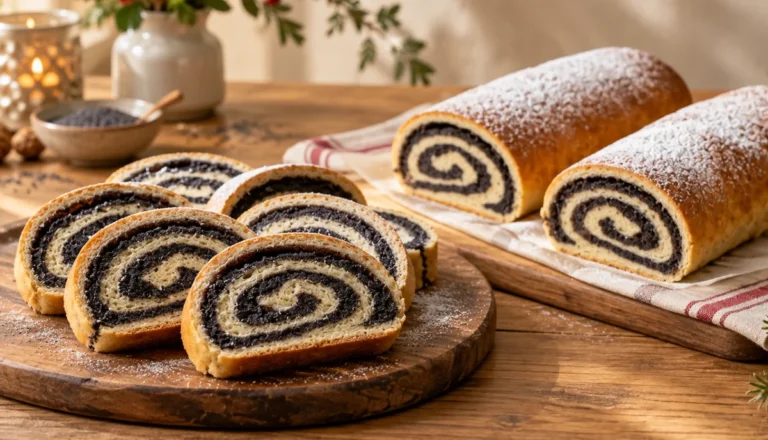
Vanilice have a tender cookie crumb and a thin fruit filling. They differ from syrup-soaked hurmašice and the pastry-and-walnut layers of Bosnian baklava. A small mixed platter can show those different textures without making the desserts seem interchangeable. A slice of Croatian poppy seed roll adds soft yeast dough and a rich ground poppy seed filling to that mix.
For this version, refrigerate the filled cookies in an airtight container at 40°F (4°C) or below, with parchment between layers, including during the twelve-hour maturation. The checked preserves manufacturer recommends refrigeration after opening. Follow the label on your own jar; this recipe does not establish a long room-temperature shelf life.
Once filled, refrigerate promptly and limit total room-temperature handling to two hours, or one hour above 90°F (32°C). Plan to serve within three to four refrigerated days as a conservative home-use window. Let only the portion being served lose its chill briefly. Refrigeration can soften the powdered-sugar surface, so a little reserved coating can refresh it.
Prepare ahead and understand the nutrition estimate
The wrapped dough can be chilled overnight. Let it become just pliable enough to roll before continuing. For another make-ahead option, freeze fully cooled, unfilled cookie halves airtight and thaw them in their closed container before filling and coating. Check ingredient labels for wheat, milk, eggs, walnuts, and possible cross-contact.
Nutrition is estimated per one of forty finished sandwiches, using checked ingredient data and the exact Metric weights. It includes the preserves and all the coating sugar. Loose sugar left in the bowl and discarded dough scraps are not measured, so the estimate assumes more is consumed than may actually stick to the cookies. If your batch makes a different number, the nutrition per cookie changes.