Bosnian Coffee – How to Make Bosanska Kafa
Bosnian coffee, or bosanska kafa, is a small, strong, unfiltered coffee made in a long-handled pot called a džezva. Powder-fine grounds meet already-hot water, the pot returns briefly to the heat to raise a layer of foam, and the coffee rests before it is poured into small cups.
The important details are the grind, enough room for the foam to rise, and the moment you take the pot off the heat. The grounds are not strained out. They settle in the pot and cup, and you leave the gritty last mouthful behind rather than drinking it.
This recipe uses a hot-water-first method with one controlled rise and a small portion of the same brewing water reserved for the finish. It makes two small cups of unsweetened coffee. Sugar cubes, a glass of drinking water, and rahat-lokum belong on the side, so each person can choose how to enjoy them.
Bosnian Coffee (Bosanska Kafa)
Ingredients
- 5/8 cup water fresh drinking water; U.S. volume rounded
- 2 tbsp powder-fine roasted ground coffee Bosnian- or Turkish-style grind, finer than typical espresso; spoon volume is approximate, so weighing is preferable
- sugar cubes serve separately, to taste; excluded from nutrition estimate
- rahat-lokum Turkish delight, optional, served on the side; excluded from nutrition estimate
- drinking water optional, in a separate glass for serving; not extra brewing water
Equipment
- Food-safe džezva A long-handled coffee pot compatible with your stove. For the base recipe, a roughly 8–10 fl oz (250–300 ml) pot leaves room above 150 ml water for the foam. Use a larger suitable pot or repeated batches when scaling.
- Small heatproof cup For the reserved hot water; the handle and pot can be very hot.
- Teaspoon For stirring and sharing the foam.
- Fildžan cups Small heatproof drinking cups; espresso cups are a practical substitute.
- Kitchen scale Recommended for repeatable coffee strength; spoon weights vary.
Method
- Measure and prepare. Measure the coffee and brewing water. Choose a food-safe, stove-compatible džezva with ample empty space above the water for rising foam. Set out the small heatproof cup and drinking cups. The optional serving water is separate from the measured brewing water.
- Heat the water first. Put the measured brewing water in the džezva and bring just to a boil over moderate heat. Keep the handle away from the burner and use a dry heatproof holder if needed. Do not leave the pot unattended.
- Reserve a little water. Remove the džezva from the heat. Carefully pour 1 tbsp (15 ml) of the hot water into the heatproof cup, about one-tenth of the original brewing water. This is part of the measured water, not additional water.
- Stir in the coffee. With the pot off the heat, add the finely ground coffee to the remaining hot water and stir gently until evenly wetted. Keep your face and hands clear of steam. Leave the sugar out of the pot for this unsweetened main method.
- Raise the foam. Return the džezva to low heat. Watch continuously as the surface foam begins to lift and expand. Remove the pot as soon as the foam rises, well before it can reach the rim or spill over. Do not maintain a rolling boil or chase repeated rises in this main method.
- Return the reserved water. With the džezva off the heat and standing securely, gently add the reserved hot water. Let the coffee stand undisturbed for about 3 minutes so the grounds begin to settle. This rest also allows some cooling, but does not guarantee it is cool enough to drink.
- Share and pour. If desired, spoon a little surface foam into each cup, then pour the coffee slowly among the displayed servings. Leave the dense grounds in the pot and stop pouring when the liquid becomes muddy. Let any fine sediment carried into the cups settle; do not filter or stir it back up.
- Sip and serve. Allow the coffee to cool to a comfortable drinking temperature before sipping. Offer the separate drinking water and optional sugar cubes or rahat-lokum on the side. Sip slowly and leave the sediment at the bottom of the cup rather than drinking the last gritty mouthful.
Notes
- Strength and portions: The precise reference ratio is 10 g coffee to 150 ml brewing water, divided into two small cups. The U.S. spoon measure is approximate and depends on the grind and packing. Finished liquid yield is lower than the starting water because of evaporation and liquid left with the grounds; this is not a measured yield.
- Method: This recipe uses a hot-water-first method with one controlled foam rise and a little of the same water reserved for the finish. Other Bosnian households use a separate kettle or repeat the rise. Neither a fixed number of rises nor one household's coffee dose is universal.
- Foam: Pjena, sometimes called kajmak in this coffee context, is coffee foam, not dairy kajmak or cream. No milk product is added to the base drink.
- Heat and scaling: Leave generous headroom and watch the pot continuously. Remove it before the foam reaches the rim. Keep the handle away from heat, use protection if it is hot, and place the pot on a stable heatproof surface. Use repeated batches if your pot cannot safely accommodate the scaled volume. Heating time depends on the stove and pot; do not multiply it automatically.
- Serving and storage: Let the coffee settle and cool enough to sip. Pour slowly without stirring up the sediment, and leave the muddy last mouthful. Freshly brewed coffee is best; do not keep reheating the grounds. Store dry coffee airtight, cool, dry, and away from strong odors.
- Nutrition: Approximately 1 kcal per small cup is a generic USDA brewed-black-coffee reference calculated for 75 g beverage, not the calories in the dry grounds and not a laboratory analysis of this unfiltered preparation. Actual served volume and extraction vary. Sugar and rahat-lokum are excluded; caffeine has not been calculated.
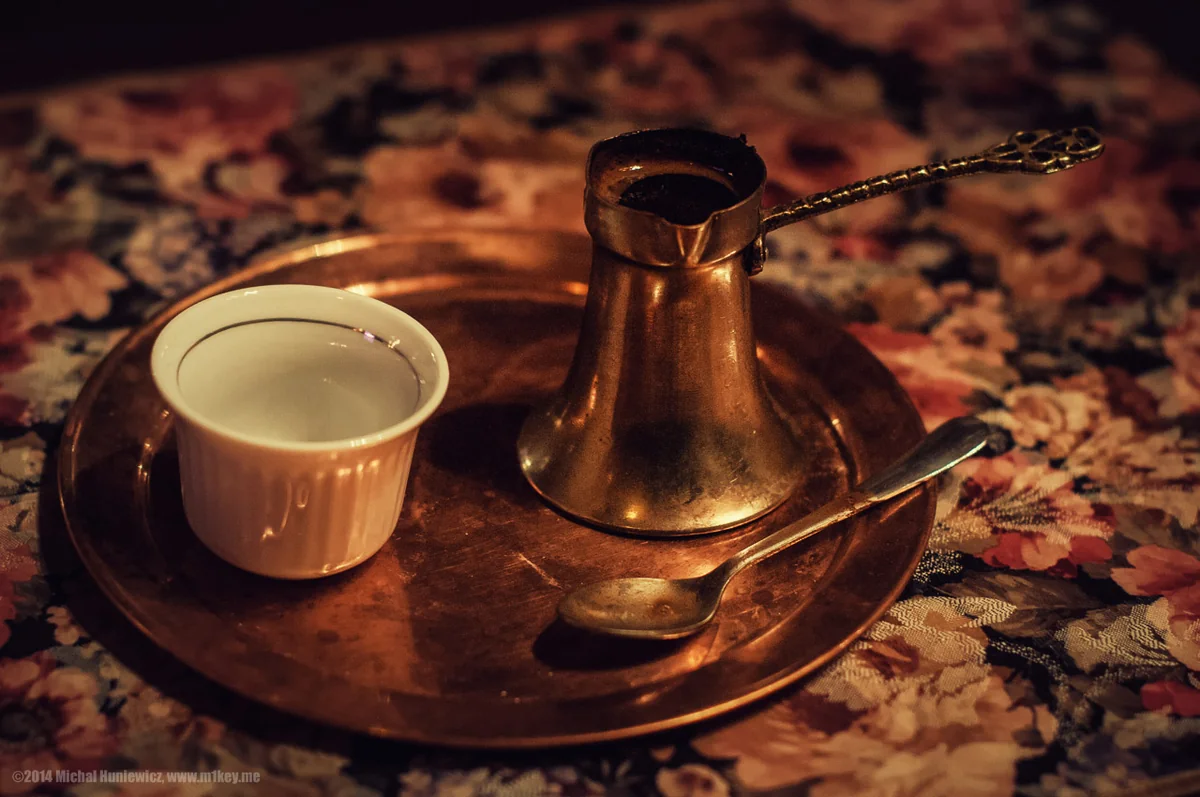
- Photo credit: Photo: Michał Huniewicz, “Bosnian coffee”, CC BY 2.0. Resized and converted to WebP; original watermark retained.
The method chosen for this recipe
Bosnian coffee has closely related household methods rather than one compulsory sequence. Here, the water boils first, a little is set aside, the coffee is stirred into the hot water off the heat, and the džezva returns to low heat just until the foam lifts. The reserved water goes back in before a short settling rest.
This choice reflects the hot-water-first preparation described in regional accounts of Bosnian coffee. Some cooks heat water in a separate kettle and pour it over coffee already in the džezva. Others raise the foam more than once. Those variations should not be confused with a requirement to boil the coffee hard or let it overflow.
One rise gives a first-time cook a clear stopping point. It is the main method here, not a claim that a second rise is inauthentic. The pot, heat source, amount of coffee, and household preference all affect the result. The measured ratio is a practical starting formula, not a national rule or a claim of personal kitchen testing.
Choose the right coffee and grind
Look for plain roasted coffee ground specifically for Bosnian or Turkish-style preparation. The texture should resemble a very fine powder, finer than the usual grind sold for espresso. Ordinary drip coffee, French-press grounds, and instant coffee are different products and do not reproduce this method.
A Balkan grocery or a U.S. seller of imported Bosnian coffee is often the simplest place to find the right grind. A product labeled Turkish-ground can also provide the necessary particle size; that label does not mean you must follow a cold-water Turkish brewing sequence. If buying from a roaster, ask whether the grinder can produce a true cezve or Turkish grind.
Use a roast and blend you enjoy. There is no need to describe one roast color or bean blend as mandatory for every Bosnian household. Avoid adding flavorings or spices to the main recipe if your aim is the straightforward coffee described here. Keep the opened coffee tightly sealed, cool, dry, and away from strong odors.
Why measuring the grounds matters
The precise reference formula is 10 g of coffee for 150 ml of brewing water, or about 67 g per liter. That quantity is divided between two small cups, not two American mugs. The cup does not receive all of the starting water: some liquid remains with the grounds, and some is lost during heating.
The U.S. measure of about two tablespoons of grounds is a convenience estimate. Powder-fine coffee can pack differently from one spoonful to another, and a heaped household teaspoon is not a standardized weight. Use a scale for repeatable strength, especially when changing brands or increasing the batch.
The water measure of ⅝ U.S. cup is also rounded; 150 ml is the precise reference. You can measure ⅝ cup as ½ cup plus two tablespoons. For a stronger or milder future batch, change the coffee dose deliberately and keep a note rather than guessing how much water disappeared into the grounds.
Džezva, fildžan, and an American stove
A džezva is a small coffee pot with a long handle and a pouring lip. Its shape helps you watch the rising surface and pour carefully. Use a pot made for food preparation, with an intact food-safe interior and a heat source approved by its manufacturer. A decorative copper souvenir is not automatically cookware.
For the base recipe, a pot of roughly 250–300 ml capacity leaves useful headroom above the measured brewing water. Do not fill a small pot to the neck and hope to lift it quickly enough. A larger batch needs a suitably larger pot or repeated smaller batches; the serving multiplier cannot create extra room in your džezva.
Keep a gas flame beneath the base rather than around the sides or handle. A very small pot must stand securely on the burner support. Induction requires compatible cookware; do not assume that a copper pot will work. Follow the pot and stove instructions rather than improvising an unstable support.
A fildžan is a small coffee cup, often handleless. Small heatproof espresso cups are a practical substitute when you do not own a traditional set. Use cups intended for hot drinks and remember that a handleless cup can become too hot to hold comfortably.
Heat the water before adding the coffee
Measure all the brewing water into the džezva and bring it just to a boil. Remove the pot from the heat before adding the grounds. This makes the sequence easier to control and keeps your hands away from a pot that is actively rising while you stir.
Reserve about one-tenth of the original brewing water in a small heatproof cup. For the base recipe, that is one tablespoon, or 15 ml. It comes from the measured water and returns to the pot later. It is not extra water added on top of the formula. The quantity in the recipe-card instruction changes with the serving multiplier.
Stir the coffee into the remaining hot water gently until it is wetted evenly. Do not leave dry clumps floating on top, but there is no need to beat air into it. Keep the sugar separate in this unsweetened version. Set the reserved water somewhere secure, away from the edge of the counter.
Raise the foam without boiling over
Return the džezva to low heat and watch the surface continuously. The coffee will develop a layer of foam that lifts as the mixture heats. Take the pot off while there is still safe space below the rim. A rolling boil is not the goal, and an overflowing pot is not evidence of a stronger or more traditional coffee.
Timing varies with the burner, pot material, and batch size, so the visual change matters more than a fixed number of seconds. Use a dry heatproof holder if the handle is hot. Set the pot on a stable heatproof surface before gently returning the reserved water.
Coffee foam is not dairy kajmak
The surface layer is coffee foam, commonly called pjena. In a coffee conversation, people may also call it kajmak or kaimak. That name describes the frothy top here; it does not mean the layered dairy product of the same name has been added.
This base drink contains coffee and water only. Milk, cream, and dairy kajmak are not ingredients in the brewing pot. The foam is also different from the pressure-produced crema of an espresso machine. You are using a stove and a džezva, not an espresso extraction.
Let the grounds settle, then pour slowly
Leave the finished coffee undisturbed for about three minutes before serving. This gives the heavier grounds time to begin settling and allows some cooling. It does not guarantee a safe sipping temperature, so take care with the first taste.
If you want to share the foam evenly, put a small spoonful into each cup before pouring. Tilt the džezva gently and divide the liquid among the small cups, stopping before dense sediment starts to run out. Some fine particles will still enter the cup; unfiltered coffee is not supposed to look like paper-filtered drip coffee.
Let the cup stand briefly if its contents have been disturbed. Do not keep stirring the sediment back into suspension. Sip the clearer coffee above it, and leave the thick, muddy bottom behind. Straining the brew through a paper filter would change the preparation described in this recipe.
Serving coffee with water, sugar, or rahat-lokum
A glass of drinking water and something sweet are familiar companions to Bosnian coffee. The water served alongside is separate from the measured brewing water. It can be sipped before or between coffee sips according to preference.
Offer sugar cubes and rahat-lokum, also known as Turkish delight, separately. For a dessert alongside the coffee, consider Bosnian baklava, hurmašice, or tufahije. Some people take a small bite of something sweet and follow it with coffee; others sweeten their cup. Neither accompaniment is necessary to make the unsweetened base recipe, and neither is included in its nutrition estimate.
Serve the džezva on a heatproof tray or surface, with room to handle it safely. Let everyone know that the pot and cups may be hot. A traditional service is an invitation to drink slowly, not a reason to swallow coffee while it can still burn your mouth.
Bosnian and Turkish coffee: related methods, careful distinctions
Both preparations belong to a wider family of very finely ground, unfiltered coffee made in a small pot. A common distinction is the starting sequence: many Turkish methods mix coffee with cold water, sometimes with sugar, before heating; this Bosnian method heats the water first and serves sweetness separately.
That is a useful comparison, not a rule covering every cook in either country. Pots, coffee blends, the number of foam rises, and serving habits overlap and vary. Avoid claims that one method always has more caffeine, is always darker, or must taste completely different solely because of its national name.
Troubleshooting the pot and the cup
There is very little foam
Check that the coffee is powder-fine and has been stored well. Then watch the heat: a violent boil can disturb the surface you are trying to preserve. A small amount of foam does not justify repeated hard boiling. Check the grind and use a controlled rise on your next batch.
The coffee boils over
Take it off the heat immediately and allow the burner area to cool before cleaning. For the next batch, leave more headroom, reduce the heat, and watch continuously. Do not put your face over the pot or try to stop an overflow by stirring a rapidly rising mixture.
The cup is unusually gritty
Allow a settling rest, pour gently, and stop before the dense grounds leave the džezva. Do not scrape the bottom of the pot into the cup. Fine sediment is expected, but drinking the last muddy mouthful is not part of the technique.
The coffee tastes too strong or bitter
Check the weighed dose and starting water before changing the method. A large heaped spoon can contain much more coffee than a lightly filled one. Hard boiling, repeated reheating, or a roast you dislike can also make the cup less pleasant. Adjust the next batch deliberately instead of pouring extra unmeasured water into a finished pot.
Scaling, freshness, and nutrition
The recipe card scales coffee, brewing water, and the reserved-water instruction together. Use repeated batches if a larger volume would crowd the pot. Do not automatically double or triple the heating time: watch for the same controlled foam rise and allow the settling rest.
Brew close to serving time. Repeatedly reheating the same grounds is not the main recipe and does not recreate a fresh pot. Keep the dry coffee sealed and prepare only the amount you expect to drink.
The small numeric nutrition estimate uses a generic USDA brewed-black-coffee entry for a 75 g beverage portion. It does not count the dry grounds as though they were eaten. The result is about one calorie per small cup before optional sugar or sweets, with uncertainty from the actual liquid yield and extraction. It is not a specific laboratory analysis of Bosnian coffee, and caffeine has not been estimated.
Frequently asked questions
Can I use espresso-ground coffee?
Typical espresso grind is coarser than the powder-fine grind needed here. Ask for a Bosnian, Turkish, or cezve grind rather than assuming every bag marked espresso is suitable.
Must I raise the foam three times?
No. This recipe uses one controlled rise. Repeated rises exist in household practice, but they are not a universal authenticity test and should never mean letting the pot boil over.
Should the coffee be sweetened in the pot?
The main recipe is brewed without sugar, with optional sweetness served separately. Adding sugar during brewing is a variation and changes the nutrition calculation.
Do I need to drink the grounds?
No. Let them settle and leave the sediment in the pot and at the bottom of the cup. Do not filter the coffee to remove every fine particle if you want to keep this preparation.
Method references
The hot-water-first sequence and household variations were cross-checked against Visit B&H’s regional account, Cheyf’s local coffee guide, and Dorian Jurić’s study of Bosniak coffee culture in Folklorica. Franck’s coffee-pot instructions provide an additional regional reference for adding grounds to boiled water and allowing a settling rest. The weighed dose above is this recipe’s stated starting formula; household spoon measures in those accounts are not exact gram conversions.
Photo: Michał Huniewicz, “Bosnian coffee”, CC BY 2.0. Resized and converted to WebP; original watermark retained.