Bosnian Baklava Recipe – Walnut Phyllo Pastry
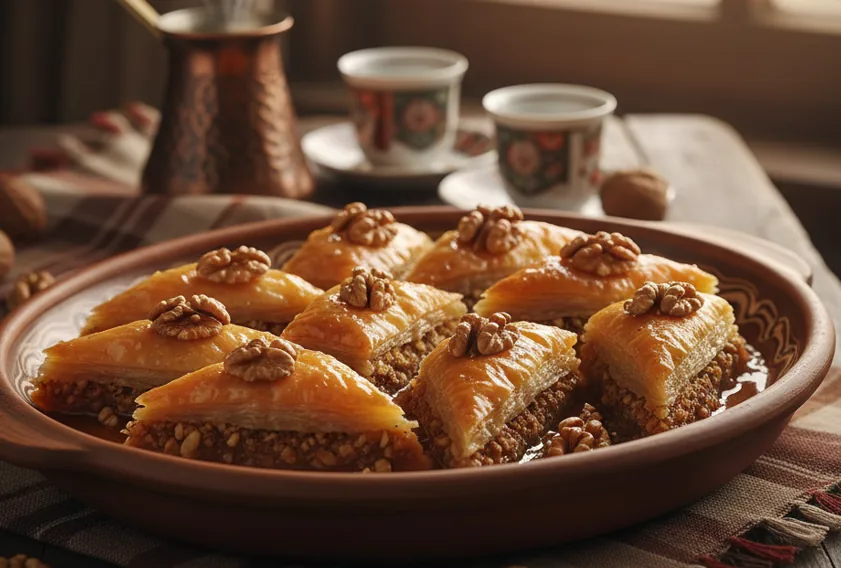
Bosnian baklava is a walnut-filled pastry made with thin phyllo sheets, butter, and agda, a lemon-scented sugar syrup. The top should be golden and delicately crisp, while the layers underneath are tender and evenly soaked. This version makes small diamond-shaped pieces with five thin walnut layers rather than one thick band of filling.
The important work happens before and just after baking: keep the phyllo covered, brush each sheet lightly with clarified butter, cut all the way through the assembled pastry, and give the lower layers enough time in the oven. For this recipe, completely cooled agda goes over hot baklava in several slow passes.
Plan for at least four hours of soaking after baking, and use a kitchen scale to keep the original proportions accurate. The US measurements below are convenient approximations; Metric preserves the exact formula. A roughly 12 × 8-inch metal pan is close to the original 30 × 20-cm pan, and larger batches are best divided among comparable pans.
Bosnian Baklava
Ingredients
- 2.125 cups water
- 2.75 cups granulated sugar US volume assumes about 200 g per cup; weighing is more precise
- 4 teaspoons fresh lemon juice
- 3 thin lemon slices from a well-washed, unwaxed lemon; remove after cooling
- 14 oz shelled walnuts grind three-quarters fairly fine and chop one-quarter more coarsely; do not make nut butter
- 0.25 cup granulated sugar
- 17.6 oz thin phyllo dough baklava-style pastry; thaw completely according to the package directions
- 8.8 oz unsalted butter starting weight before clarification
Equipment
- Rectangular metal baking pan about 12 × 8 inches (30 × 20 cm); use additional pans for larger batches
- Kitchen scale recommended for phyllo, nuts, butter, and sugar
- Measuring cups and spoons
- Medium saucepan for the syrup
- Small saucepan and bowl for clarifying butter
- Food processor or nut grinder plus a knife for the coarser walnuts
- Long sharp knife to cut all the way through the pastry before baking
- Pastry brush
- Parchment paper and barely damp kitchen towel to cover unworked phyllo; keep the towel off the dough
- Ladle and thin serving spatula
Method
- Dissolve the sugar. Put the syrup water and sugar in a medium saucepan. Heat, stirring gently, until the sugar dissolves completely.
- Simmer the agda. Bring to a boil, then simmer gently, uncovered, over medium heat for 10 minutes. Avoid vigorous stirring once it boils. Add the lemon juice and lemon slices and simmer for 3 more minutes.
- Cool the syrup. Remove from the heat and let the agda cool completely to room temperature. Remove the lemon slices. Make the syrup first so it can cool while you prepare and bake the pastry.
- Clarify the butter. Melt the unsalted butter slowly over low heat without browning. Let stand for 5 minutes, skim the foam, and carefully pour the clear butter into a bowl, leaving the milky sediment behind.
- Prepare the walnuts. Grind three-quarters of the walnuts fairly fine and chop the remaining quarter more coarsely. Combine both textures with the filling sugar. Divide into five equal portions for each pan.
- Prepare the oven and pan. Heat a conventional oven to 340°F (170°C), with a rack in the lower-middle position. Brush the bottom and sides of the metal pan lightly with clarified butter.
- Trim and count the phyllo. Trim the thawed phyllo to fit the pan. Save usable offcuts to lie flat between whole sheets; avoid thick folded lumps. Reserve about one-quarter of the pan-sized sheets for the base and one-quarter for the top. Divide the remaining half into four similar intermediate bundles.
- Keep the sheets covered. While working, cover unused phyllo with parchment paper topped with a barely damp kitchen towel. Do not put the damp towel directly on the pastry. Uncover only the sheets you are using.
- Build the base. Lay the first base sheet in the pan and brush with a thin film of clarified butter. Repeat with the rest of the base bundle, buttering each sheet lightly. Spread the first walnut portion evenly over it without packing it down.
- Add the middle layers. Add the first intermediate bundle, sheet by sheet, brushing each sheet lightly with butter. Spread the next walnut portion over it. Repeat with the remaining three intermediate bundles and three walnut portions. There should be five thin walnut layers altogether.
- Finish the top. Add the reserved top bundle one sheet at a time, lightly buttering every sheet. Brush the last sheet evenly without creating pools.
- Cut before baking. With a long sharp knife, cut all the way to the bottom of the pan. For a standard pan, make four lengthwise strips and five diagonal cuts across them to form six rows, giving about 24 small pieces, with partial shapes at the edges.
- Distribute the remaining butter. Slowly spoon the remaining clarified butter over the top and especially into the cut lines. Let the pan stand for 5 minutes.
- Bake thoroughly. Bake for 55–65 minutes, until evenly golden brown and the edges look baked rather than pale and doughy. A brown top alone is not enough. If it darkens too soon, loosely tent with foil during the final part of baking.
- Add cool agda to hot pastry. Take the fully baked baklava out of the oven and let it stand for 2 minutes. Slowly ladle the completely cooled syrup along the cuts and edges, then distribute the rest over the surface in two further passes. A brief hiss is normal. Do not dump it into one spot or press on the layers.
- Allow the syrup to absorb. Leave the baklava undisturbed at room temperature for at least 4 hours. Keep it uncovered for the first hour, then cover loosely only once fully cool. Do not move or compress the layers while they absorb the syrup.
- Serve along the existing cuts. Carefully retrace the original cuts and lift out the pieces with a thin spatula. Serve at room temperature, preferably after the syrup has distributed evenly; the flavor and texture continue to settle by the next day.
Notes
- Measure by weight. US measures are rounded kitchen equivalents; the Metric amounts preserve the source formula. Phyllo sheet sizes and counts vary. Buy enough to weigh the pastry rather than assuming one US package is sufficient.
- Pan size and scaling. The base recipe makes 24 small pieces in a roughly 12 × 8-inch (30 × 20-cm) pan. At 2x or 3x, use two or three comparable pans, divide the ingredients evenly, and retain the same layer thickness. Baking time does not multiply; rotate pans if needed and judge each pan separately.
- Butter. The listed weight is whole unsalted butter before clarification, not the weight of finished clarified butter. Do not substitute that weight of ghee as though the yields were identical.
- Timing. Prep and cook times are planning estimates with syrup cooking/cooling overlapping pastry preparation and baking. Bake for 55–65 minutes and allow at least 4 hours after adding the syrup. If the syrup has not cooled completely when the pastry is ready, allow additional time; do not pour it on warm.
- Storage. Once fully cool, cover. The source gives about 4 days in a cool room, or up to about 7 days refrigerated; refrigerate in warm conditions. These are household storage estimates, not validated preservation limits. Temper refrigerated pieces for about 30 minutes before serving. Freeze soaked portions airtight for up to about 2 months for quality, thaw in the refrigerator, and do not add more syrup.
- Nutrition estimate. About 354 kcal per piece, calculated for 24 equal pieces from the full input quantities of walnuts, phyllo, sugar, and starting butter. It includes butter sediment and syrup that may remain behind; trace citrus is excluded. Brand labels and actual retention vary. This is a calculated estimate, not a laboratory analysis.
What makes this a Bosnian-style walnut baklava?
Baklava belongs to a broad family of pastries found across southeastern Europe and the eastern Mediterranean. The nuts, shape, fat, flavorings, and syrup vary between regions and households. A generous walnut filling is especially familiar in Bosnian preparations, but this recipe should not be treated as the only authentic formula.
Here the flavor comes from walnuts, butter, thin pastry, and lemon agda. There is no honey, rose water, orange blossom water, or pistachio filling. Those ingredients belong to other versions; adding them would change the balance of this particular recipe. The pastry is sweet and rich, so the pieces are intentionally small.
Choose thin phyllo and the right pan
Phyllo is not puff pastry
Look for thin phyllo or filo sheets in a US supermarket freezer, or baklava-style yufka at a Balkan or Turkish market. Puff pastry is a different dough with fat already incorporated into its layers; it will not produce the same fine structure. Frozen phyllo must thaw completely according to its package directions. Keep the package closed until you are ready to trim and layer.
The formula needs 500 g, about 17.6 ounces, of phyllo. A common 1-pound US box is only 454 g, so do not assume that one box contains the full amount. Sheet dimensions and thickness also vary. Weigh the pastry, trim it to your pan, and count the resulting pan-sized sheets rather than relying on a universal sheet count.
Keep the depth consistent
Use a rectangular metal pan close to 30 × 20 cm, approximately 12 × 8 inches. A 9 × 13-inch pan has substantially more surface area and would spread the same ingredients more thinly. A deeper stack in a smaller pan also changes how the center bakes. For 2x or 3x, use additional pans of the original size and divide the ingredients evenly. The baking time is a guide for each pan, not a number to multiply with the ingredients.
Prepare the walnuts and clarify the butter
Grind three-quarters of the walnuts fairly fine and chop the remaining quarter more coarsely. The finer portion spreads evenly and takes up syrup between the sheets; the coarser pieces give the filling texture. Stop before the nuts become powdery or oily. A food processor should be pulsed in short bursts rather than run until the walnuts turn into a paste.
Mix the nuts with the filling sugar and divide the mixture into five equal portions for each pan. Several thin nut layers help distribute the filling through every piece. One thick layer of large chunks is more likely to spill out between smooth sheets when served.
The butter amount is the weight of ordinary unsalted butter before clarification. Melt it slowly without browning, let it settle for five minutes, skim the foam, and decant the clear fat while leaving the milky sediment in the saucepan. The final yield will be lower than the starting weight. The recipe does not establish an equal-weight substitution with purchased ghee.
Each sheet needs a thin film of butter, including its edges, rather than a puddle. Leaving wide areas completely dry can produce uneven layers; adding extra butter can leave the base greasy and soft. Removing the milk sediment also helps avoid dark, unwanted flavors during the long bake. Replacing all the butter with oil changes the flavor and texture; that variation is not part of this formula.
Cook and cool the lemon agda first
Agda is the sugar syrup used to soak this pastry. Dissolve the sugar fully in the water as it heats, then bring it to a boil and simmer uncovered for ten minutes. After boiling begins, avoid vigorous stirring. Add the lemon juice and thin slices only for the final three minutes, then take the pan off the heat.
The finished syrup should remain pourable, with a light syrupy body. Do not reduce it into a thick candy syrup. Lemon juice provides acidity and helps discourage crystallization, while briefly simmering the slices gives citrus flavor without cooking the peel for a long time. Remove the slices after cooling.
Let the agda cool completely to room temperature while you assemble and bake. Other baklava recipes may use hot syrup on cooled pastry, but that is not the method for these quantities and instructions. Keep the temperature sequence consistent: cool agda, freshly baked hot baklava.
Layer the phyllo without drying or clumping
Cover the sheets between additions
Phyllo becomes brittle quickly when exposed to air. Cover the waiting stack with parchment paper and place a barely damp kitchen towel over that. The towel should not touch the sheets: direct moisture can make them stick together and tear. Work with a few sheets at a time and replace the covering promptly.
Usable offcuts can lie flat between complete sheets. Spread them across the pan instead of gathering them into thick folded corners. Small tears inside the stack are less troublesome than a dry, crumpled mass; reserve intact sheets where possible for the upper surface.
Use proportions instead of a fixed sheet count
Reserve about one-quarter of your trimmed sheets for the bottom and one-quarter for the top. Divide the remaining half into four similar intermediate bundles. As an example only, 24 pan-sized sheets would give six bottom sheets, four bundles of three, and six top sheets. A different package count calls for the same approximate proportions, not extra pastry added to reach 24.
Butter each sheet in the bottom bundle, then spread one-fifth of the walnut mixture over it. Add the first intermediate bundle sheet by sheet, buttering each, followed by the next walnut portion. Continue until all four intermediate bundles and all five nut portions are in place. Finish with the reserved top bundle, again buttering each sheet lightly.
Cut first, then bake the whole stack thoroughly
Use a long, sharp knife to cut through every layer to the pan bottom before baking. Four lengthwise strips crossed by five diagonal cuts make about 24 small pieces in the standard pan, including partial shapes at the edges. Follow the cuts with the remaining clarified butter and let the pan stand for five minutes.
Cutting after baking would shatter the dry upper layers. The prepared channels also allow butter and, later, syrup to travel between the pieces. Make the cuts complete without dragging the top sheets out of position.
Bake in a conventional oven at 340°F (170°C) on a lower-middle rack for approximately 55–65 minutes. Look for an even golden surface and baked edges rather than judging by the darkest patch on top. A top that browns too quickly can hide pale, doughy inner layers. Loosely tent with foil during the final part of baking if needed, and allow the pastry to finish baking rather than raising the heat.
Add the syrup slowly and allow it to absorb
After removing the baked pan from the oven, wait two minutes. Ladle the fully cooled agda along the cut lines and around the edges first. Add the rest over the surface in two more passes so one spot is not flooded. A brief sizzling sound is normal. Do not press the top with a spoon or brush, or move the layers around while they are soaking.
Leave the pan undisturbed for at least four hours. Keep it uncovered for the first hour so steam can escape, then cover loosely once it has cooled completely. Immediately sealing a hot pan traps moisture against the surface. The pastry is not ready to judge just after pouring: the syrup needs time to distribute from the channels into the interior.
After soaking, the pieces should hold their layers while feeling moist and nutty inside, with a golden upper surface. Many households prefer baklava the next day, when the syrup and filling are more evenly distributed. Carefully retrace the original cuts before serving and lift the first piece with a thin spatula.
Troubleshooting walnut baklava
A soft or greasy bottom
Check whether the lower pastry was fully baked, whether butter pooled between sheets, and whether the agda was completely cool. Pouring too much syrup into one area can also make the texture uneven. Follow the fixed syrup quantity and distribute it in passes; adding more syrup is not the first remedy for pastry that has not finished soaking.
Loose top sheets or filling that falls out
Top sheets can separate when they were left too dry or were not cut through before baking. Brush thinly but evenly, including the edges, and avoid pressing the baked surface. If the filling falls out, consider whether the walnuts were all chopped too coarsely or piled into one thick band. The mixed nut textures and five thin filling layers are deliberate.
Grainy or crystallized agda
Undissolved sugar, crystals on the saucepan sides, vigorous stirring after boiling, or excessive reduction can encourage a grainy syrup. Dissolve the sugar before the simmer, use the specified lemon juice, and keep to a gentle, timed simmer. Do not scrape dried sugar crystals from the pot rim into the finished syrup.
Serving, making ahead, and storage
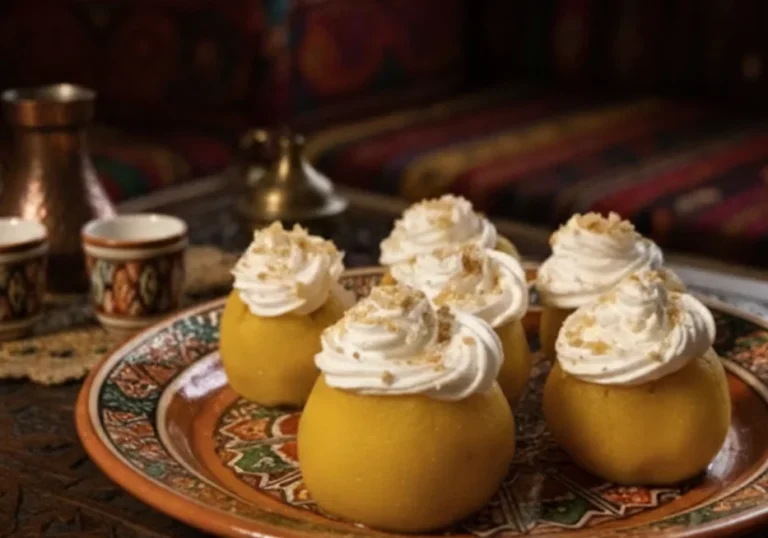
Serve small pieces at room temperature with unsweetened Bosnian coffee, black coffee, or tea. Hurmašice and kadaif are other syrup-soaked desserts served in the region, but their dough and syrup methods differ. There is no need for extra syrup when serving this baklava.
Once fully cool, cover the pan. The source recipe gives approximately four days in a cool room, with refrigeration in warm conditions or for longer storage, up to about seven days. Treat these as household storage estimates, not a validated shelf-stable preservation process. Keep the pastry protected from heat and moisture. Refrigerated butter firms up, so allow pieces about 30 minutes at room temperature before serving.
Fully soaked pieces can be frozen airtight in portions for about two months for best quality. Thaw slowly in the refrigerator and do not soak them again. Baking ahead and allowing an overnight rest is more useful than trying to rush the four-hour absorption period.