Sok od Zove – Elderflower Cordial
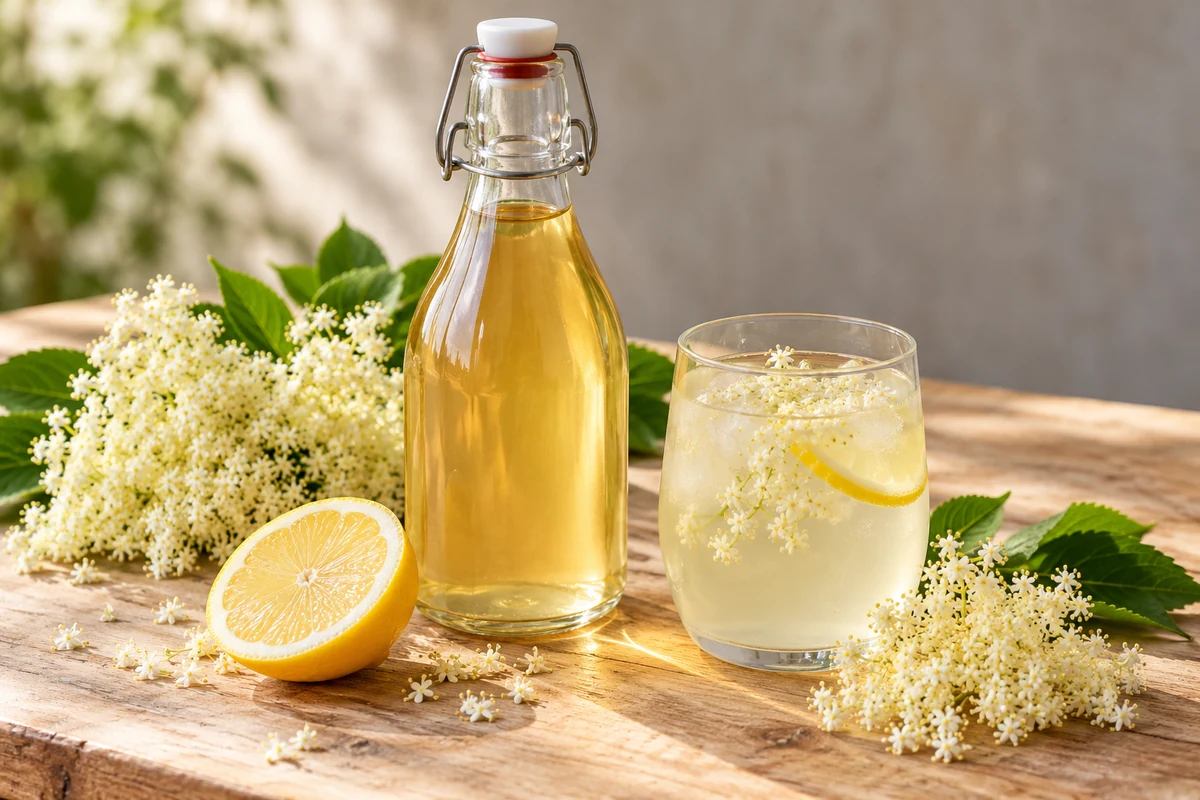
Sok od zove is a concentrated elderflower syrup scented with lemon, usually diluted with cold still or sparkling water before drinking. The regional names sirup od zove and sok od bazge refer to the same family of floral drinks; in American English, elderflower cordial or elderflower syrup makes the concentrate easier to distinguish from a ready-to-drink juice.
Fresh European black elderflowers give this cordial its character. Water and white sugar become a cooked syrup, lemon adds brightness, and carefully measured food-grade citric acid completes the formula. A covered, 48-hour infusion in the refrigerator draws the floral flavor into the syrup; it is not a countertop fermentation.
This version follows the refrigerator-infusion method published by Oregon State University Extension, using eighteen flower heads within its stated range. Start with positively identified flowers from a trusted, unsprayed food-use source, remove unwanted plant material, and keep the infusion and finished syrup refrigerated. This is a refrigerated or frozen cordial, never a pantry preserve.
Sok od Zove (Elderflower Cordial)
Ingredients
- 2 cups water U.S. volume rounded; do not include serving water in this base quantity
- 2 cups white granulated sugar keep the stated sugar quantity; adjust sweetness by diluting the drink
- 1.5 tsp food-grade citric acid level U.S. measuring teaspoons in both systems, following Extension; no universal gram equivalent; food-use product only
- 2 large unwaxed, unsprayed lemons washed; half for zest and juice, half thinly sliced; remove seeds
- 18 large fresh European black elderflower heads positively identified Sambucus nigra subsp. nigra from a trusted unsprayed food-use source; count heads before removing stems; no leaves, stems, bark, roots, berries, or unknown flowers
Equipment
- Saucepan and spoon Food-safe and suitable for hot sugar syrup.
- Standard U.S. measuring spoons Use a level teaspoon for citric acid in both unit systems; do not heap or assume a gram conversion.
- Liquid measuring cup For base water and the actual strained yield.
- Citrus grater and juicer For the lemons; avoid bitter white pith and remove seeds.
- Food-safe heatproof infusion containers with covers Suitable for hot syrup; use additional smaller vessels and adequate refrigerator space for larger batches.
- Clean kitchen scissors For trimming stems; do not retain leaves or green stem pieces.
- Fine-mesh strainer and clean muslin For draining the infusion and removing visible solids.
- Clean bottles or jars and funnel For cold storage only; hot filling does not establish shelf stability.
- Refrigerator and food thermometer Maintain 40°F (4°C) or below; refrigerate promptly without waiting for room-temperature cooling.
- Freezer-safe containers Leave at least 1 inch (2.5 cm) headspace; thaw in the refrigerator.
Method
- Verify the flowers. Use only positively identified fresh European black elderflowers (Sambucus nigra subsp. nigra) from a trusted, unsprayed food-use source away from traffic and contamination. Do not use unknown flowers, other species, or berries.
- Prepare clean equipment. Clean the work surface, utensils, heatproof food-safe infusion vessels, straining cloth, and storage containers thoroughly. Arrange refrigerator space at 40°F (4°C) or below before cooking.
- Inspect and trim. Count the required large flower heads before trimming. Gently shake them over a light-colored cloth, inspect for insects and dirt, and snip away green stems. Remove leaves, stray stem pieces, browned flowers, and debris. Do not rinse, following the published method for preserving aroma; reject contaminated material.
- Prepare the lemons. Wash and dry the lemons. Use half for finely grated yellow zest and juice, avoiding white pith, and cut the other half into thin slices. Remove visible seeds.
- Dissolve the sugar. Combine the measured base water and white granulated sugar in a saucepan. Heat while stirring until dissolved. Do not add the water intended for diluting individual glasses.
- Simmer the syrup. Bring the solution to a boil, then simmer gently for 10 minutes. Remove from the heat, handling the hot pan and syrup carefully to prevent burns.
- Add citrus and acid. Stir the lemon zest, lemon juice, and measured food-grade citric acid into the hot syrup. Measure the acid with level U.S. measuring teaspoons in either unit system; do not substitute an assumed gram equivalent.
- Pour over the flowers. Put the trimmed flowers and lemon slices in a suitable heatproof container. Carefully pour the hot syrup over them and arrange the ingredients under the liquid as far as practical. Do not add water. For scaled batches, divide the ingredients proportionally among additional suitable vessels.
- Refrigerate and infuse. Cover and place promptly in the refrigerator at 40°F (4°C) or below; do not wait on the counter until completely cold. Infuse for 48 hours from refrigerator placement, keeping it refrigerated throughout. Use smaller suitable containers for larger batches so the hot infusion does not overload the refrigerator.
- Strain and measure. Drain through a fine-mesh strainer lined with clean muslin or doubled cheesecloth into a clean bowl. Let it drip through without forcing plant pieces through the cloth. Discard the flowers and lemon slices. Measure the actual strained volume; do not top up with water to reach a target yield.
- Bottle and store cold. Transfer to clean bottles or jars, close, label with the preparation date, and refrigerate immediately. Use within a few weeks as directed by Extension, without treating this as a guaranteed expiration date. Freeze portions not needed promptly in freezer-safe containers with at least 1 inch (2.5 cm) headspace; thaw in the refrigerator. Never can or store this syrup at room temperature.
- Dilute to serve. Mix one part concentrate with five parts cold still or sparkling water as a starting ratio, then adjust in the glass. Dilution water is separate from the base recipe. Discard syrup showing mold, unexpected fermentation, gas, leakage, swollen closures, or abnormal odor without tasting.
Notes
Choose the right elderflowers
Use fresh, newly opened, cream-colored flower clusters from positively identified European black elder, Sambucus nigra subsp. nigra. This recipe uses flowers, not the dark berries that develop later in the season. Flower and berry recipes have different handling requirements and cannot be exchanged by weight or by cooking time.
European black elder is a woody shrub or small tree, but that description is not a complete identification guide. White blossoms, a sweet scent, a photograph, or a phone-app suggestion do not establish identity. If you cannot identify the plant confidently with qualified local help, buy suitable fresh flowers from a grower who can document the species and food-use growing conditions.
Do not substitute an unknown elder, red elder, dwarf elder, ornamental florist flowers, or an unrelated white-flowered plant. American and blue elder are related plants, but this recipe does not establish equivalent substitutions for the European flower material. Dried flowers also do not replace a count of fresh heads in equal grams.
Harvest clean material and trim it carefully
Choose an unsprayed site away from busy roads, contaminated runoff, spray drift, and animal waste. Leave some flower clusters on each shrub for insects and later fruit. Reject browned, wilted, musty, damaged, or visibly contaminated flowers.
Count the large heads before trimming, then gently shake them over a light-colored cloth and inspect for insects and debris. Snip the flowers away from green stems and remove stray stem pieces and every leaf. Do not include bark, roots, berries, or other plant parts. The count describes flower clusters of variable size, not a standardized weight of loose blossoms.
The Extension method avoids rinsing the flowers to preserve their delicate flavor. Follow that handling method with clean, suitable flowers; it is not a sanitizing treatment and cannot rescue contaminated plant material. Elder plants contain potentially harmful cyanogenic compounds, with plant part and preparation both relevant. Careful selection and trimming remain necessary even though this is a published flower-syrup method.
Measure the syrup ingredients accurately
The base contains water, white granulated sugar, lemons, flower heads, and food-grade citric acid. Water used to dilute a glass later is separate and is not added to the syrup pot.
Two U.S. cups of water equal approximately 473 ml; the Metric card retains the practical 475 ml measure. Two cups of granulated sugar are represented by 400 g. These are culinary equivalents with normal measuring variation, not a claim that cups are exact laboratory mass measurements.
Measure citric acid with a level U.S. teaspoon
Use the published amount of 1½ level U.S. teaspoons of food-grade citric acid for the base batch. The card intentionally keeps teaspoons for this ingredient in both unit systems. Crystal size, packing, and product formulation affect the mass of a spoonful, so 7.5 g is not treated as a universal equivalent. Use a standard measuring spoon, level it, and do not heap it or estimate with a table teaspoon.
Buy a product explicitly labeled for food use. Household descaling or cleaning products are unsuitable. Do not omit the acid, reduce the sugar, replace the sweetener, or add extra water to the stored concentrate. For a less sweet drink, change the dilution in the glass.
Use each lemon once
Wash and dry the lemons. Use half for finely grated yellow zest and juice, and slice the other half thinly. Remove visible seeds and keep the bitter white pith out of the zest. That division remains clear when the card is doubled or tripled.
Lemon size and juice yield vary. The whole-fruit count does not mean that a specific measured quantity of bottled lemon juice has been tested as a replacement. Keep the lemon allocation in the recipe rather than inventing an equivalent.
Cook the syrup before adding the flowers
Dissolve the sugar in the measured base water while heating and stirring. Bring the solution to a boil, then maintain a gentle simmer for ten minutes. Use a pan with enough space to prevent boiling syrup from splashing over the rim. Remove it from the heat before stirring in the lemon zest, lemon juice, and measured citric acid.
The ten-minute simmer belongs to the sugar syrup. The flowers are not boiled for ten minutes: they receive the hot syrup afterward. This order follows the published elderflower procedure. It should not be explained using a boiling instruction intended for elderberries, or described as a measured toxin-removal result from this kitchen.
Pour into a suitable heatproof vessel
Place the trimmed flowers and lemon slices in a clean, food-safe container that can tolerate the hot syrup. A suitable metal vessel avoids thermal shock from pouring very hot liquid into cold, unsuitable glass. Pour carefully to prevent burns, and arrange the flowers and slices under the syrup as far as practical without adding unmeasured water.
Choose containers that fit both the ingredients and the available refrigerator space. For a double or triple batch, use additional suitable vessels rather than one oversized, deep jar. Each vessel needs its proportional share of flowers, lemons, and syrup.
Infuse for 48 hours in the refrigerator
Cover the infusion and place it promptly in a refrigerator maintained at 40°F (4°C) or below. Do not leave it on the counter to become completely cold. The 48-hour infusion is counted from refrigerator placement; it includes the initial cooling period. Use suitable smaller containers for scaled batches so that hot syrup does not overload the refrigerator.
The covered infusion stays refrigerated throughout. Two days provides the intended extraction period within the one-to-three-day refrigerator range in the Extension method. Increasing the batch does not mean extending the infusion time.
Clean utensils and containers matter at every stage. Wash hands before handling equipment, keep the cloth and strainer clean, and avoid introducing used tasting spoons or dirty fingers into the infusion. Refrigeration and good hygiene complement the recipe; neither makes unidentified plant material acceptable.
Strain, bottle, and measure the yield
Line a fine-mesh strainer or colander with clean muslin or doubled cheesecloth and set it over a clean bowl. Drain the infusion through it, letting the liquid drip through rather than forcing plant pieces into the cordial. Discard the spent flowers and lemon slices.
Measure the strained syrup in a clean measuring vessel before bottling it. Evaporation, lemon juice, cluster size, and liquid retained in the discarded solids all affect the amount. Do not top it up with water to reach a target yield.
About 750 ml, or roughly twenty-five 30 ml concentrate portions, is a source-based planning estimate, not a measured result from a BalkanFeast kitchen test. The card therefore uses one batch rather than promising a fixed portion count. Divide your actual yield in milliliters by 30 to find the number of those concentrate portions.
Dilute the concentrate when serving
Start with one part syrup to five parts cold water, then adjust the drink to taste. For example, 30 ml syrup with 150 ml water gives approximately 180 ml before ice. In rounded U.S. measures, use 2 tablespoons syrup with 10 tablespoons water to preserve the same ratio.
Still water gives a quiet floral drink; sparkling water adds fizz. Dilution belongs to an individual glass, not to the stored syrup batch. Plain water adds no sugar, but it does not remove the sugar already present in the portion of concentrate.
The syrup can also flavor tea, yogurt, fruit, ice cream, and simple desserts. In this recipe, cordial means a nonalcoholic concentrate, not elderflower liqueur.
Keep it refrigerated or freeze it
Refrigerated storage
Transfer the strained cordial into thoroughly cleaned bottles or jars, close them, and refrigerate immediately at 40°F (4°C) or below. Label the containers with the preparation date. The Extension recipe says to use the refrigerated syrup within a few weeks; that is general source guidance, not a guaranteed expiration date for every home batch. Freeze portions you will not use promptly instead of planning prolonged refrigerated storage.
Discard the entire contents if you see mold, unexpected fermentation or gas, leakage, a swollen closure, or an abnormal odor. Do not skim off mold or taste a suspect syrup to decide whether to keep it. A normal appearance does not justify extending storage indefinitely.
Freezer storage
Use containers specifically intended for freezing liquids and leave at least 1 inch (2.5 cm) of headspace. Divide the syrup into convenient portions rather than filling a narrow-necked bottle to the brim. Label and date it, and thaw only the amount needed in the refrigerator. Keep thawed syrup cold and use it promptly. No unsupported multi-month storage promise is assigned here.
No pantry storage or home canning
This elderflower syrup is not shelf-stable. Hot filling, a sealed lid, a high sugar content, and added acid do not turn it into a pantry preserve. Do not water-bath can it, pressure-can it, or store it at room temperature. A preservation method for elderberries is not a canning process for this flower infusion.
Troubleshooting flavor and texture
Bitter cordial
Excess lemon pith, old flowers, and unwanted green plant material can spoil the intended flavor. Use fresh blossoms, trim carefully, and grate only the yellow zest. Do not try to disguise questionable ingredients or possible spoilage with extra sugar.
Weak aroma
Flower size and freshness influence aroma. Use sound, freshly opened large clusters and the full refrigerated infusion period. Rinsing can reduce flavor. Do not compensate for poor flowers by adding an unidentified plant, leaving the infusion warm, or extending storage.
Cloudiness, sediment, or gas
Fine flower particles may pass through a coarse strainer; clean cloth helps catch them. Straining is a texture step, not a way to remove dissolved hazards or make spoiled syrup safe. Gas, mold, and abnormal smells call for disposal, not another straining.
Different yield or sweetness
A lower yield can reflect evaporation or syrup left in the flowers and cloth. Measure the finished amount without adding water to the batch. Adjust sweetness with dilution at serving, keeping the stored concentrate formula intact.
Nutrition and portion size
A fixed per-serving nutrition panel is withheld because the finished volume and syrup retained in the discarded solids have not been measured. Sugar is the principal energy source; the lemon contribution and extraction losses also vary. A batch count should not be mistaken for one drinking portion.
Use a measured amount of concentrate for each glass, and remember that a more diluted drink still contains the sugar from that concentrate portion. No calorie value from the source is copied into the card as a measured finished-product result.
Frequently asked questions
Are sok od zove and sok od bazge different?
They are regional names used for this family of elderflower drinks. Sirup od zove and elderflower syrup emphasize that this recipe makes a concentrate. It is diluted before drinking.
Can I replace the flowers with elderberries?
No. Berries are a different ingredient with different preparation and preservation instructions. Use a separate appropriate berry recipe.
Can the infusion stay on the counter for two days?
No. Keep it covered in the refrigerator for the entire 48 hours. This is a cold infusion, not a room-temperature ferment.
Can I omit citric acid or reduce the sugar?
Follow the stated formula. If you prefer a lighter drink, use more water in the glass rather than changing the stored concentrate.
Preparation reference
The flower-syrup method follows the Elderflower syrup section of Oregon State University Extension’s preservation guidance, which credits Penn State Extension. Its refrigerator-infusion and cold-storage directions apply here; separate berry-canning instructions do not.