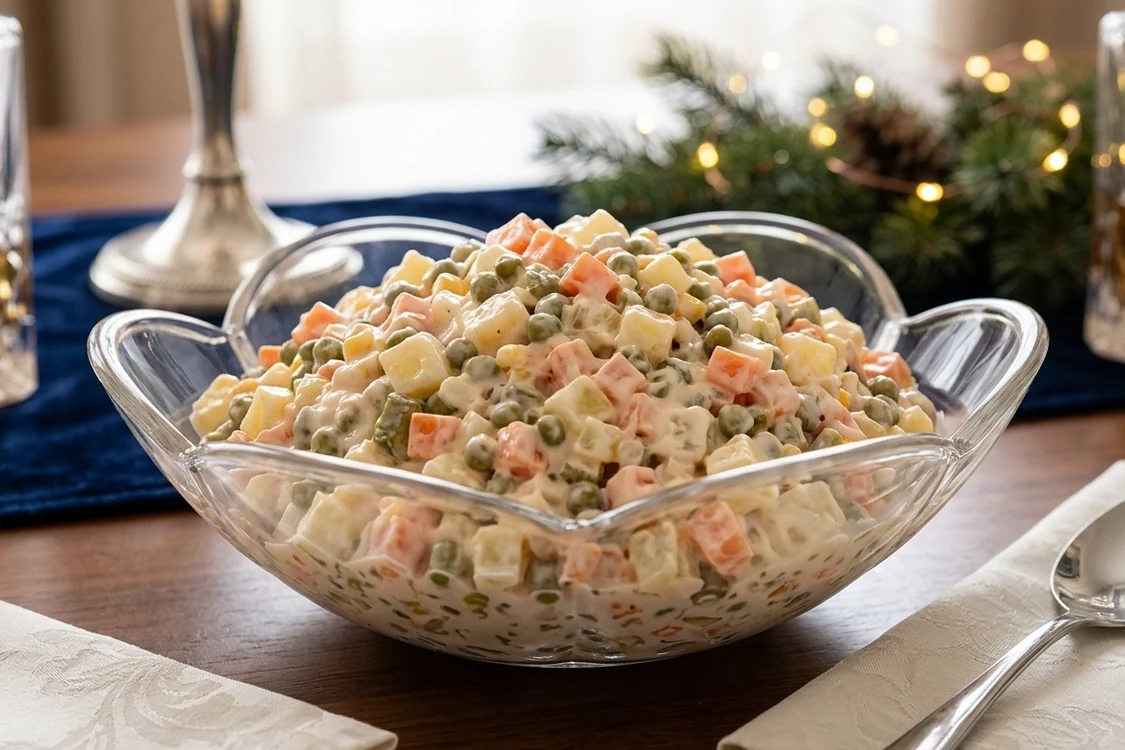
Francuska Salata Recipe – Balkan Holiday Potato Salad
Francuska salata is a cold Balkan holiday potato salad with small, distinct pieces of potatoes, carrots, peas, pickles, and hard-boiled eggs. A creamy dressing of mayonnaise, cultured sour cream, mustard, and lemon brings them together. This version contains no meat and is served as a side dish rather than a main course.
It is especially useful for Christmas, New Year’s, family gatherings, and cold holiday platters because it can be made ahead. The work is in cooking each vegetable to the right texture, chilling the components, and folding them together gently. The aim is a creamy coating around recognizable pieces, not mashed potatoes in dressing.
The source recipe makes eight generous side portions. Plan for cooling the cooked ingredients as well as at least two hours of chilling after assembly: the schedule below allows about 4 hours 10 minutes in total, with actual cooling time dependent on the containers and refrigerator. Keep the salad cold throughout storage and service.
Francuska Salata – Balkan Holiday Potato Salad
Ingredients
- 17 1/2 oz waxy potatoes small red potatoes are a practical US choice; weighed whole, cooked in their skins, then peeled cold
- 10 1/2 oz carrots peeled weight
- 10 1/2 oz frozen green peas weighed frozen; not a mixed-vegetable blend
- 8 3/4 oz firm spiced cucumber pickles drained weight; tart dill-style pickles are a practical US option, not sweet relish
- 4 large eggs source medium eggs; cook until yolks and whites are fully firm
- 5 g fine table salt weighed allowance for cooking water, which is drained; not all this salt is consumed
- 10 1/2 oz commercial regular mayonnaise made with pasteurized eggs, such as Hellmann’s Real Mayonnaise; not raw-egg homemade mayonnaise
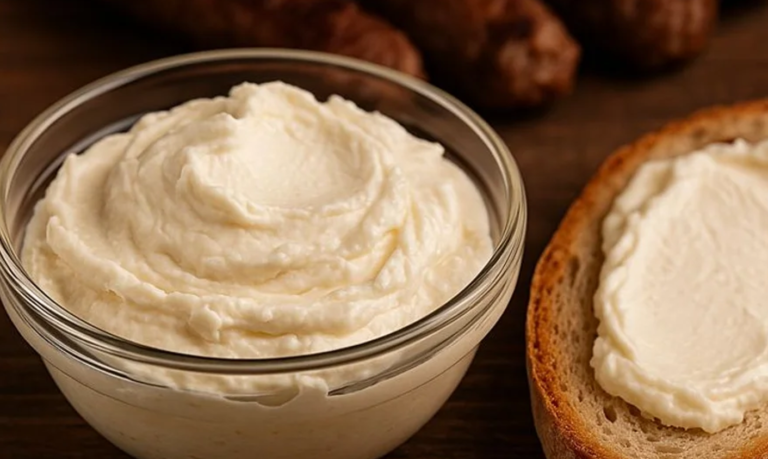
- 5 1/4 oz plain full-fat cultured sour cream US adaptation of source Sauerrahm or Schmand, approximately 20% fat; exact fat and texture vary by product
- 20 g prepared medium-hot mustard German-style, such as Kühne medium-hot; weigh to preserve the dressing ratio
- 1 tbsp fresh lemon juice
- 2 g finely ground black pepper source permits white or black pepper; this defined version uses black
- 1/2 tsp fine table salt initial dressing salt; separate from the cooking-water salt
- additional fine salt optional, only if needed after chilling; excluded from nutrition
Equipment
- 1 Potato saucepan Choose a size that lets water cover the potatoes without crowding.
- 1 Vegetable saucepan Cook carrots and peas separately, removing the carrots before adding peas.
- 1 Egg saucepan
- 1 Strainer and slotted spoon Drain cooked vegetables and diced pickles thoroughly.
- 1 Kitchen scale For drained weights and the dressing ratio.
- 1 Knife and board Aim for ¼-inch / 5–7-mm dice.
- 1 Mixing bowl For gentle folding once all ingredients are cold.
- 1 Small bowl and whisk For the dressing.
- 1 Shallow containers Use several for prompt cooling and larger batches.
- 1 Food thermometer Check ingredient and salad temperature; keep refrigerator at 40°F / 4°C or below.
Method
- Cook potatoes in their skins. Scrub the potatoes and place in a saucepan with cold water to cover. Bring to a boil, then simmer gently for approximately 20–30 minutes, depending on size, until a small knife enters easily but the potatoes remain intact. Drain. Allow additional time for the water to heat; do not force a 25-minute finish if the centers are still firm.
- Cook carrots, then peas. While the potatoes cook, cut peeled carrots into ¼-inch (5–7-mm) dice. Bring another pot of water to a boil and add the measured cooking-water salt. Cook carrots for about 6–8 minutes until tender but still holding their shape, then lift out with a slotted spoon and drain well. Return the water to a boil, add the frozen peas, and cook separately for about 2–4 minutes, or as their package directs. Drain thoroughly.
- Hard-boil and cool the eggs. Put the eggs in a separate saucepan, cover with cold water, and bring to a clear boil. Cook for about 9–10 minutes as a starting guide, until yolks and whites are fully firm; larger eggs may need longer. Transfer immediately to cold or ice water, cool, peel, and refrigerate until assembly.
- Chill the cooked ingredients promptly. Spread drained vegetables in shallow containers rather than leaving them in hot pots or a deep pile. Let heavy steam escape briefly and refrigerate promptly; small warm portions can go into the refrigerator. Allow about 60 minutes as an ingredient-cooling estimate, including at least 30 minutes refrigerated for the potatoes, and wait until all components are at 40°F (4°C) or below before dressing. Cooling can take longer. Refrigerate within 2 hours of cooking, or 1 hour above 90°F (32°C); never wait hours on the counter for room temperature.
- Drain pickles and dice cold ingredients. Drain the pickles before weighing, cut into ¼-inch (5–7-mm) dice, and drain the cut pieces again for a few minutes. Blot if very wet. Peel the completely cold potatoes and dice to match; chop the cold hard-boiled eggs into similar small pieces. Cut gently so the potatoes do not mash.
- Whisk the dressing. Whisk the mayonnaise and cold cultured sour cream together in a small bowl. Add the measured mustard and lemon juice and whisk smooth. Mix in the pepper and initial dressing salt. Taste with a clean spoon, remembering that pickles, mayonnaise, and mustard already contain salt. Keep the dressing cold.
- Fold without crushing. Loosely combine the cold potatoes, carrots, peas, and drained pickles. Add the chopped eggs. Fold in approximately three-quarters of the dressing with a large spoon or flexible spatula, then incorporate the rest gradually. Mix only until evenly coated; do not beat or mash the potato cubes.
- Chill the assembled salad. Transfer to shallow covered containers and refrigerate for at least 2 hours at 40°F (4°C) or below. For larger batches, use additional containers with space around them rather than one deep bowl. Preparing the salad the day before serving is practical; the cooling intervals are not automatically multiplied when scaling.
- Adjust and serve cold. Fold gently once more and taste just before serving. Add a little of the optional extra salt only if needed; any further pepper or lemon adjustment is outside the measured base formula. Serve a small bowl at a time, keeping the rest refrigerated. Return safely handled portions promptly to cold storage and discard food left unrefrigerated beyond 2 hours, or 1 hour above 90°F (32°C). Chilling again does not reset that limit.
Notes
A holiday side dish with a defined meatless formula
Francuska salata belongs on a larger table of prepared foods, where a cool, tangy side can contrast with warm dishes. At a winter family meal, it can accompany Bosnian sarma. It is also made for occasions outside the Christmas and New Year’s season.
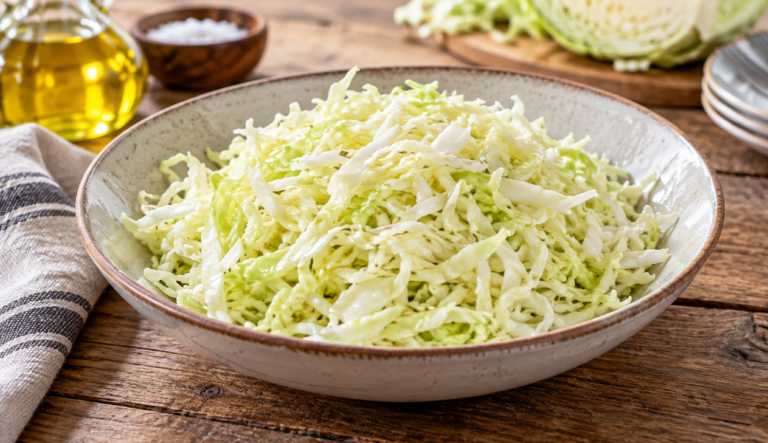
This is a different style from a fresh kupus salata: the vegetables here are cooked, chilled, finely diced, and dressed with mayonnaise and cultured cream. Keep the measured vegetable proportions rather than replacing the mixture with a standard American potato salad formula.
Francuska salata and ruska salata: names overlap
The names are not used identically in every Balkan region or household. Here, francuska salata means the meatless potato, vegetable, pickle, and egg preparation; chicken-containing ruska salata is a separate formula. That distinction describes these defined versions, not a universal rule that every family must follow.
Do not add chicken, ham, or another meat to this card while keeping the same ingredient list and nutrition. The potatoes, carrots, peas, pickles, eggs, sour cream, and mustard already establish this salad’s own identity.
Choose potatoes that stay intact and pickles that drain well
Small waxy red potatoes are a practical US choice because they hold their shape when cooked carefully. The source allows waxy or mostly waxy potatoes. Weigh them whole, cook them in their skins, and peel them only after cooling. Floury baking potatoes are more likely to break down when diced and folded.
Use peeled carrot weight and weigh the peas frozen, as in the card. Cook them separately rather than relying on a bag of mixed vegetables with a different ratio and uneven cooking needs. Keep the hard-boiled eggs in this fixed version even though some household salads omit them.
Choose firm, pleasantly tart spiced cucumber pickles. Dill-style pickles are a practical US option; sweet relish and very soft pickles change both texture and flavor. Drain before weighing, dice, drain again, and blot away excess liquid if necessary. Extra pickle brine is not part of the measured dressing.
Cook each vegetable to its own doneness
Start the unpeeled potatoes in cold water and simmer gently after the water boils. Check with a small knife rather than assuming all potatoes are ready at the same minute. They should be tender through the middle without falling apart.
Cut the carrots to about ¼-inch, or 5–7-mm, dice and cook for roughly 6–8 minutes. Remove them before cooking the frozen peas, which generally need only 2–4 minutes, or the time specified on the package. The recipe keeps those cooking intervals separate so the peas do not overcook while carrots are still firm.
The measured cooking-water salt belongs to the vegetable pot and is separate from the dressing salt. The water is drained, so its full salt quantity is not treated as eaten. Cook the eggs in a separate saucepan until whites and yolks are fully firm, then cool immediately in cold or ice water and refrigerate.
Cool promptly before adding the creamy dressing
Do not leave whole pots of cooked vegetables on the counter for hours. Drain well, spread the vegetables in shallow containers, let heavy steam escape briefly, and refrigerate promptly. Small portions of warm food can go directly into a properly functioning refrigerator; a large hot, deep pile cools much more slowly.
The source includes a refrigerated potato stage of at least 30 minutes before peeling and cutting. For this workflow, budget approximately an hour for ingredient cooling and wait until all cooked components are at 40°F (4°C) or below before dressing. That is an estimate, not proof that every refrigerator will chill a large batch in an hour. Use more shallow containers when scaling and allow additional time if needed.
Refrigerate perishables within 2 hours, or within 1 hour if the surroundings exceed 90°F (32°C). The safety limit is not permission to leave them out for the full period. This prompt-refrigeration guidance replaces a vague instruction to wait indefinitely for complete room-temperature cooling.
Dice evenly and fold without turning potatoes into mash
Peel the cold potatoes and cut them into pieces similar in size to the carrots and pickles. Chop the chilled eggs. Perfect cubes are unnecessary, but large potato chunks mixed with tiny fragments give an uneven texture. Cut with a sharp knife and use gentle pressure.
Combine the cold potatoes, carrots, peas, and drained pickles loosely, then add the eggs. Fold in about three-quarters of the dressing first and add the rest gradually. A flexible spatula or large spoon can lift from underneath without crushing the potatoes. Stop once everything is evenly coated.
A watery salad usually points to warm vegetables, poorly drained peas, or pickle liquid. A heavy, gluey salad can come from overcooked potatoes or vigorous stirring. Do not automatically add more mayonnaise to fix either problem; give the measured dressing time to settle during chilling.
Mayonnaise, sour cream, and medium-hot mustard
Choose regular commercial mayonnaise made with pasteurized eggs. Hellmann’s Real Mayonnaise is one checked US example; its manufacturer confirms pasteurized eggs. Unverified homemade mayonnaise with raw eggs is not the default substitute for this recipe.
The source combines mayonnaise with Sauerrahm or Schmand at about 20% fat. Plain full-fat American cultured sour cream is the practical adaptation used here, but its exact fat content and texture can differ. The nutrition model uses a checked Daisy regular sour-cream label. Reduced-fat sour cream, fat-free products, and sweetened dairy mixtures are not direct equivalents.
Whisk mayonnaise and sour cream together first, then add the measured medium-hot mustard and lemon juice, followed by pepper and the initial dressing salt. A plain German-style medium-hot mustard suits the source flavor better than a very hot or strongly flavored product. Pickles and condiments already contribute salt; make the final adjustment only after the assembled salad has chilled.
Making the salad ahead for a holiday table
Chill the assembled salad for at least 2 hours, or prepare it the day before serving. Keep it covered and at 40°F (4°C) or colder. The recipe’s timing includes ingredient cooling separately from this final chill; both stages matter.
For a doubled or tripled batch, ingredient totals increase, including eggs and dressing. The number of cooking pots and shallow containers may also need to increase. Do not multiply the chilling interval mechanically, but do not assume a deeper bowl will cool as quickly as several shallow ones. The actual cold temperature remains the deciding check.
Before serving, fold gently and taste with a clean spoon. The optional final salt is not an instruction to add another full measured batch of salt. Further pepper or lemon adjustments change the fixed base formula and are outside its calculated nutrition.
Safe cold service and refrigerated leftovers
Set out a small serving bowl and keep the rest in the refrigerator. Replace it with a fresh cold bowl as needed instead of topping up a warm bowl that has already been handled. For a longer buffet, keep the serving container properly chilled, such as nested in ice, and monitor that the salad stays at 40°F (4°C) or below.
Discard salad held unrefrigerated for more than 2 hours, or more than 1 hour above 90°F. Count cumulative time out of refrigeration; putting a bowl back in the refrigerator does not erase earlier warm holding. Do not judge safety by smell or taste, and do not assume pickle acidity or commercial mayonnaise preserves the entire salad at room temperature.
Keep safely handled leftovers covered and refrigerated, and use within 3 days of preparing the earliest cooked perishable component. This stays within the source’s 2–3-day guidance and general US storage guidance for egg-containing salads. Preparing components ahead does not restart their storage clock when the dressing is added.
Freezing is not recommended for this salad: the potatoes lose their texture and mayonnaise–sour cream dressing can separate. It is a refrigerated prepared side dish, not a recipe for canning or shelf-stable storage.
Practical questions
Why cook the potatoes in their skins? It helps limit water uptake and protects their structure. Let them chill before peeling and dicing, as this method requires.
Can I leave out the sour cream or mustard? They are defining parts of this measured dressing. An all-mayonnaise version would be a different formula, with different richness and nutrition.
Why is sodium missing from the nutrition panel? The amount retained from salted cooking water has not been measured, and final optional seasoning and pickle labels vary. Sodium has deliberately been omitted rather than presenting an invented precise value; it is not zero. The other estimates include the full measured dressing and are per one of eight assumed side portions.