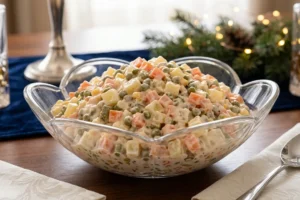
Francuska Salata – Balkan Holiday Potato Salad
431kcal
Ingredients
Vegetables and eggs
- 17 1/2 oz waxy potatoes small red potatoes are a practical US choice; weighed whole, cooked in their skins, then peeled cold
- 10 1/2 oz carrots peeled weight
- 10 1/2 oz frozen green peas weighed frozen; not a mixed-vegetable blend
- 8 3/4 oz firm spiced cucumber pickles drained weight; tart dill-style pickles are a practical US option, not sweet relish
- 4 large eggs source medium eggs; cook until yolks and whites are fully firm
For the vegetable cooking water
- 5 g fine table salt weighed allowance for cooking water, which is drained; not all this salt is consumed
Creamy dressing
- 10 1/2 oz commercial regular mayonnaise made with pasteurized eggs, such as Hellmann’s Real Mayonnaise; not raw-egg homemade mayonnaise
- 5 1/4 oz plain full-fat cultured sour cream US adaptation of source Sauerrahm or Schmand, approximately 20% fat; exact fat and texture vary by product
- 20 g prepared medium-hot mustard German-style, such as Kühne medium-hot; weigh to preserve the dressing ratio
- 1 tbsp fresh lemon juice
- 2 g finely ground black pepper source permits white or black pepper; this defined version uses black
- 1/2 tsp fine table salt initial dressing salt; separate from the cooking-water salt
- additional fine salt optional, only if needed after chilling; excluded from nutrition
Equipment
- 1 Potato saucepan Choose a size that lets water cover the potatoes without crowding.
- 1 Vegetable saucepan Cook carrots and peas separately, removing the carrots before adding peas.
- 1 Egg saucepan
- 1 Strainer and slotted spoon Drain cooked vegetables and diced pickles thoroughly.
- 1 Kitchen scale For drained weights and the dressing ratio.
- 1 Knife and board Aim for ¼-inch / 5–7-mm dice.
- 1 Mixing bowl For gentle folding once all ingredients are cold.
- 1 Small bowl and whisk For the dressing.
- 1 Shallow containers Use several for prompt cooling and larger batches.
- 1 Food thermometer Check ingredient and salad temperature; keep refrigerator at 40°F / 4°C or below.
Method
- Cook potatoes in their skins. Scrub the potatoes and place in a saucepan with cold water to cover. Bring to a boil, then simmer gently for approximately 20–30 minutes, depending on size, until a small knife enters easily but the potatoes remain intact. Drain. Allow additional time for the water to heat; do not force a 25-minute finish if the centers are still firm.
- Cook carrots, then peas. While the potatoes cook, cut peeled carrots into ¼-inch (5–7-mm) dice. Bring another pot of water to a boil and add the measured cooking-water salt. Cook carrots for about 6–8 minutes until tender but still holding their shape, then lift out with a slotted spoon and drain well. Return the water to a boil, add the frozen peas, and cook separately for about 2–4 minutes, or as their package directs. Drain thoroughly.
- Hard-boil and cool the eggs. Put the eggs in a separate saucepan, cover with cold water, and bring to a clear boil. Cook for about 9–10 minutes as a starting guide, until yolks and whites are fully firm; larger eggs may need longer. Transfer immediately to cold or ice water, cool, peel, and refrigerate until assembly.
- Chill the cooked ingredients promptly. Spread drained vegetables in shallow containers rather than leaving them in hot pots or a deep pile. Let heavy steam escape briefly and refrigerate promptly; small warm portions can go into the refrigerator. Allow about 60 minutes as an ingredient-cooling estimate, including at least 30 minutes refrigerated for the potatoes, and wait until all components are at 40°F (4°C) or below before dressing. Cooling can take longer. Refrigerate within 2 hours of cooking, or 1 hour above 90°F (32°C); never wait hours on the counter for room temperature.
- Drain pickles and dice cold ingredients. Drain the pickles before weighing, cut into ¼-inch (5–7-mm) dice, and drain the cut pieces again for a few minutes. Blot if very wet. Peel the completely cold potatoes and dice to match; chop the cold hard-boiled eggs into similar small pieces. Cut gently so the potatoes do not mash.
- Whisk the dressing. Whisk the mayonnaise and cold cultured sour cream together in a small bowl. Add the measured mustard and lemon juice and whisk smooth. Mix in the pepper and initial dressing salt. Taste with a clean spoon, remembering that pickles, mayonnaise, and mustard already contain salt. Keep the dressing cold.
- Fold without crushing. Loosely combine the cold potatoes, carrots, peas, and drained pickles. Add the chopped eggs. Fold in approximately three-quarters of the dressing with a large spoon or flexible spatula, then incorporate the rest gradually. Mix only until evenly coated; do not beat or mash the potato cubes.
- Chill the assembled salad. Transfer to shallow covered containers and refrigerate for at least 2 hours at 40°F (4°C) or below. For larger batches, use additional containers with space around them rather than one deep bowl. Preparing the salad the day before serving is practical; the cooling intervals are not automatically multiplied when scaling.
- Adjust and serve cold. Fold gently once more and taste just before serving. Add a little of the optional extra salt only if needed; any further pepper or lemon adjustment is outside the measured base formula. Serve a small bowl at a time, keeping the rest refrigerated. Return safely handled portions promptly to cold storage and discard food left unrefrigerated beyond 2 hours, or 1 hour above 90°F (32°C). Chilling again does not reset that limit.
Notes
Identity and yield: This source version is meatless and makes eight generous side portions, not eight main courses. It contains potatoes, carrots, peas, pickles, eggs, mayonnaise, cultured cream, and mustard. Names overlap by household and region; the separate chicken-containing ruska salata formula is not a universal definition of every salad with that name.
Measures and ingredients: Metric preserves the source quantities. US ounces and spoons are rounded practical measures. The small cooking salt, mustard, and pepper amounts intentionally remain weighed to avoid awkward fractions and preserve the formula. Potatoes are weighed whole before cooking; carrots are weighed peeled, peas frozen, and pickles after draining. Use waxy potatoes and firm tart cucumber pickles. Regular commercial mayonnaise made with pasteurized eggs is the main US choice; Hellmann’s confirms pasteurized eggs in its US Real Mayonnaise. The source cream is Sauerrahm or Schmand at about 20% fat. Plain full-fat US cultured sour cream is the defined practical adaptation; its exact fat and consistency may differ. Reduced-fat and fat-free products are not direct replacements.
Timing correction: Allow about 35 minutes of preparation split between washing/initial cutting and cold dicing/assembly. Budget about 35 minutes for heating water and cooking, with the potato, vegetable, and egg pots used in parallel where possible. Allow approximately 60 minutes for prompt ingredient cooling, including the source’s minimum 30-minute refrigerated potato stage, and at least 120 minutes for the assembled salad to chill. The displayed estimate is therefore 35 + 35 + 60 + 120 = 250 minutes, about 4 hours 10 minutes. The source’s 3-hour total does not fully allow for ingredient cooling and heating water. Actual cooling, potato size, equipment, and refrigerator load can extend the schedule; cold temperature, not the clock alone, determines readiness.
Cooking-water salt: The measured allowance is used for the carrot-and-pea cooking water and is separate from the initial dressing salt. The water is drained. Its full salt amount is not a consumed ingredient; retained sodium has not been measured. Optional extra seasoning after chilling is also not part of the fixed nutrition model.
Safe chilling and holiday service: Use shallow containers and refrigerate promptly rather than leaving cooked potatoes or eggs out for hours. Dress only fully cold components. Keep the finished salad at 40°F (4°C) or below. Refrigerate within 2 hours, or 1 hour above 90°F. Serve small portions and replace the serving bowl with a fresh cold one instead of topping up an old warm bowl. Keep track of cumulative time out of refrigeration. Discard salad beyond the limit, even if it looks and smells normal.
Storage: Keep covered and refrigerated, and use within 3 days of preparing the earliest cooked perishable component; making components ahead does not restart the storage clock. The source suggests 2–3 days, within general US cold-storage guidance for egg-containing salads. Do not freeze this version: potatoes lose texture and the creamy dressing may split. Mayonnaise, mustard, and pickle acidity do not make it shelf-stable or suitable for canning.
Nutrition estimate: Per one of eight assumed side portions, using the full measured dressing and all eggs and vegetables. Checked matches include Hellmann’s Real Mayonnaise (USDA FDC 2025019, 90 kcal per 13 g), Daisy regular sour cream (2756975, 60 kcal per 30 g), Kühne medium-hot mustard’s manufacturer data, and USDA red potatoes, carrots, frozen green peas, dill pickles, hard-boiled eggs, lemon juice, and black pepper. Assumptions include four approximately 50 g peeled hard-boiled eggs, raw input weights for vegetables, and a whole-potato composition match before discarded peel; cooking and draining losses vary. Sour-cream fat, pickle brand, and portion size change the estimate. Sodium is deliberately omitted because cooking-water salt retention and optional final seasoning are unknown; omission does not mean zero. Contains eggs, milk, and mustard; check all labels for additional allergens. This is an editorial adaptation, not a kitchen test.