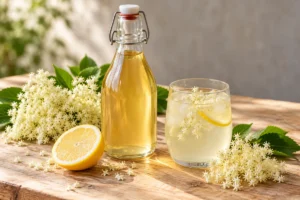
Sok od Zove (Elderflower Cordial)
Ingredients
Concentrated syrup base
- 2 cups water U.S. volume rounded; do not include serving water in this base quantity
- 2 cups white granulated sugar keep the stated sugar quantity; adjust sweetness by diluting the drink
- 1.5 tsp food-grade citric acid level U.S. measuring teaspoons in both systems, following Extension; no universal gram equivalent; food-use product only
Flowers and lemons
- 2 large unwaxed, unsprayed lemons washed; half for zest and juice, half thinly sliced; remove seeds
- 18 large fresh European black elderflower heads positively identified Sambucus nigra subsp. nigra from a trusted unsprayed food-use source; count heads before removing stems; no leaves, stems, bark, roots, berries, or unknown flowers
Equipment
- Saucepan and spoon Food-safe and suitable for hot sugar syrup.
- Standard U.S. measuring spoons Use a level teaspoon for citric acid in both unit systems; do not heap or assume a gram conversion.
- Liquid measuring cup For base water and the actual strained yield.
- Citrus grater and juicer For the lemons; avoid bitter white pith and remove seeds.
- Food-safe heatproof infusion containers with covers Suitable for hot syrup; use additional smaller vessels and adequate refrigerator space for larger batches.
- Clean kitchen scissors For trimming stems; do not retain leaves or green stem pieces.
- Fine-mesh strainer and clean muslin For draining the infusion and removing visible solids.
- Clean bottles or jars and funnel For cold storage only; hot filling does not establish shelf stability.
- Refrigerator and food thermometer Maintain 40°F (4°C) or below; refrigerate promptly without waiting for room-temperature cooling.
- Freezer-safe containers Leave at least 1 inch (2.5 cm) headspace; thaw in the refrigerator.
Method
- Verify the flowers. Use only positively identified fresh European black elderflowers (Sambucus nigra subsp. nigra) from a trusted, unsprayed food-use source away from traffic and contamination. Do not use unknown flowers, other species, or berries.
- Prepare clean equipment. Clean the work surface, utensils, heatproof food-safe infusion vessels, straining cloth, and storage containers thoroughly. Arrange refrigerator space at 40°F (4°C) or below before cooking.
- Inspect and trim. Count the required large flower heads before trimming. Gently shake them over a light-colored cloth, inspect for insects and dirt, and snip away green stems. Remove leaves, stray stem pieces, browned flowers, and debris. Do not rinse, following the published method for preserving aroma; reject contaminated material.
- Prepare the lemons. Wash and dry the lemons. Use half for finely grated yellow zest and juice, avoiding white pith, and cut the other half into thin slices. Remove visible seeds.
- Dissolve the sugar. Combine the measured base water and white granulated sugar in a saucepan. Heat while stirring until dissolved. Do not add the water intended for diluting individual glasses.
- Simmer the syrup. Bring the solution to a boil, then simmer gently for 10 minutes. Remove from the heat, handling the hot pan and syrup carefully to prevent burns.
- Add citrus and acid. Stir the lemon zest, lemon juice, and measured food-grade citric acid into the hot syrup. Measure the acid with level U.S. measuring teaspoons in either unit system; do not substitute an assumed gram equivalent.
- Pour over the flowers. Put the trimmed flowers and lemon slices in a suitable heatproof container. Carefully pour the hot syrup over them and arrange the ingredients under the liquid as far as practical. Do not add water. For scaled batches, divide the ingredients proportionally among additional suitable vessels.
- Refrigerate and infuse. Cover and place promptly in the refrigerator at 40°F (4°C) or below; do not wait on the counter until completely cold. Infuse for 48 hours from refrigerator placement, keeping it refrigerated throughout. Use smaller suitable containers for larger batches so the hot infusion does not overload the refrigerator.
- Strain and measure. Drain through a fine-mesh strainer lined with clean muslin or doubled cheesecloth into a clean bowl. Let it drip through without forcing plant pieces through the cloth. Discard the flowers and lemon slices. Measure the actual strained volume; do not top up with water to reach a target yield.
- Bottle and store cold. Transfer to clean bottles or jars, close, label with the preparation date, and refrigerate immediately. Use within a few weeks as directed by Extension, without treating this as a guaranteed expiration date. Freeze portions not needed promptly in freezer-safe containers with at least 1 inch (2.5 cm) headspace; thaw in the refrigerator. Never can or store this syrup at room temperature.
- Dilute to serve. Mix one part concentrate with five parts cold still or sparkling water as a starting ratio, then adjust in the glass. Dilution water is separate from the base recipe. Discard syrup showing mold, unexpected fermentation, gas, leakage, swollen closures, or abnormal odor without tasting.
Notes
Citric acid: Follow the Extension volume measure with level U.S. teaspoons in both systems. The mass varies with the product and granulation; 7.5 g is not assumed to equal 1½ tsp.
Yield and portions: One batch is estimated at about 750 ml (about twenty-five 30 ml concentrate portions), based on the culinary source, not a measured BalkanFeast result. Measure the actual strained volume. Evaporation and liquid retained in solids change yield. Do not top up.
Serving: Start with one part syrup to five parts water. Serving water is not a base ingredient. Keep the stored concentrate undiluted.
Time: Plan 30 minutes preparation, 15 minutes syrup cooking including a 10-minute simmer, and 48 hours refrigerated infusion. Initial cooling takes place during that refrigerator period. Times are planning estimates.
Cold storage only: Keep at 40°F (4°C) or below. Extension says use within a few weeks; this is not a guaranteed expiration date. Freeze portions not needed promptly, leaving 1 inch (2.5 cm) headspace. Never can or store at room temperature.
Nutrition: No fixed panel is supplied because actual yield, extraction, and losses have not been measured.