Bosnian Uštipci Recipe – Quick Yogurt Fritters
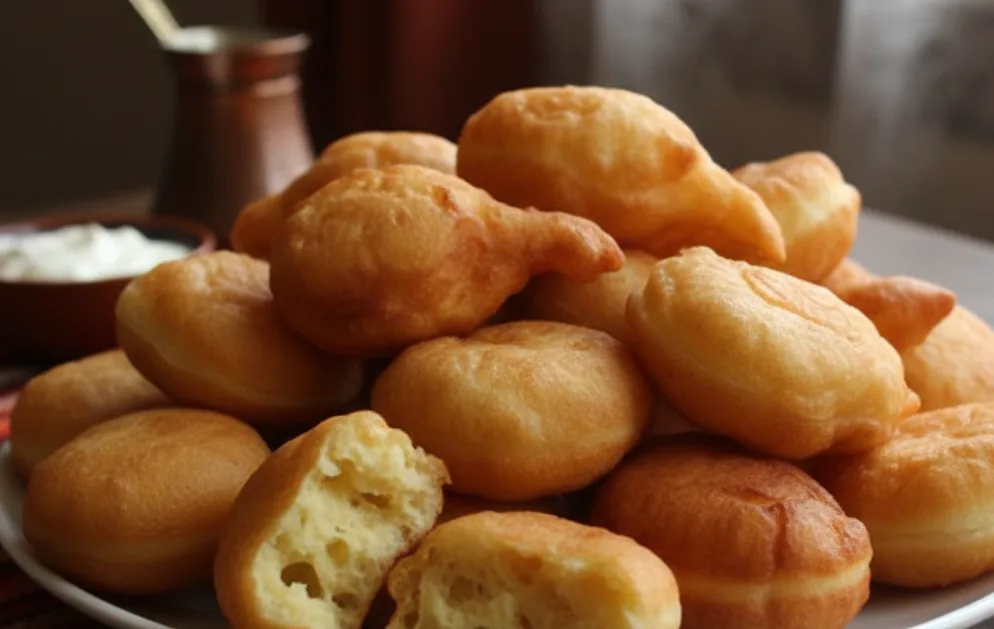
Bosnian uštipci are small pieces of fried dough with a golden, lightly crisp outside and a soft, airy center. This quick version uses plain yogurt, egg, and baking powder instead of yeast. The dough is deliberately sticky: you scoop it with two lightly oiled spoons rather than rolling it out or shaping it with your hands.
A short 20-minute rest gives the flour time to absorb the moisture before frying. Small, evenly sized portions and a thermometer help keep the outside from becoming dark before the middle cooks. Break open the first fritter after it cools briefly; the center should be tender and porous, with no wet, doughy core.
Serve the uštipci warm for breakfast, as a snack, or alongside a savory meal. Plain yogurt, cheese, ajvar, commercially prepared kajmak, honey, and jam are familiar accompaniments. The recipe makes about 16 fritters; four pieces are a substantial breakfast portion, and the exact Metric formula is available alongside rounded US measurements.

Bosnian Uštipci
Ingredients
- 2 1/2 cups all-purpose flour spooned and leveled; US adaptation of German Type 550 flour
- 2 1/8 teaspoons baking powder not baking soda; spoon weights vary, so weighing is more precise
- 7/8 teaspoon fine salt US measure is approximate
- 1 1/4 teaspoons granulated sugar
- 8.8 oz plain whole-milk yogurt regular unstrained yogurt, about 3.5% fat
- 1 large egg about 50 g each without shells
- 4 1/4 cups sunflower oil approximate supply; reserve a little cold oil for the spoons and maintain the specified safe frying depth; not all is absorbed
Equipment
- Kitchen scale helpful for accurate dough quantities and even portions
- Large mixing bowl and small bowl
- Whisk and sturdy spoon or spatula
- Small deep heavy pot about 7–8 inches (18–20 cm) wide, with ample headroom above the oil
- Deep-fry thermometer clip securely; sensing tip should not touch the pot bottom
- Two tablespoons for portioning, lightly coated in cold oil rather than water
- Small dish for reserved cold oil
- Slotted spoon
- Plate or rack with paper towels for draining
Method
- Combine the dry ingredients. Whisk the flour, baking powder, salt, and sugar thoroughly in a large mixing bowl so the leavener is evenly distributed.
- Mix egg and yogurt. Briefly beat the egg in a separate bowl, then stir in the yogurt until smooth.
- Make a sticky dough. Add the yogurt mixture to the dry ingredients. Stir with a sturdy spoon or spatula only until no dry flour remains. Do not knead. The dough should be thick, soft, and distinctly sticky, holding a mound on a spoon rather than running like pancake batter.
- Rest for 20 minutes. Cover and leave at room temperature for 20 minutes. This is a short dough rest, not a yeast rise. Do not prepare it hours ahead or beat it vigorously after resting.
- Reserve cold oil. Before heating the frying oil, set a little of it aside in a small dish for coating the portioning spoons. Keep this dish away from the hot pot.
- Prepare the frying pot. Pour the remaining oil into a small deep heavy pot, aiming for about 1¼–1½ inches (3–4 cm) depth. Leave ample headroom and never fill more than one-third of the pot. The listed oil quantity is approximate; pot dimensions determine the amount needed. Do not pour a scaled 2x or 3x supply into the same small pot.
- Heat and prepare to drain. During the final 10 minutes of the dough rest, heat the oil slowly to 340–350°F (170–175°C). Monitor with a deep-fry thermometer. Prepare a plate or rack lined with paper towels.
- Oil the spoons. Lightly coat two tablespoons with the reserved cold oil. Do not wet them with water: water droplets can make hot oil spit. Leave the rested dough otherwise undisturbed.
- Drop small portions. Scoop a heaping spoonful of dough, about 35–40 g (1¼–1⅖ oz). Use the second spoon to ease it into the oil from close above the surface, keeping your hands clear. Add only 3–4 pieces at a time, with room to float and turn.
- Fry the first side. Fry for about 2 minutes, until the underside is golden. Adjust the heat to keep the oil at about 330–350°F (165–175°C), avoiding both sluggish frying and rapid darkening.
- Turn and finish. Turn gently with a slotted spoon and fry for another 2–3 minutes, until golden all over. Time is a guide; the interior must cook through before the crust becomes dark.
- Check the first fritter. Remove one, allow it to cool briefly, and break it open. The center should be soft and airy, with no wet or doughy core. If the outside browns before the center cooks, make the next portions smaller and reduce excessive heat within the stated frying range.
- Drain without piling. Lift out the cooked fritters with a slotted spoon and let excess oil drain, then transfer to the prepared paper towels. Avoid immediately packing or tightly covering the hot fritters.
- Recover heat and repeat. Before adding another batch, let the oil return to about 340°F (170°C). Continue with the remaining dough in small batches, lightly oiling the spoons again as needed. Expect about four batches for the standard quantity when frying four at a time; larger batches of dough take longer.
- Serve warm. Let stand for 2–3 minutes before eating. Serve warm with plain yogurt, cheese, commercially prepared kajmak, ajvar, honey, or jam as desired. These accompaniments are not included in the recipe quantities or calorie estimate.
- Cool and handle the oil. Turn off the heat and let the frying oil cool completely in a safe place before filtering for suitable reuse or disposing of it according to local guidance. Do not pour oil down the drain.
Notes
- Yield. Makes about 16 fritters from roughly 620 g of dough, with portions of about 35–40 g each. Four fritters make a substantial breakfast or snack serving; toppings are separate.
- Dough. Use plain regular whole-milk yogurt, close to 3.5% fat, not strained Greek yogurt. The dough should be thick, soft, and sticky. Do not knead, roll, or add flour merely to make it easy to handle. This is a baking-powder version, not a yeasted mekike dough.
- Measures. US measures are rounded kitchen equivalents. Flour volume assumes 120 g per cup; baking powder assumes 4.8 g per teaspoon and fine salt about 6 g per teaspoon. For the exact source formula, weigh the Metric quantities. The egg is a US large egg, about 50 g without its shell.
- Oil and scaling. The oil is a frying supply, not an amount to consume. In the specified pot, use about 1¼–1½ inches (3–4 cm) depth with ample empty space above it; do not fill more than one-third of the pot. At 2x or 3x, keep the same depth, temperature, portion size, and small batch size. Never pour the multiplied oil quantity into the original small pot. More dough needs additional batches; the 20-minute frying estimate will increase.
- Timing. Heat the oil during the last 10 minutes of the 20-minute dough rest. Fry each small batch for about 4–5 minutes, allowing temperature recovery between batches. The 55-minute total is a planning estimate, not a kitchen-tested stopwatch result. Do not extend the rest into a long yeast-style rise.
- Storage. Best freshly fried. Cool leftovers promptly and refrigerate covered within 2 hours; use within 2 days. Reheat at 355°F (180°C) for about 5–7 minutes, until hot throughout. A microwave softens the crust. Cooked cooled fritters may be frozen separately, then packed together; the source provides no tested freezer duration or exact reheating time from frozen.
- Nutrition estimate. About 119 kcal per fritter, calculated for 16 pieces using the dough ingredients and an assumed total oil uptake of 60 g from the source. Oil absorption has not been measured and can vary substantially. The full liter of frying oil is not counted as eaten. Toppings are excluded; no complete nutrient panel is claimed.
Which kind of uštipci are these?
Uštipci are made in Bosnia and Herzegovina and elsewhere in southeastern Europe, with differences between regions and households. Some versions use yeast; others use yogurt and baking powder. Shapes range from small spoon-dropped pieces to flatter or elongated forms. This recipe is the quick, spooned yogurt version, rather than a formula intended to represent every regional preparation.
Uštipci and mekike
The mekike preparation commonly made with yeast involves a longer rise and larger pieces of dough pulled by hand into irregular flat shapes before frying. These uštipci are smaller, thicker spoonfuls from a soft baking-powder dough. Do not substitute yeast, extend the rest into several hours, or stretch the dough into flatbreads while keeping the same instructions. The names and boundaries can vary locally, so the distinction here is between these particular preparations.
They also differ from sweet yeast-raised krofne, which are shaped and often filled with jam. Croatian fritule are another small fried pastry, generally directed toward a sweet serving with citrus or powdered sugar. Uštipci can work with both savory and sweet accompaniments; this dough contains only a little sugar and has no filling.
Ingredients and US shopping choices
Flour, yogurt, and egg
The original formula uses German Type 550 wheat flour. Ordinary US all-purpose flour is a practical choice for this type of dough, although flour specifications and absorption vary by brand. Use the stated weight for the most reliable comparison; the cup measure assumes 120 g per cup, spooned into the cup and leveled rather than compressed. Bread flour and self-rising flour are not interchangeable with the listed flour and separate leavener.
Choose plain regular whole-milk yogurt, close to 3.5% fat. Strained Greek yogurt has a different consistency and moisture balance, while sweetened yogurt changes the flavor. Milk is thinner and should not be substituted one-for-one simply because another uštipci recipe uses it. This fixed formula uses yogurt; it does not establish a tested milk adjustment.
A US large egg, about 50 g without its shell, is a practical match for the whole egg in the recipe. The small amounts of salt and sugar season the dough without turning it into a sweet doughnut batter. Weighing the small dry ingredients is more precise than relying on spoon densities that differ between brands.
Baking powder and frying oil
Baking powder provides the lift; baking soda is a different ingredient. Whisk it thoroughly through the flour before adding the wet mixture so that individual pieces rise evenly. Check that the powder is within its useful date and has been stored dry. Adding extra powder is not a remedy for dough made too firm with excess flour.
Use sunflower oil suitable for frying, as in the source formula. The oil quantity is the supply needed to create the frying bath, not the amount absorbed by the food. A small deep pot approximately 18–20 cm, or 7–8 inches, wide keeps the required quantity manageable. The correct depth and safe headroom matter more than emptying a measured container into a pot that cannot safely hold it.
Recognize the right dough consistency
Whisk the dry ingredients in one bowl and the egg with yogurt in another. Stir the wet mixture into the dry ingredients with a sturdy spoon or spatula, stopping once no dry flour remains. The dough should be thick, soft, and visibly sticky. It holds a mound on the spoon and can be pushed off with a second spoon; it should not stream off like thin pancake batter.
A dry dough that rolls neatly between your hands is not the target. Extra flour may make portioning easier but can produce compact, dry fritters. Long kneading is unnecessary for this version and works against the gentle handling of the soft dough. Small irregular surfaces on the finished pieces are normal.
Rest briefly rather than proofing for hours
Cover the bowl for 20 minutes at room temperature. This short rest lets the flour take up moisture; it is not a yeast fermentation stage and does not require doubling in size. Start heating the oil during the final ten minutes so the rested dough can be fried promptly.
After resting, avoid beating, kneading, or repeatedly stirring the dough. Work directly from the bowl with the spoons. A long make-ahead hold is not part of this formula. If you double or triple the recipe, plan the frying capacity so the extra dough is not left waiting through an unnecessarily prolonged session.
Set up a controlled frying bath
Before heating, reserve a little cold oil in a small dish to coat the spoons. Put the rest in the deep pot to a depth of roughly 3–4 cm, or 1¼–1½ inches, leaving plenty of empty space above it. Never fill more than one-third of the pot. If the vessel cannot provide both the specified depth and ample headroom, use a deeper suitable pot.
Heat slowly to about 340–350°F (170–175°C). Clip a deep-fry thermometer securely so its sensing tip reads the oil without touching the bottom. During frying, maintain approximately 330–350°F (165–175°C); these Fahrenheit figures are practical rounded equivalents. The oil should actively fry the dough without racing to a dark crust.
Each addition of cool dough lowers the temperature. Fry only three or four pieces at a time with room to float and turn, and allow the oil to recover to about 340°F (170°C) before the next batch. Increasing the burner excessively while the oil is recovering can overshoot the target once the batch is removed.
Scaling does not mean filling the pot higher
The recipe controls multiply the listed ingredients, including the approximate oil supply. Keep the same safe oil depth, individual portion size, and small batch size when making more dough. Do not pour two or three times the oil into the original small pot. More fritters require additional batches, so the frying time will increase; it does not remain twenty minutes for an unlimited quantity.
Shape with oiled spoons and fry in small batches
Lightly coat two tablespoons with the reserved cold oil. Scoop a heaping portion of approximately 35–40 g, then use the second spoon to ease it into the hot oil from close above the surface. The spoons are portioning tools, not a requirement that the dough fit a level measuring tablespoon. Weighing a few portions helps establish a consistent size.
Use oil rather than water on the spoons. Water droplets entering hot oil can cause dangerous splattering. Keep the small oil dish separate from the hot pot, keep utensils dry apart from their thin oil coating, and avoid dropping dough from a height.
Fry for about two minutes until the underside is golden, turn gently, and fry for another two to three minutes. Turn with a slotted spoon rather than squeezing the pieces. Keep watching both the color and thermometer. The timing is a guide for the specified small portions, not a substitute for checking the center.
Check the first fritter before continuing
Remove the first cooked piece, let it cool briefly, and break it open. A properly cooked center is soft and airy, with a set crumb rather than a sticky or wet core. A dark exterior alone does not prove that the middle is ready.
If the crust becomes dark before the inside cooks, the oil may be too hot or the portion too large. Correct excessive heat within the stated range and make subsequent portions smaller rather than increasing the temperature. Keep the remaining pieces frying until cooked through; do not taste raw dough.
Lift cooked fritters out with the slotted spoon, allow excess oil to drain, then place them on the prepared paper towels or lined rack. Avoid immediately piling them into a covered bowl: trapped steam softens the surface. Let them stand for two or three minutes before serving, because the center is hot even when the outside feels manageable.
Troubleshooting uštipci
Dark outside, wet inside
Review portion size and the actual oil reading. Oversized pieces take longer for heat to reach the center, and oil above the target browns the outside too quickly. Check another opened fritter after adjusting the next batch. Do not judge all later batches solely by the color of the first one.
Greasy or heavy fritters
Low oil temperature and an overcrowded pot can lead to excessive oil uptake. Allow recovery between batches, maintain space around the pieces, and drain promptly. Paper towels cannot fully correct oil already absorbed during sluggish frying. There is no need to add extra flour to solve a temperature problem.
Dense dough or uneven puffing
Dense fritters can result from excess flour, overworking, or weakened baking powder. The dough is supposed to stay sticky. Uneven rising can also come from poorly distributed leavener or very different portion sizes. Mix the dry ingredients thoroughly before adding the yogurt and egg, then keep the final mixing brief.
Serving savory or sweet uštipci
Serve freshly fried uštipci with plain yogurt, a mild cheese, ajvar, or commercially prepared kajmak from a properly refrigerated source. This recipe does not rely on a homemade kajmak preparation. They can also accompany soups and stews in place of bread.
For a sweet serving, offer honey, jam, or a little powdered sugar separately. Those toppings do not need to be mixed into the dough. Pogača, cheese-filled kiflice, and other breakfast breads can form a larger spread, while prženice are a different preparation using already baked bread dipped in an egg mixture. Four uštipci are a substantial portion; offer fewer when several other dishes are on the table.
Storage, reheating, and handling used oil
Freshly fried uštipci have the clearest contrast between the lightly crisp surface and soft interior. Cool leftovers promptly and refrigerate in a closed container within two hours; use within two days. Reheat at 355°F (180°C) for approximately five to seven minutes, until hot throughout. An air fryer may also reheat them, but this formula does not establish a separate tested setting. The microwave warms the interior while softening the crust.
Cooked, cooled pieces can be frozen individually on a tray and then packed together. The source does not provide a tested freezer duration or an exact reheating schedule from frozen, so no precise promise is given here. Thaw in the refrigerator and reheat; expect a softer surface than on freshly fried pieces. Freezing this uncooked dough is a different workflow and is not specified.
After frying, turn off the heat and let the oil cool completely in a safe location before moving, filtering, or disposing of it. Suitable reuse depends on its condition and previous heating; discard oil that has deteriorated rather than assuming it can be reused indefinitely. Follow local disposal guidance and never pour frying oil down a drain.