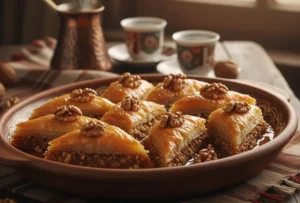
Bosnian Baklava
354kcal
Ingredients
Agda (Lemon Sugar Syrup)
- 2.125 cups water
- 2.75 cups granulated sugar US volume assumes about 200 g per cup; weighing is more precise
- 4 teaspoons fresh lemon juice
- 3 thin lemon slices from a well-washed, unwaxed lemon; remove after cooling
Walnut Filling
- 14 oz shelled walnuts grind three-quarters fairly fine and chop one-quarter more coarsely; do not make nut butter
- 0.25 cup granulated sugar
Phyllo Layers
- 17.6 oz thin phyllo dough baklava-style pastry; thaw completely according to the package directions
- 8.8 oz unsalted butter starting weight before clarification
Equipment
- Rectangular metal baking pan about 12 × 8 inches (30 × 20 cm); use additional pans for larger batches
- Kitchen scale recommended for phyllo, nuts, butter, and sugar
- Measuring cups and spoons
- Medium saucepan for the syrup
- Small saucepan and bowl for clarifying butter
- Food processor or nut grinder plus a knife for the coarser walnuts
- Long sharp knife to cut all the way through the pastry before baking
- Pastry brush
- Parchment paper and barely damp kitchen towel to cover unworked phyllo; keep the towel off the dough
- Ladle and thin serving spatula
Method
- Dissolve the sugar. Put the syrup water and sugar in a medium saucepan. Heat, stirring gently, until the sugar dissolves completely.
- Simmer the agda. Bring to a boil, then simmer gently, uncovered, over medium heat for 10 minutes. Avoid vigorous stirring once it boils. Add the lemon juice and lemon slices and simmer for 3 more minutes.
- Cool the syrup. Remove from the heat and let the agda cool completely to room temperature. Remove the lemon slices. Make the syrup first so it can cool while you prepare and bake the pastry.
- Clarify the butter. Melt the unsalted butter slowly over low heat without browning. Let stand for 5 minutes, skim the foam, and carefully pour the clear butter into a bowl, leaving the milky sediment behind.
- Prepare the walnuts. Grind three-quarters of the walnuts fairly fine and chop the remaining quarter more coarsely. Combine both textures with the filling sugar. Divide into five equal portions for each pan.
- Prepare the oven and pan. Heat a conventional oven to 340°F (170°C), with a rack in the lower-middle position. Brush the bottom and sides of the metal pan lightly with clarified butter.
- Trim and count the phyllo. Trim the thawed phyllo to fit the pan. Save usable offcuts to lie flat between whole sheets; avoid thick folded lumps. Reserve about one-quarter of the pan-sized sheets for the base and one-quarter for the top. Divide the remaining half into four similar intermediate bundles.
- Keep the sheets covered. While working, cover unused phyllo with parchment paper topped with a barely damp kitchen towel. Do not put the damp towel directly on the pastry. Uncover only the sheets you are using.
- Build the base. Lay the first base sheet in the pan and brush with a thin film of clarified butter. Repeat with the rest of the base bundle, buttering each sheet lightly. Spread the first walnut portion evenly over it without packing it down.
- Add the middle layers. Add the first intermediate bundle, sheet by sheet, brushing each sheet lightly with butter. Spread the next walnut portion over it. Repeat with the remaining three intermediate bundles and three walnut portions. There should be five thin walnut layers altogether.
- Finish the top. Add the reserved top bundle one sheet at a time, lightly buttering every sheet. Brush the last sheet evenly without creating pools.
- Cut before baking. With a long sharp knife, cut all the way to the bottom of the pan. For a standard pan, make four lengthwise strips and five diagonal cuts across them to form six rows, giving about 24 small pieces, with partial shapes at the edges.
- Distribute the remaining butter. Slowly spoon the remaining clarified butter over the top and especially into the cut lines. Let the pan stand for 5 minutes.
- Bake thoroughly. Bake for 55–65 minutes, until evenly golden brown and the edges look baked rather than pale and doughy. A brown top alone is not enough. If it darkens too soon, loosely tent with foil during the final part of baking.
- Add cool agda to hot pastry. Take the fully baked baklava out of the oven and let it stand for 2 minutes. Slowly ladle the completely cooled syrup along the cuts and edges, then distribute the rest over the surface in two further passes. A brief hiss is normal. Do not dump it into one spot or press on the layers.
- Allow the syrup to absorb. Leave the baklava undisturbed at room temperature for at least 4 hours. Keep it uncovered for the first hour, then cover loosely only once fully cool. Do not move or compress the layers while they absorb the syrup.
- Serve along the existing cuts. Carefully retrace the original cuts and lift out the pieces with a thin spatula. Serve at room temperature, preferably after the syrup has distributed evenly; the flavor and texture continue to settle by the next day.
Notes
- Measure by weight. US measures are rounded kitchen equivalents; the Metric amounts preserve the source formula. Phyllo sheet sizes and counts vary. Buy enough to weigh the pastry rather than assuming one US package is sufficient.
- Pan size and scaling. The base recipe makes 24 small pieces in a roughly 12 × 8-inch (30 × 20-cm) pan. At 2x or 3x, use two or three comparable pans, divide the ingredients evenly, and retain the same layer thickness. Baking time does not multiply; rotate pans if needed and judge each pan separately.
- Butter. The listed weight is whole unsalted butter before clarification, not the weight of finished clarified butter. Do not substitute that weight of ghee as though the yields were identical.
- Timing. Prep and cook times are planning estimates with syrup cooking/cooling overlapping pastry preparation and baking. Bake for 55–65 minutes and allow at least 4 hours after adding the syrup. If the syrup has not cooled completely when the pastry is ready, allow additional time; do not pour it on warm.
- Storage. Once fully cool, cover. The source gives about 4 days in a cool room, or up to about 7 days refrigerated; refrigerate in warm conditions. These are household storage estimates, not validated preservation limits. Temper refrigerated pieces for about 30 minutes before serving. Freeze soaked portions airtight for up to about 2 months for quality, thaw in the refrigerator, and do not add more syrup.
- Nutrition estimate. About 354 kcal per piece, calculated for 24 equal pieces from the full input quantities of walnuts, phyllo, sugar, and starting butter. It includes butter sediment and syrup that may remain behind; trace citrus is excluded. Brand labels and actual retention vary. This is a calculated estimate, not a laboratory analysis.