Palačinke Recipe – Balkan-Style Thin Crepes
This palačinke recipe makes thin, tender Balkan crepes that bend easily around a simple apricot-jam filling. Milk and sparkling mineral water produce a fluid batter, while a short rest helps the flour hydrate before the final liquid goes in. There is no baking powder or baking soda.
Palačinke are familiar across the Balkans and belong to more than one national kitchen. They can be breakfast, dessert, or part of another meal, with sweet or savory fillings. The version in the card is specifically rolled with smooth apricot jam; other fillings are variations with their own nutrition and allergen considerations.
A shallow 9½-inch nonstick skillet, a wide spatula, and a light touch with oil are the useful tools here. Allow about an hour for mixing, resting, cooking, and filling. The recipe estimates 12 large crepes, and one crepe is the nutrition serving rather than a complete meal for one person.
Palačinke – Balkan-Style Thin Crepes
Ingredients
- 8 3/4 oz all-purpose flour plain, not self-rising; practical US adaptation of German Type 405; weighing is preferred
- 3 large eggs about 50 g without shell per egg, matching the source egg-weight target
- 1 1/4 cups whole milk source about 3.5% milkfat; ordinary US whole milk is commonly 3.25%
- 6 3/4 fl oz sparkling mineral water add after the covered batter rest
- 2 1/2 tsp granulated sugar
- 1/3 tsp fine table salt coarse and kosher salt have different volume weights
- 3 1/4 tsp sunflower oil for the batter; add after the rest; US spoon measure is rounded
- 1 1/8 tsp sunflower oil total for the pan, applied in a very thin film as needed
- 9 tbsp smooth apricot jam without large fruit pieces; US volume uses approximately 20 g per tablespoon
Equipment
- 1 Nonstick skillet Approximately 9½ inches / 24 cm; choose a shallow pan and follow its manufacturer’s heat guidance.
- 1 Mixing bowl
- 1 Whisk
- 1 Kitchen scale For the closest source ingredient ratios and jam portions.
- 1 Small measuring cup About 70 ml, a scant ⅓ US cup, as a starting batter portion for each crepe.
- 1 Wide spatula Use a surface-safe tool for a nonstick pan.
- 1 Pastry brush For a very thin film of pan oil.
- 1 Plate and clean towel Stack and loosely cover the cooked crepes.
Method
- Whisk the eggs. Whisk the eggs, sugar, and salt in a large bowl for about 30 seconds, until evenly blended.
- Add milk and flour. Whisk in the milk, then add the flour in several additions, whisking each addition until no visible dry lumps remain. Do not add the sparkling water or batter oil yet.
- Rest the batter. Cover completely and rest for 20 minutes at room temperature to let the flour hydrate. Do not extend this into prolonged unrefrigerated storage.
- Finish the batter. After the rest, slowly stir in the sparkling mineral water, followed by the oil assigned to the batter. Mix just until smooth and thin enough to flow rapidly across the pan.
- Heat and lightly oil. Preheat a 9½-inch (24-cm) nonstick skillet over medium to medium-high heat for 2–3 minutes, following its manufacturer’s heat limits. Spread a small portion of the separate pan oil into a very thin film with a brush or folded paper towel. Do not leave a pool of oil.
- Swirl a thin layer. Pour approximately 70 ml of batter, a scant ⅓ US cup, into the center and immediately lift and swirl the pan to coat the base thinly. Use this as a starting portion rather than a guarantee of exact yield; pan shape and batter thickness matter.
- Cook and turn. Cook the first side for about 60–75 seconds, until the surface is no longer visibly liquid and the edges begin to release. Slide a wide spatula underneath and turn carefully. Cook the second side for another 20–30 seconds, until set; it needs less color than the first.
- Stack and repeat. Transfer each cooked crepe to a plate and cover loosely with a clean kitchen towel to keep it flexible. Repeat with the remaining batter, stirring briefly every few crepes. Reapply a trace of the measured pan oil only if needed. Larger batches make more crepes of the same size and require more pan time.
- Fill and roll. Divide the measured apricot jam evenly among the finished crepes, spread in a thin layer, and roll loosely. Serve warm or at room temperature without holding the cooked crepes out for prolonged periods.
Notes
Thin Balkan crepes, not thick pancakes
A palačinka should spread quickly over the pan and cook into a flexible sheet. The goal is different from a thick American pancake: no tall, fluffy middle, and no need for a chemical leavener. These crepes are also quite different from our Bosnian uštipci, which are fried pieces of a yogurt-based dough.
French crêpes are a useful comparison because they also use a fluid batter and a thin layer in the pan. There is no reliable border based on a single ingredient: household recipes vary on both sides. This particular Balkan version uses oil and sparkling mineral water, but those ingredients are not a universal definition of every palačinka.
Flour, eggs, milk, and the order of mixing
The source uses German Type 405 wheat flour. Plain American all-purpose flour is a practical adaptation, although the milling classification and absorption are not identical. Weigh the flour instead of packing it into a cup. If you use cups elsewhere in your kitchen, a spooned-and-leveled all-purpose reference of 120 g per cup is only an approximation, not a guarantee for every brand or measuring technique.
US large eggs closely match the source’s shell-free target of about 50 g per egg. The original whole milk is around 3.5% fat; ordinary US whole milk is commonly 3.25%, a small disclosed adaptation. Use plain sparkling mineral water, not a flavored or sweetened drink. Keep the batter oil separate from the small measured amount used to grease the pan.
Whisk the eggs with sugar and salt, add milk, and work in the flour gradually. This makes lumps easier to prevent than dumping flour into all the liquid at once. Do not judge the final consistency before the rest and immediately add more flour: the sparkling water and oil are deliberately added later.
Why the batter rests before the sparkling water goes in
The covered 20-minute rest gives the flour time to absorb liquid. Afterward, gently mix in the sparkling mineral water and then the batter oil. The finished mixture should flow freely when you tilt the pan, rather than sit in a thick mound that needs spreading with a spoon.
Adding the sparkling water after the rest keeps the sequence consistent with this formula and lets you cook the diluted batter promptly. It is not a reason to whip the batter vigorously or add baking powder for extra lift. The intended result is thin and soft.
Choosing the pan and swirling a thin layer
Use a shallow nonstick skillet approximately 24 cm, or 9½ inches, across. Heat it over medium to medium-high heat for a few minutes, within the manufacturer’s temperature guidance. A thin film of oil is enough; visible pools encourage irregular, fried patches instead of an even crepe surface.
Start with approximately 70 ml of batter per crepe, a scant one-third US cup. Pour in the center, lift the pan immediately, and swirl so the batter reaches across the base before it sets. Pan slopes and cooking-surface diameter differ, so treat that amount as a starting point. A thick crepe may simply need less batter, rather than a change to the whole formula.
Stir the bowl briefly every two or three crepes to redistribute the batter. Use only a trace of the measured pan oil when the surface needs it. The main recipe’s oil amounts already include both batter and pan; there is no additional unmeasured pour between every crepe.
When to turn, and how to avoid tearing
The first side usually takes about 60–75 seconds. Wait until the upper surface is no longer visibly liquid and an edge begins to release. Slide a wide spatula underneath and turn in one controlled movement. The second side needs only about 20–30 seconds, just enough to cook through; it does not need the same browning as the first.
Tearing: Turning too early leaves the sheet too weak to lift. Give it a little longer, check that the pan was adequately preheated, and avoid very thin holes caused by uneven swirling. Do not taste raw batter, which contains both uncooked flour and eggs.
Sticking: Check the condition of the nonstick surface, its heat setting, and whether a light film of oil is needed. A damaged coating or an insufficiently heated pan can make the first crepe difficult even when the batter is correct.
Dry, brittle edges: Reduce excessive cooking time, particularly on the second side. Stack the finished crepes and cover loosely with a clean towel. The stack retains enough warmth and moisture to keep them supple for rolling.
Apricot jam and other ways to fill palačinke
For the main version, use smooth apricot jam without large pieces of fruit. Spread the measured jam thinly among the finished crepes and roll loosely. If your preserves are chunky, smooth them first and measure the amount that will actually be used. Apricot filling also appears in vanilice, where it joins tender cookie halves rather than filling a crepe.
Other fruit preserves, ground walnuts, or a chocolate-nut spread are familiar sweet options. Cheese, spinach, mushrooms, or other savory fillings belong to separate preparations; they need suitable cooking and storage instructions of their own. The nutrition in this card applies to the apricot-filled version, not every possible filling. A small serving with Bosnian coffee is one simple way to serve them as dessert.
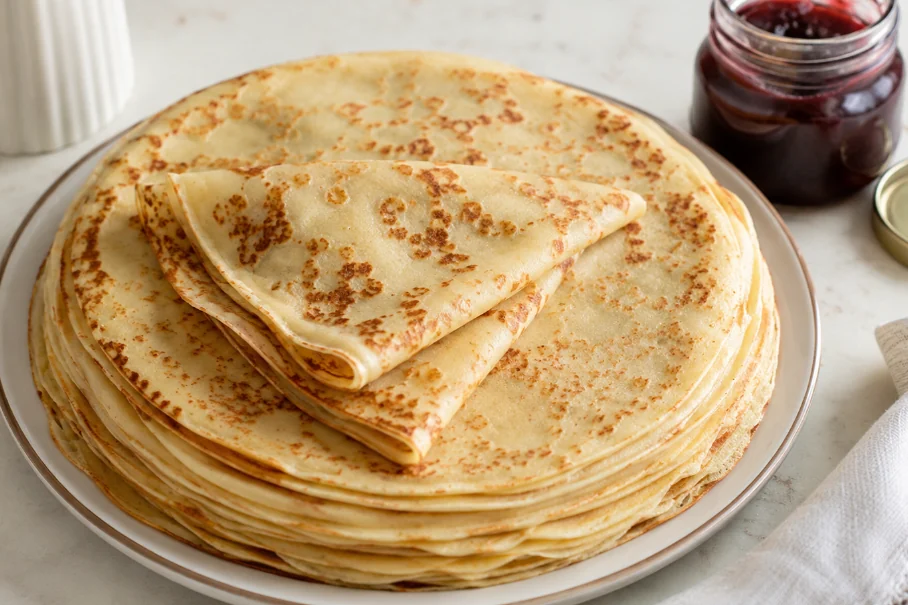
The original recipe photograph shows stacked and folded crepes with a dark fruit jam alongside them. The measured version below the introduction is the apricot-filled, rolled preparation described in the recipe card.
Preparing ahead, refrigerating, and freezing
For a head start, mix the eggs, milk, flour, sugar, and salt, cover, and refrigerate for up to 24 hours. Stir again before cooking, and add the sparkling water and batter oil just before using. The ordinary 20-minute rest in the method is for immediate preparation; it is not an instruction to leave an egg-and-milk batter out for hours.
Cool leftover crepes without prolonged room-temperature holding, then refrigerate promptly in a shallow, covered container. Keep at 40°F (4°C) or below and use within 3 days. Refrigerate within 2 hours of cooking, or within 1 hour when the temperature is above 90°F. Separate soft crepes with parchment if they tend to stick.
For freezing, leave the crepes unfilled, place parchment between them, and seal airtight. Freeze for up to 2 months for best quality, then thaw in the refrigerator. Reheat covered in short intervals in a microwave or gently in a covered skillet until hot throughout; leftovers should reach 165°F (74°C). Avoid prolonged heating that dries the edges.
Practical questions
Does doubling the recipe change the rest? No. The covered rest stays about 20 minutes; the amount of batter, oil, and jam increases. Make more crepes of the same size and allow additional pan time.
Is the yield exactly 12 crepes? It is an approximate source estimate for the stated pan and portion size. A different cooking-surface diameter or thicker pour changes the count. Divide the measured filling among the crepes you actually make.
How is nutrition calculated? The estimate uses the exact Metric amounts and assumes 12 equal crepes, all the apricot jam, and full retention of both oil quantities. Some pan oil can remain on the brush or skillet, so actual fat may be lower. The card lists the ingredient matches and the milk-fat approximation.