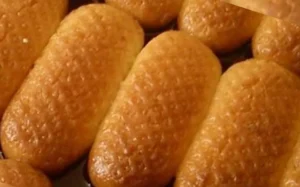
Hurmašice
214kcal
Ingredients
Agda (Lemon Sugar Syrup)
- 3 3/4 cups water US volume is rounded; Metric gives the exact amount
- 3 cups granulated sugar
- 4 teaspoons fresh lemon juice
- 3 thin lemon slices from a well-washed, unwaxed lemon; remove after cooling
Butter Dough
- 8.8 oz unsalted butter softened, not melted
- 2.1 oz granulated sugar
- 1 large egg about 50 g each without shells; room temperature
- 1 large egg yolk about 17–18 g each; room temperature
- 1.75 oz plain whole-milk yogurt regular unstrained yogurt, about 3.5% fat; room temperature
- 17.6 oz all-purpose flour preferably a lower-protein brand; see flour note
- 2 1/2 teaspoons baking powder US volume assumes 4.8 g per teaspoon; check the label or weigh
- 1/3 teaspoon fine salt US volume is approximate; weighing is more precise
Equipment
- Kitchen scale recommended; ounces are weights, not fluid ounces
- Measuring jug and spoons
- Medium saucepan
- Heatproof bowl for cooling the syrup, with an optional cold-water bath
- Large mixing bowl and hand mixer
- Spatula
- Coarse kitchen grater clean and dry; used to imprint the dough, not grate it
- Deep metal baking pan about 15 × 11 inches (38 × 28 cm); must hold the syrup; avoid thermal-shock-prone glass or ceramic
- Ladle or large spoon
Method
- Dissolve the syrup sugar. Combine the syrup water and sugar in a medium saucepan. Heat while stirring until the sugar has dissolved completely.
- Simmer the light agda. Bring to a boil, then simmer gently over medium heat for 5 minutes. Add the lemon juice and slices and simmer for 3 more minutes. Keep the syrup pourable; do not reduce it to a thick consistency.
- Cool completely. Pour the agda into a heatproof bowl and let it cool completely to room temperature. A cold-water bath around the bowl can help it cool sooner. Keep bath water out of the syrup and remove the lemon slices after cooling.
- Prepare the oven and pan. Heat a conventional oven to 355°F (180°C), with a rack in the middle. Set out a deep metal pan about 15 × 11 inches (38 × 28 cm). No greasing is needed for this butter-rich dough. The pan must be deep enough to hold the syrup.
- Cream butter and sugar. Beat the soft butter and dough sugar with a hand mixer for 3–4 minutes, until creamy. The butter should be pliable, not melted.
- Add the egg, yolk, and yogurt. Beat in the whole egg completely, then beat in the yolk. Briefly mix in the plain yogurt until combined.
- Combine the dry ingredients. In a separate bowl, mix the flour, baking powder, and salt thoroughly so the leavener is evenly distributed.
- Make a soft dough. Add the dry mixture to the butter mixture in portions, using low mixer speed at first. Finish briefly with your hands only until the dough is smooth and combined. Do not knead it like bread or keep working it after it comes together.
- Rest for 10 minutes. Let the dough rest for 10 minutes. It should be soft, shapeable, and barely sticky rather than dry or stiff. Do not add more flour just to make it feel firm.
- Portion evenly. Divide into equal portions of about 31 g each, making 30 cookies per standard batch. For larger batches, increase the number of pieces rather than their size.
- Shape and imprint. Roll each portion into a ball, then an oval about 2⅜ inches (6 cm) long. Gently press the top against the coarse face of a clean grater to make the pattern, lengthening it slightly without forcing dough through the holes. Keep the oval plump rather than flattening it into a thin disk.
- Arrange in the pan. Place the cookies pattern-side up in the deep metal pan, leaving about ¾ inch (2 cm) between them. Use additional comparable pans for larger batches.
- Bake until golden. Bake on the middle rack for about 25–30 minutes, until evenly golden brown without becoming dark or dry. Baking time depends on the pan and oven; retain the same cookie size when scaling.
- Pour cool syrup over hot cookies. Remove the pan from the oven and wait 2 minutes. Slowly pour the completely cooled agda between the still-hot cookies first, then over their tops. Use a metal pan to avoid the thermal-shock risk of glass or ceramic.
- Baste after 20 minutes. After about 20 minutes, spoon some syrup from the pan over any tops that are not fully moistened. Handle the cookies gently and do not press them down.
- Soak before serving. Let stand at room temperature for at least 4 hours, uncovered for the first hour. Cover loosely only after completely cool. An overnight rest gives more evenly soaked cookies; refrigerate after the soaking period. Serve with some of the pan syrup.
Notes
- Flour and US measurements. Metric preserves the source formula. The source uses German Type 405 flour; ordinary US all-purpose flour is an adaptation and brands differ in strength. Prefer a lower-protein all-purpose flour, avoid bread or self-rising flour, and weigh it. Ounces in this recipe are weights. The flour adaptation has not been kitchen-tested here.
- Baking powder. The US spoon amount assumes 4.8 g per teaspoon, as on the Clabber Girl label. Brands vary; weighing 12 g is more precise. Use baking powder, not baking soda.
- Portions and scaling. The base dough weighs about 940 g before baking and makes 30 portions of about 31 g. At 2x or 3x, keep the individual cookie size and spacing unchanged and use additional comparable pans. Divide dough and syrup evenly; do not multiply baking time.
- Timing. The 40-minute prep estimate includes the 10-minute dough rest; cook time allows for the syrup and 25–30-minute bake. Syrup cooling overlaps the preparation and baking. Allow at least 4 hours of soaking afterward, or overnight for a more even texture. Extra time may be needed if the syrup has not fully cooled.
- Temperature sequence. For this specific formula, completely cooled agda goes over hot cookies after a 2-minute pause out of the oven. Other recipes may use a different temperature sequence; keep this formula consistent.
- Storage. After the soaking period and once completely cool, cover and refrigerate with some of the pan syrup. The source suggests about 5 days; this is a household storage estimate, not a validated preservation limit. Temper portions for about 20 minutes before serving. Freezing unsoaked or lightly soaked cookies is mentioned in the source, but a precise freeze-and-resyrup method is not established for this formula.
- Nutrition estimate. About 214 kcal per cookie, calculated for 30 equal portions using all the starting butter, flour, dough and syrup sugar, whole egg, yolk, and yogurt. All syrup is counted even if some remains in the pan; trace citrus and label-rounded leavening calories are excluded. Ingredient brands, absorption, and portion size vary. This is a calculated estimate, not a laboratory analysis.