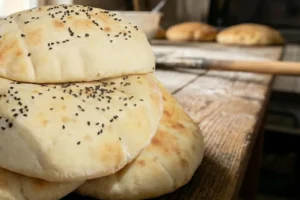
Bosnian Somun
475.85kcal
Ingredients
- 17 2/3 oz all-purpose flour preferably unbleached; weigh for best results
- 1 1/2 cups lukewarm water for the initial dough; 82–86°F (28–30°C)
- 2 1/4 tsp instant dry yeast
- 2 1/2 tsp sugar
- 2 tsp fine salt
- 5 tsp lukewarm water for dissolving the salt
- 8 tsp water for wetting hands and shaping
- 2 tsp nigella seeds also called ćurekot; not ordinary cumin
Equipment
- Kitchen scale Recommended for the flour and salt.
- Mixing bowl Large enough for the dough to rise.
- Stand mixer Fitted with a dough hook.
- Bench scraper For handling the sticky dough.
- Measuring jug For the separate water quantities.
- Parchment paper For shaping on a cool surface only. Remove completely before loading; no paper goes into the oven.
- Heavy sheet pan Oven-safe at 480°F (250°C); preheat inverted for at least 35 minutes. Use a dry wooden peel or a second, cool inverted sheet pan to load the dough.
- Kitchen towel Clean; for covering and softening the baked bread.
Method
- Start the dough. Stir the yeast and sugar into the water listed for the initial dough. Add the flour and mix with a dough hook on low speed for about 2 minutes, until no dry patches remain.
- Rest, then add salt. Cover the shaggy dough and rest for 15 minutes. Dissolve the salt in the separate water listed for dissolving the salt. With the mixer running on low to medium-low, gradually work in the salt water. Knead for 6–8 minutes, until more elastic but still soft and sticky.
- Let rise and fold. Cover and let rise at warm room temperature for 45 minutes. After about 20 minutes, wet one hand and stretch and fold the dough toward the center from all four sides. Cover again for the remaining rising time.
- Divide and rest. Turn onto a lightly water-dampened surface. Divide into portions of about 8 oz (226 g) each. Gently round with damp hands, cover, and rest for 20 minutes. Avoid adding extra flour.
- Preheat the baking surface. While the dough rests, preheat the oven to 480°F (250°C), conventional top and bottom heat. Place a heavy, inverted sheet pan on a lower-middle rack and heat it for at least 35 minutes before baking.
- Shape the rounds. Place each dough ball on a separate piece of parchment on a cool work surface; the paper is for shaping only and must not enter the oven. With damp fingertips, gently press into a round about 7–8 inches (18–20 cm) across and ⅝ inch (1.5 cm) thick. Do not use a rolling pin. Cover loosely and let rise for 25 minutes.
- Press the pattern. Just before baking, wet your fingertips and press parallel lines into each round, then cross them to make a diamond pattern. Make definite indentations without cutting through the dough. Distribute the nigella seeds evenly over the breads.
- Bake in batches. Use a dry wooden peel or the back of a second, cool sheet pan, lightly dusted with the same all-purpose flour, for loading. With a wide bench scraper, gently loosen a round from its paper and support it as you move it onto the peel; leave all paper behind. Give the peel a small shake to check that the bread slides. If it sticks, gently lift the stuck edge with the scraper and dust just that spot; do not pull or force the dough. Slide it directly onto the hot inverted pan, using dry oven mitts and keeping hands clear of the hot metal. Bake only as many as fit comfortably, usually two at a time, keeping the others loosely covered. Bake each batch for 8–10 minutes, until puffed and lightly golden. Keep the oven closed for the first 7 minutes.
- Soften and serve. Loosely wrap the hot breads in a clean kitchen towel and rest for 10 minutes to soften the thin crust. Serve warm, or cool completely on a rack before storing.
Nutrition
Calories475.85kcalCarbohydrates98.7gProtein13.91gFat1.81gSaturated Fat0.28gSodium1167.66mgSugar2.85g
Notes
- Weigh the dough ingredients: US measures are rounded. Select Metric for the source weights and the intended 75% dough hydration. The water for shaping is separate and is not poured into the dough.
- Sticky dough: Use damp hands and a bench scraper rather than kneading in extra flour. The dough should become elastic while remaining soft.
- Nigella: These seeds are also called ćurekot or kalonji. They are included in this version and are different from ordinary cumin.
- Timing: The rising and resting total includes the initial 15-minute rest, 45-minute first rise, 20-minute bench rest, 25-minute final rise, and 10-minute towel rest. Oven preheating overlaps with the rests. Baking time allows for two batches; larger quantities take longer.
- Paper-free baking: Parchment is only a cool shaping surface and is removed before baking. Ordinary parchment and wax paper must not enter this 480°F (250°C) oven. Use a dry, lightly flour-dusted peel or second cool inverted pan; loosen each round gently with a wide scraper and check that it slides before loading. Use only a light surface dusting of the same flour, never knead extra flour into the dough.
- Storage: Best the day it is baked. Cool completely before sealing; keep for about one day at room temperature or freeze for up to three months. Lightly moisten and reheat at 350°F (180°C) for 5–7 minutes.
- Nutrition: Estimated per whole bread from the metric ingredient weights, using the WPRM calculator plus Steenbergs nigella-seed nutrition data. Flour and seed brands vary.