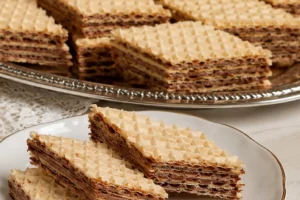
Oblatne – Chocolate Walnut Wafer Cake
180.05kcal
Ingredients
Wafer Layers
- 5 large rectangular wafer sheets unfilled cake wafers, about 11½ × 15⅜ inches (29 × 39 cm) and 1.76 oz (50 g) each
Chocolate-Walnut Filling
- 8.45 fl oz whole milk US fluid ounces, rounded; use Metric for the reference volume
- 6.35 oz granulated sugar weighed
- 0.28 oz vanilla sugar additional to the granulated sugar; weigh
- 7.05 oz butter cut into pieces; plain unsalted is a practical US choice
- 5.29 oz dark chocolate 60–70% cocoa; chopped
- 0.71 oz unsweetened cocoa powder not sweetened drinking-chocolate mix
- 8.82 oz walnuts shelled; finely ground without turning into nut butter
- 5.29 oz plain butter biscuits very finely ground; crisp European-style butter cookies, not American breakfast biscuits
Equipment
- Kitchen scale
- Saucepan
- Whisk
- Silicone spatula
- Food processor
- Two large boards or flat trays; each at least the wafer-sheet size
- Offset spatula
- Parchment paper
- Distributed weights 4½–6½ lb (2–3 kg) per base-size block, spread across its top board
- Long sharp knife
- Refrigerator thermometer
Method
- Prepare the wafers and crumbs. Keep the wafer sheets dry on a clean, flat board. Finely grind the butter biscuits until no coarse pieces remain. Grind the walnuts separately, stopping before they turn oily or become nut butter. Set out a second full-size board or tray and distributed weights. For scaled recipes, make separate base-size blocks, each using five sheets.
- Heat the milk base. Combine the milk, granulated sugar, and vanilla sugar in a saucepan. Heat over medium heat, stirring regularly, until the sugar dissolves and the milk just starts to simmer. Do not boil it down into a different syrup.
- Melt the butter and chocolate. Reduce the heat to low, add the butter in pieces, and stir until melted. Add the chopped dark chocolate and cocoa, remove the pan from the heat, and stir until smooth. Do not keep boiling after adding the chocolate.
- Thicken with walnuts and biscuits. Stir in the ground walnuts, then work in the biscuit crumbs in two additions. Mix until evenly combined. Rest for about 5–10 minutes, stirring two or three times, until warm and spreadable rather than very hot and runny. Do not let it become cold and stiff.
- Build even layers. For each base-size block, place a wafer on the bottom board with the deeper-patterned side facing up. Divide that block's share of filling into four equal portions. Spread a portion thinly and evenly to the edges, place the next sheet squarely on top, and press lightly with flat hands. Repeat to make four filling layers between five sheets. Leave the final top bare. Divide filling evenly among blocks when scaling.
- Press flat without breaking. Cover the bare top with parchment and the second full-size board or tray. Distribute about 4½–6½ lb (2–3 kg) evenly over that board for each block. Avoid one heavy point in the middle, which can crack the sheets or force filling out.
- Press briefly and refrigerate. In a cool kitchen, press for up to about 1 hour, then refrigerate the still-weighted block for at least 3 hours at 40°F (4°C) or below. Count filling cooling, assembly, pressing, and later serving toward the cumulative 2-hour unrefrigerated limit; above 90°F (32°C), the limit is 1 hour. If the kitchen is warm or the limit is approaching, move the weighted block to the refrigerator immediately and complete at least 4 hours of pressing and chilling there. Do not leave it out longer to improve texture.
- Cut small rectangles. Once fully chilled and firm, remove the weights, board, and parchment. Allow about 10 minutes at room temperature only if the unrefrigerated time allowance permits. Cut each base-size block into six strips and each strip into six small rectangles, using a long sharp knife. Each block yields 36 pieces; the total grows with the number of blocks. Wipe the blade as needed and keep remaining pieces covered in the refrigerator.
Notes
- The base recipe uses five sheets, about 250 g combined, with four filling layers. Match both sheet area and count: 29 × 39 cm is the reference. At 2x use ten sheets for two blocks and 72 pieces; at 3x use fifteen sheets for three blocks and 108 pieces. Do not build one tower with all the scaled sheets.
- Look for large unfilled Balkan wafer cake sheets, also called oblatne or oblande, at Balkan or Eastern European groceries and specialty suppliers. Tiny baking wafers, chocolate melting wafers, breakfast waffles, graham crackers, and filled wafer cookies are different products.
- Plain crisp butter biscuits such as Leibniz-style cookies preserve the specified filling. American breakfast biscuits are not equivalent. Hazelnuts and Plazma biscuits belong to alternative versions and are not included in this formula or nutrition estimate. Vanilla sugar stays separate from granulated sugar; no unlisted extract is added.
- Use weighed ounces for solids. Milk is given in US fluid ounces, a volume rather than a weight. Metric and a measuring jug preserve its reference amount. Avoid cups for finely ground nuts or biscuits because packing and grind change the weight.
- The one-hour cool-room press is an upper planning allowance, not extra time outside the dairy safety limit. Refrigerate sooner when needed, keeping total pressing and chilling at least four hours. Do not stack warm blocks in the refrigerator; leave space for cooling. Extra assembly time at larger scales may require moving each completed block into refrigeration promptly.
- Store covered at 40°F (4°C) or below and use within 3 days as a conservative limit within general cooked-leftover guidance, not a tested shelf-life guarantee. Discard after excessive room-temperature exposure; smell cannot establish safety. Freeze fully chilled portions airtight for longer storage and thaw in the refrigerator; wafer texture may soften. No specific freezer-quality duration has been tested.
- Nutrition is an independent estimate per one-thirty-sixth, counting all filling and approximately 250 g wafers. It uses DEA Balkanina's published plain-oblande analysis as a wafer proxy, Leibniz Original biscuit data, USDA whole milk (1.03 g/ml), sugar, butter, walnuts, unsweetened cocoa, and 60–69% dark chocolate composition. Vanilla sugar is approximated as granulated sugar. The 60–70% chocolate range, actual wafer weight, labels, and trimming change the result; the source calorie number was not copied.