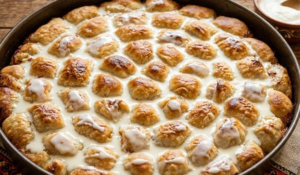
Mantije – Sandžak Baked Beef Pastries
727kcal
Ingredients
Dough
- 4 1/6 cups unbleached all-purpose flour weigh for best results; spoon and level cups; original flour is German Type 405; minimal extra dusting flour is not included in nutrition
- 1 1/3 tsp fine table salt for the dough; not coarse or kosher salt by the same volume
- 9 1/2 fl oz lukewarm water for the dough; about 86–95°F (30–35°C)
- 1 tbsp sunflower oil for the dough; separate from layering oil
Layering and brushing
- 5 2/3 tbsp unsalted butter melted and cooled to just warm; US spoon measure is approximate
- 2 tbsp sunflower oil mix with melted butter; this pool also supplies the light ball and pan coating
Beef filling
- 17 5/8 oz ground beef fresh; 80/20 ground chuck is the defined US choice; US weight is rounded
- 7 oz onion prepared weight; very finely diced, about 2–3 mm
- 2 tbsp cold water for the filling, not the dough
- 1 1/3 tsp fine table salt for the filling; separate from dough and sauce salt
- 1 tsp ground black pepper conversion basis: about 2.3 g per teaspoon
Garlic yogurt sauce
- 1 5/8 cups plain whole-milk yogurt unflavored regular whole-milk yogurt, about 3.5% milkfat; US cup measure is approximate; use Metric for the exact weight
- 2 cloves garlic medium, peeled and crushed; approximately 3 g per clove; the original allows a milder amount
- 1/2 tsp fine table salt for the yogurt sauce
Equipment
- Kitchen scale for dough portions and very small filling portions
- Mixing bowls keep raw filling separate from the ready-to-eat yogurt sauce
- Rolling Pin allow a work surface large enough for the thin rectangles
- Pastry wheel or knife cut even squares; keep fingers clear
- Pastry brush use the measured butter-oil mixture
- Metal baking pans two 12 × 14-inch (30 × 35-cm) pans at 1x; more pans or batches when scaling
- Thin-probe food thermometer check beef filling in representative center pastries
- Clean Kitchen Towel for the optional post-bake softening rest, outside the oven
Method
- Mix the yogurt sauce. Before handling raw beef, stir the yogurt, crushed garlic, and sauce salt together. Cover and refrigerate until serving.
- Prepare the filling. Mix the beef, very finely diced onion, measured cold filling water, filling salt, and pepper just until evenly distributed. Do not pre-cook the beef. Cover and refrigerate; take out only the portion needed while shaping. Wash hands, tools, and work surfaces after raw-meat handling.
- Knead the dough. Mix the flour and dough salt, then add the lukewarm dough water and dough oil. Knead for about 8–10 minutes until smooth, elastic, and manageable, with no dry flour pockets. Keep the measured 56% hydration as the starting point; this is not a wet flatbread dough.
- Prepare the brushing mixture. Combine the melted, just-warm butter with the separate layering oil. Reserve a little of this mixture for lightly coating the dough balls and pans; keep a substantial portion for brushing the formed pastries. Do not add an unmeasured extra pool of fat.
- Divide and rest. Divide into equal dough balls using the scale-specific batch guide in Notes. Lightly coat, cover completely, and rest for about 30 minutes. The dough relaxes rather than rising; it contains no yeast.
- Build the stacks. Roll each ball into a round about 7–8 inches (18–20 cm) wide on a minimally floured surface. Make stacks of three rounds each, brushing the lower two rounds with a thin film of the butter-oil mixture. Keep enough mixture for the pans and final brushing. Cover the stacks and rest another 10 minutes. Preheat a conventional oven to 410°F (210°C) during this stage.
- Roll and cut. Keep the other stacks covered while rolling one stack to a thin rectangle about 16 × 20 inches (40 × 50 cm). Cut about 2-inch (5 cm) squares. Keep cut dough covered so the borders stay flexible. Repeat with the remaining stacks; retain usable edge pieces rather than assuming a perfectly measured yield.
- Portion the filling. Count the usable squares and divide the chilled filling proportionally among them. For the stated small squares, about 4.6–5.2 g filling per piece is a practical calculated starting range, not a heaped teaspoon. Test-close a few pieces first, leaving clean borders; use the actual count and the Notes calculation to avoid a large leftover mound of filling.
- Close and arrange. Bring two opposite corners together above the filling, then bring the other corners to the center. Pinch the side openings tightly closed. Set seam-side down in lightly coated metal pans, compactly but without crushing or stretching neighboring parcels. Use additional pans if needed. Keep formed raw pastries and unused filling refrigerated while other batches are shaped.
- Brush and bake. Brush the tops and gaps with the remaining butter-oil mixture. Bake in the fully preheated oven for about 30–35 minutes, until golden and the dough is cooked through. With two pans, use separated upper- and lower-middle racks, swap rack positions and rotate front to back after about 20 minutes. Check representative pastries from the middle of each pan with a thin thermometer probe: the beef filling must reach at least 160°F (71°C). Continue baking if necessary; browning alone is not a safety check.
- Rest briefly. Rest for about 10 minutes after baking. Loosely cover with a clean towel for softer tops, or leave uncovered for a crisper surface. Do not cover with a towel inside the oven.
- Serve with cold yogurt. Divide the cooked pastries and sauce into the servings shown. Serve the hot mantije with the refrigerated garlic yogurt alongside or spooned over just before eating. Do not soak the whole tray in sauce far in advance.
Nutrition
Serving1main portion (1/6 recipe with sauce)Calories727kcalCarbohydrates70.4gProtein25.81gFat37.32gSodium1318mg
Notes
Yield and filling: Six main portions. The two source rectangles each contain 8 × 10 theoretical squares at the stated dimensions: at most about 160 before edge losses. Allow roughly 144–160 finished small pastries, about 24–27 per main portion; this is a calculated working estimate, not a measured kitchen yield. The raw filling is about 740 g, including pepper: approximately 4.6 g per piece at 160 or 5.1 g at 144. Divide by your actual cut count and keep borders clean. Do not use a heaped teaspoon on every square. If the count differs greatly, reassess square size and rolling before committing all the filling.
Batch guide: At 1x, six dough balls make two three-round stacks and about 144–160 parcels for six portions. At 2x, twelve balls make four stacks and roughly 288–320 parcels for twelve portions. At 3x, eighteen balls make six stacks and roughly 432–480 parcels for eighteen portions. Keep round size, rectangle dimensions, square size, and filling per individual parcel comparable. Stacks always contain three rounds; the number of stacks increases.
Pans and batches: Plan two 12 × 14-inch (30 × 35-cm) metal pans at 1x, roughly half the parcels in each, rather than forcing the theoretical maximum into one pan. Allow room for each closed parcel, usually around 1–1¼ inches wide, without excessive compression. At 2x/3x allow four/six comparable pans and additional oven batches. The 35-minute cook allowance assumes two pans fit safely at once with room for air circulation. A one-pan oven requires another approximately 30–35-minute baking round; larger batches also extend elapsed time. Follow actual doneness, not the clock alone.
Timing: Plan about 2 hours 55 minutes: approximately 90 minutes active preparation, 30 + 10 minutes covered dough rests, up to 35 minutes baking, and a 10-minute post-bake rest. Prepare sauce and filling before mixing the dough in this workflow. Oven preheating overlaps the later dough work and is not added again. The source’s 50-minute preparation estimate is optimistic for hand-closing this many tiny parcels; 90 minutes is a planning allowance, not a kitchen-tested result. Beginners or extra oven rounds need longer.
Measurements and adaptation: The source formula is unchanged in Metric. Dough water is about 56% of flour weight. US cups use 120 g all-purpose flour per cup, spooned and leveled; weighing is more reliable. Fine table salt uses 6 g/tsp and ground pepper 2.3 g/tsp. One US tablespoon is 14.79 ml, rounded to the source’s 15 ml; water uses 29.57 ml/fl oz. US measures are practical rounded equivalents; Metric retains the exact original quantities. Butter uses 14.2 g per tablespoon, yogurt about 245 g per cup, and 1 oz is 28.35 g. The spooned-and-leveled flour cup is an approximation. Yogurt thickness and onion preparation affect volume. Garlic is defined as two medium cloves, modeled at 6 g; the original allows one or two. Whole-milk yogurt is the source’s approximately 3.5%-fat category; brands and thickness vary. US all-purpose flour is a practical adaptation of Type 405, not an identical milling classification.
Storage and preparation ahead: Keep beef, filling, formed raw pastries, and yogurt at 40°F (4°C) or below when not actively working. Cook raw assembled pastries within the original ground-beef refrigerated window of one to two days; assembly does not restart it. Keep raw meat away from sauce and serving tools. Refrigerate cooked pastries in shallow containers within two hours, or one hour above 90°F (32°C), and use within two days. Store the yogurt separately and follow its label’s shorter limit if applicable. Reheat pastries throughout to 165°F (74°C), covering initially to limit drying, then uncover briefly if desired. Freeze promptly chilled baked pastries without yogurt for longer keeping; thaw in the refrigerator. No independently tested frozen shelf life is claimed.
Nutrition: Estimate per one-sixth of the complete recipe, including the full yogurt sauce and all measured butter and oil, with no credit for fat left in the pan. Checked USDA FoodData Central matches use unbleached all-purpose flour, unsalted butter, sunflower oil, raw 80/20 ground beef, raw onion and garlic, fine table salt, ground pepper, and plain whole-milk yogurt. The yogurt match contains 3.25 g fat/100 g as a composition proxy for the source’s approximate 3.5%; it is not a brand guarantee. Oil is modeled at about 13.6 g per 15 ml; the garlic model uses 6 g total. Minimal extra dusting flour and food left on utensils are not measured. Trimming losses, brands, fat drainage, sauce use, and actual portions change the result. Contains wheat and milk. Editorially reviewed; not independently kitchen-tested.