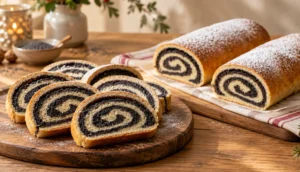
Makovnjača – Croatian Poppy Seed Roll
241kcal
Ingredients
Yeast dough
- 17 1/2 oz all-purpose flour plain, not self-rising; practical US adaptation of German Type 405; weigh for best results
- 8 1/2 fl oz whole milk lukewarm, about 90°F (32°C); source whole milk, with US 3.25% milkfat a practical match
- 3/4 oz fresh compressed baker’s yeast refrigerated cake yeast, not the same weight of active dry or instant yeast
- 2 3/4 oz granulated sugar use a small portion to activate the yeast, then the remainder in the dough
- 2 3/4 oz unsalted butter melted and cooled until just lukewarm
- 1 large egg approximately 50 g without shell; practical US match for the source medium egg
- 1 large egg yolk approximately 17 g; for the dough
- 1/3 tsp fine table salt coarse or kosher salt has a different volume weight
- 1/2 lemon, finely grated zest only scrub the peel; avoid the bitter white pith
Cooked poppy seed filling
- 10 1/2 oz finely ground culinary poppy seeds plain and unsweetened, not whole seeds or a prepared sweet filling
- 8 1/2 fl oz whole milk for the filling
- 4 1/4 oz granulated sugar for the filling
- 3 1/2 tbsp unsalted butter for the filling
- 8 g vanilla sugar weighed because packet sizes vary; keep as sugar, not liquid extract
- 30 g fine soft-wheat semolina Weichweizengrieß; weighed for reliable thickening, not durum pasta semolina
- 1/2 lemon, finely grated zest only for the filling
Egg wash
- 1 large egg yolk separate from the yolk in the dough
- 1 tbsp whole milk for the egg wash
Equipment
- 1 Large baking sheet An 18 × 13-inch rimmed half-sheet can hold the base batch’s two rolls, about 14 inches long, with a generous gap. Use more sheets or baking batches if they do not fit without touching.
- 1 Kitchen scale Especially useful for seeds, flour, yeast, thickener, and matching dough/filling portions.
- 1 Mixing bowl
- 1 Small bowl For dissolving fresh yeast.
- 1 Saucepan For melted butter and the cooked filling.
- 1 Rolling Pin
- 1 Pastry brush and fork For egg wash and gentle steam vents.
- 1 Cooling rack
- 1 Food thermometer Check dough near the center, not just the filling.
- 1 Serrated knife
Method
- Activate the fresh yeast. Melt the dough butter over low heat and let it cool until lukewarm. Stir the crumbled fresh yeast and a small portion of the dough sugar into the lukewarm dough milk, about 90°F (32°C). Rest for 10 minutes. This sugar and milk come from the measured dough ingredients, not extra additions.
- Knead the soft dough. Combine the flour, remaining dough sugar, and salt. Add the whole egg, dough yolk, dough lemon zest, cooled melted butter, and yeast milk. Knead for 8–10 minutes until smooth, elastic, and soft, with no heavy sticking. Avoid adding enough work-surface flour to make the dough stiff.
- Give the first rise. Cover the bowl and let the dough rise in a comfortably warm place for about 60 minutes, until approximately doubled. Prepare and cool the filling during this rise.
- Cook the filling. Heat the filling milk, filling sugar, filling butter, and vanilla sugar in a saucepan, stirring until the butter melts. Stir in the finely ground poppy seeds, soft-wheat semolina, and filling lemon zest. Cook gently over low heat, stirring, for 2–3 minutes until slightly thickened. Transfer to a shallow heatproof bowl and cool completely. It should spread easily without running or releasing a puddle of milk.
- Divide and roll. Line a large rimmed baking sheet with parchment rated for the oven temperature. Gently deflate the risen dough and divide into equal roll-size portions, approximately 500 g (about 1 lb 2 oz) each; divide the cooled filling evenly to match. Roll each dough portion on a lightly floured surface into an even rectangle about 12 × 14 inches (30 × 35 cm). Keep the other portions covered. The dough should be thin and even, not paper-thin.
- Spread and shape. Spread a filling portion evenly over each rectangle, leaving a ½–¾-inch (1½–2-cm) clean border. Avoid thick mounds and bare gaps. Roll from a long side with enough support to enclose the filling, without stretching the dough tightly. Place seam-side down on the baking sheet with room between rolls.
- Proof the shaped rolls. Cover with a clean towel and rise for another 30 minutes. Use more comparable baking sheets when scaling rather than making larger rolls or crowding a tray. During this final rise, preheat a conventional oven to 355°F (180°C), with a rack in the middle.
- Brush and vent. Whisk the separate wash yolk and wash milk together. Brush the proofed rolls lightly and evenly, then gently prick the surface at several points with a fork so steam can escape. Discard wash left after contact with raw dough.
- Bake through the dough. Bake on the middle rack for about 35–40 minutes, until golden and structurally firm. If browning too quickly, tent loosely with foil for the last part of baking. Check a dough portion near the middle of a roll, not only a pocket of filling: about 190°F (88°C) is a useful secondary bread-doneness guide, alongside no raw or gummy dough. Bake longer if necessary; color alone is insufficient.
- Cool before slicing. Rest on the baking sheet for 10 minutes, then transfer carefully to a rack. Allow about 60 more minutes, or longer if needed, until completely cool before cutting. The cooling allowance is an estimate, not a guarantee for every kitchen. Refrigerate promptly within 2 hours, or within 1 hour if the surroundings are above 90°F (32°C); if still warm, finish cooling in the refrigerator before wrapping tightly.
- Slice and serve. Cut with a sharp serrated knife without pressing down hard. Each roll gives approximately 12 slices, depending on thickness; the serving unit is one assumed slice, not one whole roll. Serve plain; optional powdered sugar is outside the fixed ingredient and nutrition calculation.
Notes
Yield and scaling: The source makes two medium rolls and approximately 24 slices. That is an estimated 12 slices per roll, not a measured slice weight. At 2x make four comparable rolls and approximately 48 slices; at 3x make six and approximately 72 slices. Keep rectangle dimensions, individual roll size, oven temperature, and proofing intervals comparable. More baking batches extend elapsed time.
Timing: Allow about 25 minutes for initial setup, yeast activation, and kneading, then 60 minutes for the first rise, about 20 minutes for dividing and shaping, and 30 minutes for the second rise. Make and cool the filling during the first rise; preheat during the second. The displayed Prep 45 minutes covers the initial setup and shaping allowances, while filling work overlaps the rise. Baking is about 40 minutes. Cooling adds a 10-minute tray rest plus an estimated 60 minutes on the rack. Thus 45 + 90 + 40 + 70 = 245 minutes, or about 4 hours 5 minutes. The source’s 2 hours 55 minutes omits full post-bake cooling. Cold dough, slow filling cooling, grinding seeds, or extra oven batches may extend the schedule.
Ingredients in the US: Use plain all-purpose flour as a practical Type 405 adaptation; absorption is not identical. Fresh cake yeast stays the main formula: Red Star sells refrigerated compressed yeast in limited US markets, often seasonally. Active dry and instant yeast are not interchangeable gram for gram with fresh yeast; use the manufacturer’s conversion and method if making a separate adaptation. Keep fresh yeast refrigerated and check its date. Milk should be lukewarm, not hot.
Seeds and thickener: Use food-grade culinary poppy seeds, finely ground and unsweetened. Do not replace with a sweet canned filling or whole seeds. Buy plain ground seeds from European baking suppliers, or grind culinary seeds in small batches using a poppy-seed mill or a grinder whose manufacturer approves oily seeds. Unplug before scraping the chamber; avoid overheating them into a paste. The source thickener is fine soft-wheat semolina, Weichweizengrieß. Diamant is an imported example sold by US European grocers. Durum pasta semolina and instant flavored breakfast cereal are not automatic equivalents. Vanilla sugar is available from European baking aisles and US Dr. Oetker stockists; weigh the amount because packet sizes vary.
Measures and ratio: Metric retains the source weights. US ounces and spoons are rounded practical equivalents; the small vanilla-sugar and semolina amounts intentionally remain weighed. Use a scale for the closest match. The ingredient totals imply roughly 1 kg raw dough and 0.76 kg filling before cooking losses, a filling-to-dough ratio near three-quarters by weight. Portion weights are calculations, not kitchen-test results.
Storage and making ahead: Fully cool, then wrap to prevent drying. Because the dense filling contains cooked milk, use conservative refrigerated storage: refrigerate within 2 hours, or 1 hour above 90°F, at 40°F (4°C) or colder and use within 3 days. If not yet cool, refrigerate before the limit rather than leaving it out indefinitely. For longer preparation ahead, freeze well-wrapped cooled rolls or slices for up to 1 month for best quality; thaw in the refrigerator. Bring only the portions being served briefly toward room temperature. An overnight raw-dough proof has not been tested for this adaptation.
Nutrition estimate: Per one of 24 assumed equal slices, using the exact Metric formula, all butter, poppy seeds, sugar, and egg wash. Checked USDA matches include all-purpose flour, whole milk, fresh compressed yeast (175042), poppy seeds (171330), butter, whole egg, yolk, and lemon peel. Assumptions: US 3.25% whole milk, a 50 g shell-free egg, 17 g per yolk, approximately 6 g total lemon zest, vanilla sugar represented by sugar, and plain dry farina (173916) as a composition proxy for the small soft-wheat-semolina amount, not an ingredient substitution. Dusting flour and optional powdered sugar are excluded; wash remaining on the brush can reduce intake. Contains wheat, milk, and eggs. This recipe has been editorially checked, not kitchen-tested.