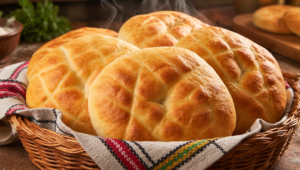
Lepinja – Soft Balkan Flatbread for Ćevapi
356kcal
Ingredients
Dough
- 4 1/6 cups unbleached all-purpose flour spooned and leveled; weighing is more reliable; original uses German Type 550
- 11.83 fl oz water for the dough; lukewarm, 82–86°F (28–30°C)
- 2 1/4 tsp dry yeast one standard 7 g packet at 1x; use fresh yeast
- 2 tsp granulated sugar weigh for the exact formula
- 1 2/3 tsp fine table salt not an equal-volume measure of kosher salt; use a scale if possible
- 1.06 oz sunflower oil by weight, for the dough
After baking
- 4 tsp water only for brushing the baked breads; keep separate from dough water
Equipment
- Kitchen scale recommended for flour, oil, salt, and equal portions
- Mixing bowl large enough for the dough to expand
- Stand mixer dough hook; optional, knead by hand if preferred
- Bench scraper wide enough to support soft rounds
- Heavy sheet pan or baking steel uncoated, oven-safe to 480°F (250°C); preheat at least 30 minutes
- Wooden peel or a cool rimless transfer pan; lightly dust for loading
- Pastry brush for finishing water
- Clean Kitchen Towel for the final 10-minute rest
- Cooling rack for complete cooling before storage
Method
- Activate the yeast. Stir the dry yeast and sugar into the measured dough water at 82–86°F (28–30°C). Let stand for about 10 minutes. This follows the source’s lukewarm-water method; activity may be subtle at this temperature. Use fresh yeast within its date.
- Mix and knead. Add the flour and mix on low for about 2 minutes. Add the salt and sunflower oil, then knead for 8–10 minutes, until elastic, soft, and slightly tacky. Follow your mixer’s dough-capacity limits; mix larger quantities in separate batches if needed. Avoid adding flour just to make the bowl completely clean.
- Let the dough rise. Cover and leave at warm room temperature for about 60 minutes, until noticeably expanded and aerated. Allow longer in a cool room.
- Heat the baking surface. During the first rise, heat the conventional oven to 480°F (250°C), with an inverted heavy, uncoated sheet pan or a baking steel on the lower-middle rack. Use equipment rated for this temperature and preheat the surface for at least 30 minutes. No parchment, wax paper, or ordinary silicone mat goes into this hot oven.
- Divide and relax. Turn the dough onto a lightly flour-dusted work surface and gently divide into equal portions matching the selected flatbread yield. Each piece is about 151 g (5.3 oz) before baking, at every scale. Round loosely, cover, and rest for about 10 minutes.
- Shape and proof. Press each round gently by hand to about 6–6¼ inches (15–16 cm) across. Keep the thickness even; do not roll out or forcefully deflate the dough. Make shallow indentations with damp fingertips, without cutting through or making a diamond pattern. Cover loosely on the lightly dusted work surface and proof for about 15 minutes.
- Load safely. Gently lift a proofed round with a wide bench scraper onto a dry, lightly flour-dusted wooden peel or the flat back of a cool, rimless transfer pan. Give a small shake to confirm it slides freely; lift any sticky edge and dust just underneath. Transfer promptly, sliding the dough directly onto the preheated baking surface. Keep hands clear of hot metal, use dry oven mitts, and leave space between breads. Never try to pull stuck dough free over the hot oven.
- Bake in batches. Bake for about 8–10 minutes per batch, until puffed, with lightly golden patches and a set, lightly colored underside. The crust should remain thin. Remove with a heat-safe peel or broad spatula and repeat, allowing the hot surface to recover between batches as needed. Keep waiting dough covered and use additional batches at larger yields.
- Brush and soften. Lightly brush the hot breads with the separately measured finishing water, distributing it across the full selected yield. Loosely wrap each batch in a clean kitchen towel for about 10 minutes. The center should be set and porous, with no wet, gummy seam; return an underbaked bread to the oven rather than relying on the towel rest to finish it. Serve warm, or unwrap and cool completely on a rack before storing.
Notes
Yield and scaling: 1x makes 6 breads, 2x makes 12, and 3x makes 18, each about 151 g of raw dough and 6–6¼ inches wide. Keep the same individual size and temperature. Use extra mixer batches and baking batches rather than crowding the surface.
Timing: About 2 hours 35 minutes assumes two baking batches of three breads. The 105-minute custom time includes 10 minutes for yeast activation, a 60-minute first rise, a 10-minute bench rest, a 15-minute final proof, and a 10-minute towel rest after the last batch. Oven preheating overlaps the first rise. The 30-minute prep allowance covers hands-on work and loading; smaller baking surfaces, slower dough, and scaled batches add elapsed time.
Measurements: Metric preserves the original formula: dough water is 70% of flour weight; finishing water is separate. US measures are rounded: flour assumes 120 g/cup, fine table salt 6 g/tsp, dry yeast 7 g per 2¼ tsp, and sugar about 4 g/tsp. US liquid ounces use 29.5735 ml; teaspoons are rounded. Use Metric and a scale for precise hydration. A minimal flour dusting is a handling aid, not a change to the dough formula.
Storage: Cool fully before sealing. Enjoy the same day or keep plain bread airtight at room temperature until the next day; freeze individually for up to 3 months for quality. Refresh lightly dampened bread at 350°F (180°C) for 5–7 minutes, checking it is warmed through. Refrigerate meat or dairy fillings separately under their own safe-storage instructions.
Nutrition: Estimated per 1 whole flatbread from exact Metric quantities using USDA FoodData Central all-purpose unbleached flour, active dry yeast, granulated sugar, sunflower oil, and table salt. All dough oil and salt are included; variable handling flour and serving accompaniments are excluded. Brand differences and US rounding affect results. Contains wheat. Editorially reviewed; the adapted peel-loading method has not been kitchen-tested.