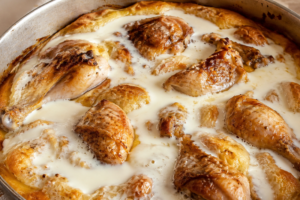
Kvrguša – Bosnian Chicken and Batter Bake
Ingredients
Chicken and seasoning
- 35 1/4 oz bone-in chicken thighs and drumsticks skin-on; choose smaller, similarly sized pieces; US weight rounded; the Metric weight includes bones
- 1 1/2 tsp fine table salt for the chicken; keep separate from batter and finishing salt
- 1/2 tsp ground black pepper for the chicken
- 1 tsp sweet paprika for the chicken; not automatically smoked or hot
- 1 1/3 tbsp sunflower oil to coat the chicken; separate from pan oil; US volume rounded
Batter
- 2 1/2 cups unbleached all-purpose flour spoon and level cups; weigh for best results; practical US match for source Type 405
- 4 large eggs US large is a practical match for the source’s German size M; approximately 50 g out of shell per egg
- 1 2/3 cups whole milk for the batter; source 3.5% milkfat; US whole milk is commonly about 3.25%, a practical adaptation; US volume rounded
- 8 1/2 fl oz plain sparkling mineral water unflavored, freshly opened; stir in last; US volume rounded
- 10 g baking powder weigh in either system to preserve the source amount; not baking soda
- 1 tsp fine table salt for the batter
For the pan
- 2 tbsp sunflower oil coat the baking pan; not part of the chicken coating
Cultured-cream finish
- 8 7/8 oz full-fat cultured sour cream unflavored; source Schmand or sour cream at 20–24% milkfat preferred; ordinary US full-fat sour cream around 18% is a disclosed practical adaptation, not identical; US weight rounded
- 3 3/8 fl oz whole milk for the finish, separate from batter milk; US volume rounded
- 1 small pinch fine table salt for the finish; the source does not define a gram weight
Equipment
- 1 Round metal baking pan about 14 inches (35–36 cm) wide and 2 inches deep per base batch; see scaling notes
- 1 Mixing bowl and whisk make a smooth pourable batter
- 1 Small bowl keep the cream finish separate
- 1 Kitchen scale weigh flour, chicken, cream, and baking powder
- 1 Liquid measures keep batter milk and finishing milk separate
- 1 Tongs and oven mitts handle the hot chicken and pan safely
- 1 Food thermometer verify chicken and batter reach 165°F (74°C)
- 1 Serving spatula portion the cooked batter between the chicken pieces
Method
- Season and chill the chicken. Pat the chicken dry with paper towels without rinsing it. Combine the chicken salt, black pepper, and sweet paprika. Rub the pieces with the measured chicken-coating oil, then season all over. Cover and refrigerate for 20 minutes. Keep raw poultry separate from other food and clean hands, tools, and work surfaces afterward.
- Prepare the oven and pan. While the chicken chills, preheat a conventional oven to approximately 390°F (200°C), with a rack in the middle. Coat a roughly 14-inch (35–36-cm) round metal baking pan with the separate pan oil. Arrange the chicken with a little space between pieces. For larger scales use additional comparable pans; do not make one deep casserole.
- Prebake the chicken. Bake for 20 minutes, turning the pieces once after about 10 minutes to begin coloring both sides. This is only the first cooking stage. Continue directly with the batter and the remaining bake; do not cool partially cooked chicken for finishing later.
- Mix and rest the batter. During the chicken’s first baking stage, whisk the eggs with the batter salt. Whisk in about half of the batter milk. Combine flour and baking powder, then whisk them into the egg mixture in portions. Gradually add the remaining batter milk, followed by the sparkling water. The batter should be smooth and pourable, a little thicker than a very thin crêpe batter, not a kneadable dough. Rest it for 5 minutes during the same prebaking interval, then stir briefly.
- Pour around the chicken. Carefully remove the hot pan using oven mitts. With tongs, lift the chicken pieces slightly to loosen any that stick. Pour the batter evenly between and partly beneath them, keeping as much of the upper skin exposed as possible. Leave the cooking juices in the pan; they flavor the baked batter.
- Bake the chicken and batter together. Increase the conventional oven to approximately 430°F (220°C). Bake for another 25–30 minutes as an initial guide, until the batter is puffed, fully set, and deep golden with some crisp darker edges. Check representative thick chicken pieces away from bone and the center of the batter with a food thermometer: both must reach at least 165°F (74°C). Continue baking if either is under temperature or the batter is wet and raw inside. If everything is cooked but the batter is pale, allow about 3–5 extra minutes while watching closely.
- Whisk the cultured-cream finish. While the main bake finishes, whisk the cultured sour cream with the separate finishing milk and its small pinch of salt until smooth and pourable. Keep chilled until ready to use. This is the measured finishing mixture, not extra batter.
- Pour and warm the finish. Once the chicken and batter are fully cooked, remove the pan and switch the oven off. Pour the cultured-cream mixture over the hot baked batter without needing to bury all the chicken skin. Return the pan to the switched-off, still-hot oven for about 5 minutes so the finish warms and partly soaks in. Do not boil it away or continue cooking until the dish dries out.
- Rest and portion. Remove the pan and rest for 5 minutes. Cut or scoop the batter between the chicken pieces. Divide the cooked meat, batter, and cream finish evenly among the main portions shown, carving larger pieces if needed. Remember that the chicken is bone-in and serve promptly.
Notes
Pan and scaling: Use a roughly 14-inch (35–36-cm) round metal tepsija or baking pan, about 2 inches deep, for the base recipe. It is within the source’s approximately 32–36-cm range. Keep the chicken in one layer with gaps for the batter. At 1x use one comparable pan for six main portions; at 2x use two pans for twelve portions; at 3x use three pans for eighteen portions. Bake in separate rounds if the oven cannot hold pans with good circulation. Preserve batter depth and chicken-piece size; more pans need more handling and possibly separate oven batches.
Chicken yield: The measured raw chicken weight includes bones and skin. Six servings means six shares of the whole bake, not a promise that every package provides six equal whole pieces. Select smaller thighs and drumsticks when possible; carve fully cooked larger pieces to distribute the meat fairly. Do not replace the bone-in dark meat with a different cut while keeping the same cooking assumptions.
American ingredients: All-purpose flour is a practical adaptation of Type 405, not an identical milling classification. Flour cups use 120 g per cup, spooned and leveled. US large eggs are a practical match for German M eggs; egg count scales directly. Original milk is approximately 3.5% fat; ordinary US whole milk is commonly about 3.25%. The source’s Schmand or sour cream is approximately 20–24% milkfat. Prefer a matching unflavored cultured product; full-fat American cultured sour cream around 18% is a practical but non-identical adaptation at the same Metric mass. Lower-fat and fat-free products are not direct substitutes. These adaptations are not independently kitchen-tested.
Measures: US ounce and volume values are rounded approximations; Metric preserves the source formula. One ounce is 28.35 g, one US cup 236.59 ml, one fluid ounce 29.57 ml, and one tablespoon 14.79 ml. Fine table salt uses about 6 g per teaspoon; ground black pepper and sweet paprika use about 2.3 g per teaspoon. Baking powder stays weighed in grams for reliability. The source’s finishing salt is a small pinch with no measured mass, so it remains a scalable pinch rather than an invented sodium quantity.
Time: Allow approximately 1 hour 40 minutes: 20 minutes nonoverlapping preparation and transfers, 55 minutes oven time, and 25 minutes additional time for the 20-minute refrigerated seasoning interval plus the final 5-minute rest. Oven time includes 20 minutes prebaking, about 30 minutes with batter, and 5 minutes warming the finish in the switched-off oven. Mix and rest the batter during prebaking, whisk the finish during the second bake, and preheat during the refrigerated seasoning interval; those overlapping tasks are not added again. Larger pieces, slow handling, and separate pan batches extend the total. The final rest is explicit rather than omitted from the displayed total.
Safe handling and leftovers: Do not rinse raw chicken. Keep raw chicken and dairy at 40°F (4°C) or below when not actively working. Verify at least 165°F (74°C) in the thickest chicken away from bone and in the batter center before adding the ready-to-eat cultured-cream finish. Do not rely on browned skin alone. Refrigerate leftovers in shallow containers within 2 hours, or within 1 hour above 90°F (32°C), and use within 2 days. Reheat covered at about 340°F (170°C) until chicken and batter reach 165°F throughout; 15–20 minutes is only a starting estimate for small portions. The creamy finish and crisp edges soften on storage and freezing. Season raw chicken ahead within its original refrigerated storage window, but never prebake it partially and chill it for later completion.
Nutrition and allergens: Nutrition is not displayed because the cooked edible yield of the selected bone-in chicken, retained skin and fat, and exact cultured-cream product have not been verified in a checked calculation. The source calorie figure has not been copied. Contains wheat, eggs, and milk. No independent kitchen test is claimed.