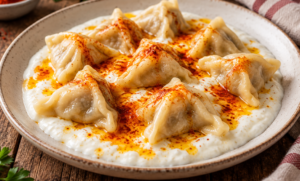
Klepe – Bosnian Beef Dumplings
705kcal
Ingredients
Dough
- 3 1/3 cups unbleached all-purpose flour weigh for best results; spoon and level cups; original Type 405 or 550; minimal extra dusting flour is not included in nutrition
- 7/8 cup lukewarm water US volume rounded; Metric retains the exact source volume; about 86–95°F (30–35°C)
- 1 1/3 tsp fine table salt dough salt; keep separate from filling, sauce, and cooking salt
- 2 1/4 tsp sunflower oil US spoon measure is approximate; all goes into the dough
Beef filling
- 10 1/2 oz ground beef 80/20 ground chuck; within the original 15–20% fat range; US weight rounded; Metric is exact
- 1/2 cup onion prepared onion, very finely diced about 2–3 mm or finer; US volume is approximate
- 1 tsp fine table salt filling salt
- 1 g freshly ground black pepper weigh in either system; no paprika in the filling
Garlic yogurt sauce
- 1 5/8 cups thick plain whole-milk yogurt unflavored; original approximately 3.5% milkfat; regular yogurt, not an automatic Greek-yogurt substitution; US volume is approximate
- 2 cloves garlic large, peeled and grated; source weight is approximately 4 g per clove; weigh for the closest match
- 1/2 tsp fine table salt sauce salt
Paprika butter
- 2 1/8 tbsp unsalted butter for the finishing drizzle; US spoon measure is approximate
- 1 1/3 tsp sweet paprika US spoon measure is approximate; not smoked or hot paprika
Boiling medium — mostly discarded
- 12 3/4 cups water for boiling; distribute scaled amounts among suitable pots or fresh rounds as needed; not fully consumed; US volume rounded
- 3 1/3 tsp fine table salt cooking-water salt; not all absorbed; maintain about 6.7 g salt per liter of water
Equipment
- Kitchen scale weigh flour, small seasonings, and filling portions
- Mixing bowls separate raw meat and ready-to-eat sauce
- Rolling Pin roll evenly to the specified thin sheet
- Pastry wheel or knife cut roughly 5-cm squares
- Trays and clean towel lightly flour trays; keep raw dumplings separate and covered
- Large cooking pot at least 6-quart capacity for the base cooking water with headroom; actual load must remain uncrowded
- Slotted spoon release sticking pieces and lift cooked dumplings
- Thin-probe food thermometer verify the beef center at least 160°F (71°C)
- Small saucepan melt butter gently and stir paprika in off heat
Method
- Make the cold sauce. Before handling raw ground beef, mix the yogurt, finely grated garlic, and sauce salt. Cover and refrigerate. Keep its bowl and utensils separate from raw-meat preparation.
- Prepare the filling. Dice the onion very finely, about 2–3 mm or finer. Mix with beef, filling salt, and black pepper just until evenly combined. Cover and refrigerate until needed; do not add paprika or pre-cook the filling. Wash hands, tools, and work surfaces after raw-meat handling.
- Knead a firm dough. Combine the flour and dough salt, then add the lukewarm dough water and sunflower oil. Knead for 8–10 minutes until smooth, elastic, and fairly firm. The measured water is about 52.5% of the flour weight; the dough should hold its shape, not resemble a sticky batter.
- Rest covered. Cover the dough completely and rest for 30 minutes. If it still springs back strongly when rolling, allow an additional short covered rest rather than forcing it. This is a relaxation rest, not a yeast rise.
- Roll and cut. Divide into comfortable working portions using the Notes batch guide, keeping unused dough covered. Roll one portion evenly to approximately 1 mm (about 0.04 inch) thick on a minimally floured surface. Cut approximately 2-inch (5 × 5-cm) squares. Keep the cut squares covered and repeat with the remaining portions. Count usable squares before portioning filling; do not thicken the dough merely to force a specific piece count.
- Divide the filling. Divide the chilled filling proportionally among the actual squares you cut. Test-close a few first, keeping clean borders. The Notes show why a fixed 3 g on every square does not necessarily use the full filling. Use smaller amounts when your cut count is higher; do not overload the last few dumplings. Keep unused filling refrigerated.
- Seal triangular packets. Place filling in the center, fold each square diagonally, and gently press out trapped air around the meat. Pinch all edges fully closed, keeping meat and excess flour out of the seal. Set the triangles separately on a lightly floured tray under a clean towel. Refrigerate formed raw dumplings while waiting for other cooking batches.
- Prepare the boiling water. Bring the measured cooking water and its separate salt to a boil in a roomy pot. Start heating the water during the final shaping so heating can overlap that work. At larger scales, use comparable pots or additional rounds; keep the same salt concentration instead of crowding a huge batch into one pot.
- Cook in uncrowded batches. Lower a manageable batch into the boiling water. After about 30 seconds, gently release any dumplings sticking to the bottom with a slotted spoon. Once the water returns to a boil, reduce excessive turbulence. Gently cook for about 8–10 minutes per batch as an initial guide; thickness, filling size, and the actual load may require longer. Floating is not proof that the beef is cooked.
- Verify the beef temperature. Check representative larger dumplings, including pieces from the last-loaded part of the batch. Use a suitably thin thermometer probe to confirm at least 160°F (71°C) in the filling center. If a small dumpling is difficult to probe, cut open a sample to expose the filling and obtain a thermometer reading. An open sample can reveal an obviously raw center, but visual checks alone cannot verify the safe temperature. Continue cooking as needed, then lift with a slotted spoon and drain briefly. Keep waiting cooked portions hot at 140°F (60°C) or above, or serve batches promptly.
- Make the paprika butter. As the final batch cooks, melt the measured butter gently over low heat. Remove the pan from heat, then stir in the sweet paprika for a few seconds. Do not let it turn dark or scorch; it belongs in this drizzle, not in the raw meat filling.
- Serve without baking. Divide the hot klepe among the servings shown, add the cold garlic yogurt, and drizzle with the warm paprika butter. Serve promptly. Do not put the boiled dumplings in the oven; there is no baking stage in this version.
Nutrition
Serving1main portion (1/4 recipe with sauces)Calories705kcalCarbohydrates84.07gProtein27.22gFat27.95g
Notes
Yield limitation: Four main portions. The revised source estimates about 70–90 dumplings, but that count is unverified at the specified approximately 1-mm thickness and 5-cm squares. Actual dough area, trimming, and rolling can produce a higher count. Do not thicken the dough to force 70–90 pieces. This remains an editorial yield uncertainty, not a measured kitchen yield.
Filling mathematics: The base filling is about 387 g: 300 g beef, 80 g onion, 6 g salt, and 1 g pepper. Dividing it among 70–90 pieces gives about 5.5–4.3 g per piece; 3 g each would use only 210–270 g, leaving roughly 117–177 g. At 3 g per piece the full filling would require about 129 pieces. Count your usable squares and divide 387 g by that count at 1x, or use the scaled filling total. At 160 pieces, for example, the base filling averages about 2.4 g. Test sealing before filling everything and do not overload a small square. These are arithmetic examples, not alternative guaranteed yields.
Scaling: At 1x use two working dough portions for four main servings; at 2x use four comparable portions for eight servings; at 3x use six portions for twelve servings. The source piece estimate would scale to 140–180 or 210–270, with the same unresolved thickness/count limitation. Preserve 1-mm sheets, 5-cm squares, triangular seals, and uncrowded pot loading. Increase batches rather than individual size. The cooking medium is 20 g salt per 3 L water, about 6.7 g/L. Scaled water and salt can be distributed among pots or fresh cooking rounds; do not interpret the scaled total as a demand for one enormous pot.
Time: The displayed approximately 1 hour 50 minutes consists of 60 minutes active preparation, a full 30-minute covered dough rest, and about 20 minutes cooking for two uncrowded batches. This workflow prepares sauce and filling before mixing and resting the dough, so those tasks are not counted twice during the rest. Water heating overlaps the last shaping; the butter drizzle overlaps the last cooking batch. Allow roughly 1 hour 50 minutes to 2 hours 30 minutes or longer if hand shaping is slow, the cut count is higher, the dough needs extra relaxation, or more boil batches are required. Two cooking batches are an estimate, not a required load regardless of pot size. Each additional batch adds roughly another 8–10 minutes plus time to return to a boil. The individual cooking interval does not automatically double at 2x/3x.
American ingredients and measurements: Unbleached all-purpose flour is a practical match for Type 405/550, not an identical classification. Cups use 120 g flour per cup, spooned and leveled; fine table salt uses 6 g/tsp. US measures are practical rounded approximations; the Metric selector retains the exact source formula and is preferred for dough precision. One US cup is 236.59 ml and one ounce is 28.35 g. Checked ingredient-specific references use 160 g chopped onion per cup, 245 g plain whole-milk yogurt per cup, 14.2 g butter per tablespoon, 4.5 g sunflower oil per teaspoon, and 2.3 g sweet paprika per teaspoon. Yogurt thickness and onion packing vary. The small black-pepper quantity stays weighed in grams. Nutrition remains based on the exact Metric ingredients, excluding the mostly discarded boiling medium. Defined beef is 80/20 ground chuck. Use thick regular plain whole-milk yogurt near the original approximately 3.5% milkfat. If a regular yogurt has loose whey, drain it briefly under refrigeration, then weigh the yogurt used; that changes composition somewhat, so an exact nutrition match is not claimed. Greek yogurt has different concentration and moisture and is not the default fixed formula. Garlic is defined by the source’s two approximately 4-g peeled cloves at 1x; use the Metric weight when clove size differs. Sweet paprika supplies the finishing flavor without automatically adding smoke or heat.
Make ahead and leftovers: Keep raw beef, filling, formed raw klepe, and yogurt at 40°F (4°C) or below when not actively working. Cook raw assembled dumplings within the ground beef’s original one-to-two-day refrigerated window. Cooked dumplings and sauce are best kept separately. Refrigerate in shallow containers within two hours, or within one hour above 90°F (32°C), and use within two days or the yogurt label’s shorter limit. Do not leave waiting batches warm for long periods. Reheat cooked dumplings throughout to 165°F (74°C); the texture may soften. Store or add the yogurt separately rather than boiling the sauce. An independently tested freezing method or storage duration is not claimed for this dough.
Nutrition: Estimate per one-fourth of the full measured dough, filling, garlic yogurt, and paprika butter. Checked USDA FoodData Central matches use unbleached flour, sunflower oil, raw 80/20 beef, raw onion and garlic, fine table salt, ground black pepper, unsalted butter, sweet paprika, and plain whole-milk yogurt. The generic yogurt match contains 3.25 g fat/100 g as a proxy for the source’s approximately 3.5%; brands and straining differ. The full boiling water and its 20 g salt are excluded from the consumed-ingredient model. Some cooking salt is absorbed, but uptake has not been measured; sodium is therefore intentionally not displayed rather than presented as an exact total. Dusting flour, trimming losses, cooking losses, and unequal sauce portions add uncertainty. Contains wheat and milk. This preserves the revised October 29, 2026 formula and boiling method; it is editorially reviewed, not independently kitchen-tested.