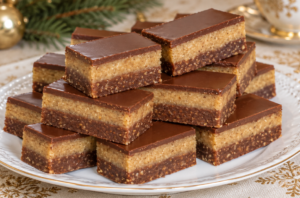
Bajadera – No-Bake Chocolate Walnut Bars
199kcal
Ingredients
Base mixture
- 10 5/8 oz plain butter biscuits Plain Leibniz Butter Biscuit Original or the same crisp, unfilled butter-biscuit category; finely ground.
- 10 5/8 oz walnuts Finely ground, not nut butter; no other nut substitution in this formula.
- 1 1/4 cups granulated sugar
- 2 tsp vanilla sugar Dry vanilla-flavored sugar; weigh for accuracy because packet sizes vary.
- 3 1/3 fl oz water Measured liquid amount; US volume is rounded.
- 6 3/8 oz unsalted butter Cut into pieces to melt into the hot syrup.
- 1/6 tsp fine table salt Best weighed; not coarse kosher salt.
Dark mixture
- 3 1/2 oz dark chocolate About 60% cacao, plain sweetened bittersweet baking bar; finely chopped.
Chocolate topping
- 5 1/4 oz dark chocolate About 60% cacao, plain sweetened bittersweet baking bar; finely chopped.
- 1 1/2 tbsp sunflower oil For the glaze only; weighing is most precise.
Equipment
- Digital kitchen scale For cookie crumbs, ground nuts, butter, chocolate, and oil; a fine-resolution scale helps with salt.
- Rectangular pan About 8 × 10 inches (20 × 25 cm), preferably at least 2 inches deep. Use matching additional pans when scaling.
- Parchment paper Leave handles on opposite sides for lifting the chilled slab.
- Food processor Grind cookies and walnuts finely in separate batches.
- Small saucepan For the hot syrup.
- Mixing bowls One large bowl plus bowls for dividing the warm mixture.
- Heatproof bowl For gently melting the topping chocolate.
- Silicone spatula For mixing thoroughly.
- Offset spatula Or a flat-bottomed glass for pressing even layers.
- Long sharp knife Warm and dry thoroughly before slicing.
- Airtight container For refrigerated storage; parchment separates stacked bars.
Method
- Prepare the pan. Line a pan about 8 × 10 inches (20 × 25 cm) with parchment, leaving handles on opposite sides. For larger quantities, prepare additional matching pans as described in the notes so the layer depth stays the same.
- Grind the dry ingredients. Process the butter biscuits into fine crumbs. Finely grind the walnuts separately in short pulses, stopping before they become a paste. Combine thoroughly in a large heatproof mixing bowl. Finely chop the chocolate portions and keep the dark-mixture and topping amounts separate.
- Make the syrup. Put the granulated sugar, vanilla sugar, fine salt, and measured water into the saucepan. Heat while stirring until dissolved, then bring briefly to a boil. Remove from heat as soon as the sugar is dissolved and the mixture has boiled; do not simmer it down to caramel or a thick candy syrup. Be careful of hot syrup splashes.
- Melt in the butter. With the saucepan off the heat, stir in the butter pieces until fully melted and the liquid is uniform.
- Combine the base. Pour the hot liquid over the cookie-and-walnut mixture and stir thoroughly, scraping the bottom and corners. It should be evenly moist, soft, and formable, with no loose dry pockets or free liquid. Keep working while it is warm; do not add unmeasured water or milk.
- Divide and color. Weigh the warm base into two equal portions. Keep one pale. Stir the listed dark-mixture chocolate into the other until completely melted and evenly incorporated. If the chopped chocolate needs help, melt that measured portion gently in a dry heatproof bowl, then mix it in without adding liquid. Divide the finished dark portion into two equal portions.
- Make three layers. Press the first dark portion evenly across the pan, including the corners. Add the full pale portion, distribute gently, and press level without smearing the layers together. Finish with the remaining dark portion and smooth the surface. Keep the order DARK–LIGHT–DARK, with each layer uniform from edge to edge. At larger scales, distribute each corresponding layer evenly among the matching pans.
- Chill the base. Refrigerate for about 30 minutes so the top firms before glazing. Keep the pan level.
- Prepare the topping. During the latter part of the initial chill, gently melt the separate topping chocolate in a dry heatproof bowl over barely simmering water, without letting the bowl touch the water, or microwave at low power in short bursts, stirring often. Stir in the measured sunflower oil until smooth. Let cool for about 3–5 minutes while remaining pourable; keep water and steam out of the chocolate.
- Glaze. Spread the topping in a thin, even layer over the chilled base. Smooth gently with an offset spatula, dividing the topping evenly among matching pans when scaling.
- Chill thoroughly. Return to the refrigerator at 40°F (4°C) or below for at least 3 additional hours, until the entire slab is firm. Allow longer if the center is still soft; overnight chilling is also suitable.
- Cut cleanly. Use the parchment handles to lift the chilled slab onto a board. Let stand for about 10 minutes to take the hard refrigerator edge off the glaze. Warm a long knife in hot water and dry it completely before cutting small rectangles. Clean, warm, and dry the blade again as needed. Divide the selected total yield evenly among the matching pans when scaling, then return the bars to refrigerated storage.
Notes
Version and cookies: This is homemade cookie-and-walnut Bajadera, not an exact reproduction of Kraš confectionery. Use plain, crisp, unfilled butter biscuits, such as Leibniz Butter Biscuit Original sold in the US. Avoid chocolate-coated or filled versions; graham crackers, vanilla wafers, and assorted Danish butter cookies are not validated substitutes for this formula. Weigh the cookies before grinding, rather than counting them.
Measurements: Metric keeps the exact formula. Ounces are weight unless marked fl oz. Cookie crumbs and ground walnuts remain weight measures because their volume changes with grind and packing. The US water measure is rounded; vanilla sugar assumes about 4 g per teaspoon, fine table salt 6 g per teaspoon, and sunflower oil about 13.6 g per tablespoon. The oil measure is therefore a rounded equivalent of the Metric weight. Weigh vanilla sugar and the small salt amount for best accuracy. Packet sizes vary, so do not assume one packet equals the listed amount. Dr. Oetker vanilla sugar is a practical US baking-aisle or European-grocery option.
Chocolate and layers: Choose a plain sweetened bittersweet baking bar around 60% cacao, not 100% unsweetened baking chocolate, filled candy, or compound coating. Keep the dark-mixture chocolate separate from the topping chocolate and keep topping oil separate from base butter. Split the warm base equally; one half stays pale and the other receives chocolate. Split that dark portion equally again. Press DARK–LIGHT–DARK, then add the glaze. Make each layer level from edge to edge; the pale middle is expected to be thicker than either individual dark layer because it contains a larger share of the base.
Yield and scaling: One base-size pan gives about 36 small bars, for example a 6-by-6 grid. At 2x use two matching pans for 72 bars; at 3x use three for 108. Divide the scaled mixture and glaze evenly between pans, preserving the layer proportions and depth. Process ingredients in batches and use a large enough saucepan for syrup. Do not stack the full scaled quantity in one deep pan. Each pan needs the full chilling periods; extra active work is not reflected by multiplying the clock automatically.
Timing: The displayed 4 hours 20 minutes allows 35 minutes of active preparation, layering, glazing, and cutting; about 5 minutes for syrup heating; 30 minutes of initial chilling; at least 3 additional hours after glazing; and about 10 minutes standing before cutting. Melt the topping and let it cool for 3–5 minutes during the latter part of the first chill so it remains pourable without adding a separate wait. Larger batches or a soft center need more time. No-bake means no oven, not no heat: the syrup and melted chocolate can burn skin.
Texture: Dissolve the sugar, bring the syrup briefly to a boil, and remove from heat; do not boil it down to caramel or a thick candy syrup. Work while the combined mixture is warm and formable, without free liquid. Grind thoroughly and mix into the corners of the bowl before judging dryness. Do not add unmeasured water or milk as a rescue. Chill a soft slab longer before cutting, and use a warm, completely dry knife to reduce cracking of the topping.
Storage and allergens: Refrigerate promptly at 40°F (4°C) or below, including during both setting periods. Store covered with parchment between layers and plan to use within 3–4 days as a conservative home-storage window, not a tested shelf-life claim. Limit total room-temperature handling to 2 hours, or 1 hour above 90°F (32°C). Freeze fully chilled portions airtight if needed and thaw in the refrigerator. Contains walnuts, milk, and wheat/gluten; the checked US butter biscuits also contain egg. Read your cookie and chocolate labels for soy, other nuts, coconut, and cross-contact information.
Nutrition estimate: Per one of 36 finished bars, using all the base and the entire chocolate-and-oil glaze. The US Leibniz butter-biscuit label reference is 130 kcal, 4 g fat, 23 g carbohydrate, and 2 g protein per 30 g. Checked USDA matches cover English walnuts, unsalted butter, sugar, dark chocolate with 60–69% cacao solids, and sunflower oil; vanilla sugar is modeled as sucrose. The calculation uses the exact Metric weights, including both chocolate portions and the separate topping oil. Chocolate brands, cookie formulas, label rounding, trimmings, and actual bar size change the result. The recipe is editorially reviewed, not kitchen-tested.