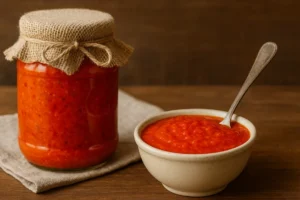
Ajvar
168.42kcal
Ingredients
- 6 2/3 lb red sweet pointed peppers ripe and thick-fleshed; whole weight before trimming
- 2 1/4 lb eggplants whole weight before trimming
- 6 3/4 fl oz sunflower oil
- 5 tsp fine salt
- 4 cloves garlic large; peeled and finely grated
- 2 tbsp white wine vinegar 5% acidity; distilled white vinegar is an alternative
- 1 red hot pepper optional; adjust to taste
Equipment
- Heavy baking sheets Arrange the vegetables in a single layer; use additional roasting batches when needed.
- Heat-safe bowl and cover For steaming the roasted peppers.
- Knife and cutting board For peeling and trimming.
- Large sieve and clean cloth Set over a bowl and drain in the refrigerator.
- Grinder or food processor Use a medium plate or short pulses to retain texture.
- Wide heavy pot A broad surface helps evaporation; larger quantities may need more pots or batches.
- Sturdy spoon Sweep the entire pot bottom while stirring.
- Kitchen scale For the vegetable weights and seasoning.
- Shallow storage containers Heat-safe for cooling; use freezer-safe containers for frozen portions.
Method
- Prepare the vegetables. Wash and dry the peppers and eggplants. Preheat the oven to 450°F (230°C), conventional heat, or 410°F (210°C) with convection. Prick each eggplant several times with a fork.
- Roast in uncrowded batches. Arrange the whole vegetables in a single layer on heavy metal baking sheets. Roast each batch for about 40–55 minutes, turning the peppers once or twice, until the skins blister and darken and the flesh softens. Remove eggplants when completely soft; large ones may need longer. Roast any optional hot pepper alongside the sweet peppers.
- Steam and peel. Transfer each batch of hot peppers to a heat-safe bowl, cover, and steam for 20 minutes. Remove stems, seeds, pale membranes, and skins without rinsing the flesh. Scoop the eggplant flesh from its skin and discard burnt skin fragments.
- Drain under refrigeration. Place the peeled flesh in a clean cloth-lined sieve over a bowl. Refrigerate peeled portions promptly as you work, within 2 hours of roasting, or within 1 hour if the room is above 90°F (32°C). Cover loosely and drain in the refrigerator for 3 hours after adding the last batch. Discard the drained liquid.
- Grind with some texture. Pass the drained vegetables through a medium grinder plate, or pulse in small batches in a food processor. Aim for a fine, slightly fibrous texture rather than a smooth puree. Include the peeled optional hot pepper if using.
- Reduce the excess liquid. Put the ground vegetables into a wide, heavy-bottomed pot. Cook uncovered over medium heat for about 15 minutes, stirring across the bottom to evaporate excess moisture.
- Work in the oil gradually. Stir in about one quarter of the oil. Once incorporated, add the next portion, continuing until all the oil is worked in. Cook uncovered over low to medium-low heat for 60–90 minutes, stirring regularly and more often as the mixture thickens.
- Season near the end. About 15 minutes before the end of cooking, stir in the grated garlic, salt, and vinegar. Continue stirring and cooking until the spread is thick and glossy, clings to the spoon, and a trail drawn across the pot bottom stays briefly visible. Cool a spoonful on a clean plate before tasting the seasoning.
- Cool and refrigerate promptly. Divide the cooked ajvar into clean, small, shallow heat-safe containers. Refrigerate promptly rather than leaving a deep pot or full jars to cool on the counter. Refrigerate within 2 hours of cooking, or 1 hour above 90°F (32°C). Keep at 40°F (4°C) or colder and use within 3–4 days.
- Freeze surplus, do not pantry-store. For longer storage, chill promptly in the refrigerator, then pack in freezer-safe portions with expansion space and freeze at 0°F (−18°C). Best quality is about 3 months. Thaw in the refrigerator and use within 3–4 days. This recipe is not a validated canning process: hot filling, a sealed lid, vinegar, or an oil layer do not make it shelf-stable.
Nutrition
Calories168.42kcalCarbohydrates15.4gProtein2.55gFat12.2gSaturated Fat1.27gSodium735.83mgFiber5.84gSugar10.09g
Notes
- Peppers: Thick-fleshed, fully red pointed peppers such as kapija are preferred. Ripe red bell peppers are a practical US alternative; yield and roasting time vary.
- Measurements: US quantities are rounded. Select Metric for the source weights. Vegetable weights are before roasting, peeling, and trimming.
- Texture: Peel without rinsing, drain in the refrigerator, and grind or pulse briefly. A wide pot and slow reduction produce a thick, slightly textured spread.
- Timing: The displayed time is a planning estimate for preparation, roasting in batches, steaming, refrigerated draining, and slow reduction. Some tasks overlap; extra batches or wetter vegetables take longer. Final chilling for storage is additional.
- Scaling: Increase roasting batches and cooking surface area. Ingredient multipliers do not make one overloaded pan cook at the same speed.
- Storage: Refrigerate promptly in small, shallow containers at 40°F (4°C) or colder and use within 3–4 days. Freeze chilled portions for about 3 months of best quality. Use clean utensils and discard questionable food without tasting.
- No pantry canning: The vinegar is for flavor. Hot filling, an oil layer, and a vacuum lid are not a validated preservation process. This recipe is for refrigeration or freezing only.
- Nutrition: Approximate per serving, calculated from the starting metric ingredient quantities; optional hot pepper is excluded. Peels, seeds, drained juice, and actual nutrient retention were not measured, so retained nutrients and portion weight vary.